
Colon Cancer and Its Surgical Treatment: An Evidence-Based Review (Part 2)
The obstructed or perforated patient, stent versus stoma, Hartmann's versus anastomosis, preventing and diagnosing anastomotic leak, stomas, en bloc resection for T4b disease, enhanced recovery, complications and life after surgery: what the evidence says today.
- Colon Cancer
- Surgical Oncology
- Emergency Surgery
- Evidence-Based Medicine

Executive Summary
Part 1 of this series covered the elective operation for colon cancer: surgical anatomy, complete mesocolic excision and the extent of lymphadenectomy, laparoscopic and robotic access, lymph node yield and the quality standards that define an adequate resection. This part covers what happens when the elective pathway is not available or not enough: the obstructed or perforated patient, the choice between anastomosis and stoma, the anastomosis itself and its failure, the tumour that has grown into a neighbouring organ, and the recovery, complications and long-term consequences that follow any colon resection. About one in five colon cancer resections is non-elective and carries two to three times the mortality of elective surgery [1]; the decisions reviewed here are where most of that excess is won or lost.
Key evidence-based conclusions
- Left-sided obstruction rarely needs an emergency resection. A stent or a decompressing stoma as a bridge gives similar 3-year recurrence and survival to emergency resection in randomised trials and matched national cohorts, with primary anastomosis in 70–88% of patients and a permanent stoma in 22–24% rather than 35–45%[2–5]. Stent perforation occurs in about 7–8% and should be disclosed [6].
- A decompressing stoma is a valid bridge, not a second-best one. In 236 matched Dutch patients it gave lower 90-day mortality than emergency resection (1.7% vs 7.2%) and, against stenting, more primary anastomoses and fewer major complications at the cost of more temporary stomas [4,7].
- Perforation is managed by source control first and oncology second, but not instead. Mortality is about 9% after perforation at the tumour and up to 31% after diastatic caecal perforation; survivors of an R0 resection approach stage-matched survival [8–10]. Hartmann's procedure remains the safer choice in faecal peritonitis or shock, with the caveat that about half of such stomas are never reversed [11,12].
- Technique matters at the margins, not the core. Stapled ileocolic anastomosis leaks less than hand-sewn in old trials (OR 0.48)[13]; intracorporeal anastomosis gives faster recovery and probably fewer incisional hernias [14,15]; indocyanine green perfusion assessment reduces leakage after left-sided and rectal anastomoses in pooled trials (OR 0.64) but shows no benefit for the right colon [16,17]; drains neither prevent nor detect leaks [18].
- Leak prevention is a bundle and leak detection is a timetable. Oral antibiotics, with or without mechanical preparation, reduce surgical-site infection and probably leakage (Cochrane RR 0.60)[19,20]; a C-reactive protein below about 172, 124 and 144 mg/L on days 3, 4 and 5 has a 97% negative predictive value [21]; a negative CT does not exclude a leak, and delay after a false-negative scan raised mortality from 4.2% to 45.5% in one series [22].
- Stomas are the complication patients remember. Preoperative marking is associated with half the stoma complications (OR 0.45)[23]; dehydration drives 17% readmission after loop ileostomy [24]; prophylactic mesh at end colostomy reduced hernia in pooled trials (RR 0.53, low certainty) but the two largest trials were negative [25–27]; biological mesh at stoma closure reduced hernia from 20% to 12%[28].
- An adhesion to another organ is malignant until proven otherwise, and it cannot be proven at operation. Infiltration is present in 44–55% of adherent organs; en bloc resection gave 5-year survival of 61% against 23% when the adhesion was divided [29–31]. Six weeks of preoperative oxaliplatin-based chemotherapy raised complete resection from 89% to 94% and cut 2-year recurrence from 21.5% to 16.9% in FOxTROT [32]; in mismatch repair-deficient tumours, neoadjuvant checkpoint inhibition produced a pathological response in 98%[33].
- Recovery and survivorship are measured in years, not days. Enhanced recovery shortens stay by about 2 days and reduces morbidity (RR 0.60), mainly through fewer medical complications, and benefit tracks compliance [34,35]. Intensive follow-up doubles salvage surgery without improving survival (HR 0.91)[36], whereas a structured exercise programme after adjuvant chemotherapy improved 5-year disease-free survival from 73.9% to 80.3% in a randomised trial [37].
Abstract
Background. Roughly one in five colon cancers presents as an emergency, most often with obstruction, and emergency resection carries two to three times the mortality of elective surgery and a far higher stoma rate. Anastomotic leakage, stoma complications, locally advanced disease and the long tail of recovery determine much of what patients experience after surgery, yet recommendations on each differ between societies.
Objective. To synthesise current evidence on the management of malignant large-bowel obstruction and perforation, the choice of emergency operation, anastomotic technique and leak, stomas and their reversal, multivisceral resection and neoadjuvant treatment for T4b disease, enhanced recovery, complications and survivorship, and to identify which strategies suit which presentations.
Methods. Structured searches of PubMed/MEDLINE, Europe PMC, the Cochrane Library, publisher databases, guideline repositories and trial registries through 11 October 2026, prioritising guidelines, systematic reviews, randomised trials and national registry cohorts published since 2016, plus landmark earlier studies. Quantitative claims were checked against the original abstracts or full texts.
Results. Three randomised trials and several national propensity-matched cohorts show that bridging left-sided obstruction with a stent or decompressing stoma lowers stoma rates without compromising 3-year oncological outcomes [2–4]. Randomised diverticulitis trials and cancer cohorts support primary anastomosis with diversion over Hartmann's procedure in stable patients [38,39]. Oral antibiotic bowel preparation reduces infection and probably leakage [19]; indocyanine green assessment helps left-sided but not right-sided anastomoses [16]; day 3–5 C-reactive protein rules leakage out but not in [21]. En bloc multivisceral resection achieves R0 in 87–96% with 5-year survival near 50%[40,41], and neoadjuvant chemotherapy or immunotherapy improves resection and early recurrence in selected patients [32,33]. Enhanced recovery reduces morbidity by 40% in pooled trials, driven by medical rather than surgical complications [34]. Intensive surveillance does not improve survival [36]; structured exercise does [37].
Conclusions. Emergency colon cancer surgery should be converted into elective surgery whenever physiology allows, by stent or stoma. When resection cannot wait, the reconstruction should match the patient rather than the habit of the unit, and every stoma should be marked, counselled and given a reversal plan. Leak care is a bundle of prevention, scheduled biomarkers and low thresholds for imaging and reoperation. Adherent organs are resected en bloc, ideally after neoadjuvant treatment chosen by mismatch repair status. The main evidence gaps are randomised comparisons of stent against decompressing stoma, of reconstruction strategies in perforated cancer, and of neoadjuvant treatment against upfront surgery for radiologically staged T4b disease.
Methods
Design. Structured narrative review with quantitative synthesis of published pooled estimates. We did not perform a de novo PRISMA 2020 systematic review, risk-of-bias assessment of every primary study, or new meta-analysis; GRADE ratings are quoted from the source reviews where available, and otherwise given as the authors' judgement and labelled as such.
Sources and dates. PubMed/MEDLINE listings, Europe PMC, the Cochrane Library, publisher sites (Springer, Wiley, Oxford Academic, JAMA Network, LWW, Elsevier, Nature, NEJM), guideline repositories of the American Society of Colon and Rectal Surgeons (ASCRS), European Society of Coloproctology (ESCP), European Society of Gastrointestinal Endoscopy (ESGE), World Society of Emergency Surgery (WSES), ERAS Society, European Hernia Society (EHS), National Comprehensive Cancer Network (NCCN) and European Society for Medical Oncology (ESMO), and trial registries. Search terms included malignant large bowel obstruction, colonic stent, bridge to surgery, decompressing stoma, perforated colon cancer, Hartmann, primary anastomosis, diverting ileostomy, anastomotic leak, indocyanine green, oral antibiotic bowel preparation, C-reactive protein, parastomal hernia, stoma closure, T4b, multivisceral resection, neoadjuvant chemotherapy colon, FOxTROT, NICHE, enhanced recovery, prehabilitation, postoperative ileus, failure to rescue, follow-up colorectal cancer and exercise colon cancer. Last search: 11 October 2026.
Inclusion. Clinical practice guidelines and consensus statements; systematic reviews and meta-analyses; randomised trials; national audits and registry cohorts, especially propensity-matched analyses; prospective multicentre cohorts with defined outcomes. Priority was given to 2016–2026 publications, with landmark earlier trials (SCOTIA, Stent-in 2, STITCH, the Hartmann-versus-anastomosis trials, CALGB 89803) retained where no newer evidence supersedes them. Exclusion. Single-centre retrospective series without comparison groups unless no better evidence existed for an organ-specific question, case reports, abstracts without extractable data, and studies whose numbers could not be traced to the source.
Verification and limitations. Each quantitative claim was checked against the source abstract or, where accessible, the full text; where a figure rests on bibliographic metadata only, the text says so. Automated access to some PubMed pages was blocked during the search, so some bibliographic details rest on Europe PMC or publisher records, and for a minority of citations the co-author list beyond the first author was confirmed only against those records. The NCCN guideline sits behind a login and is cited for scope and version only; the ESMO 2020 full text returned an access error and is cited for date and scope. Embase, Scopus, Web of Science and WHO ICTRP were not searched directly. Much of the randomised evidence on anastomosis, leakage and stoma closure comes from rectal cancer surgery; where it is transferred to colonic anastomoses this is stated.
Definitions and Terminology
| Term | Definition used in this review |
|---|---|
| Malignant large-bowel obstruction | Mechanical obstruction of the colon by a primary tumour, confirmed on contrast-enhanced CT. No agreed clinical, radiological or endoscopic definition exists in the literature [42]. |
| Bridge to surgery | Temporary relief of obstruction (stent or decompressing stoma) to allow resuscitation, staging and elective resection, usually 2–4 weeks later. |
| Self-expanding metal stent (SEMS) | Endoscopically placed, fluoroscopically guided colonic stent; used as a bridge to surgery or as definitive palliation. |
| Decompressing stoma | Loop colostomy (or loop ileostomy if the ileocaecal valve is incompetent) formed without resection to decompress the obstructed colon. |
| Hartmann's procedure | Resection of the diseased segment with end colostomy and closure of the distal stump; the stoma may be reversed later or remain permanent. |
| Primary anastomosis, with or without diversion | Resection with immediate reconstruction; a loop ileostomy may be added to limit the consequences of a leak without preventing one. |
| Anastomotic leak (ISREC grades A–C) | Defect of the intestinal wall at the anastomosis communicating with the extraluminal compartment. Grade A: no change in management; grade B: active intervention without re-laparotomy; grade C: re-laparotomy [43]. |
| High-output stoma | Stoma output above about 2,000 mL per day; the main cause of dehydration and readmission after loop ileostomy [44]. |
| Parastomal hernia | Incisional hernia at the stoma trephine, clinically or radiologically detected; the dominant late complication of end colostomy [45]. |
| T4a versus T4b (TNM 8) | T4a: tumour perforates the visceral peritoneum. T4b: tumour invades or adheres to adjacent organs or structures [46]. |
| Multivisceral (en bloc) resection | Removal of the primary tumour together with every adherent organ or structure in continuity, without dividing the adhesion. |
| R0 / R1 / R2 | No residual tumour / microscopic residual tumour at a margin / macroscopic residual tumour. |
| Enhanced recovery after surgery (ERAS) | A bundle of about twenty perioperative measures aimed at reducing the stress response and restoring function early; compliance is measured against the ERAS Society guideline [47]. |
| Clavien–Dindo grade; Comprehensive Complication Index | Grading of a complication by the treatment it requires (I–V); the index converts all graded events into a single score from 0 to 100 [48,49]. |
| Failure to rescue | Death after a serious complication; varies between hospitals far more than the complication rate itself [50,51]. |
Scope and Relationship to Part 1
Part 1 of this series dealt with the planned operation in a fit patient: the embryological planes of the mesocolon, complete mesocolic excision with central vascular ligation, the extent of lymphadenectomy and the lymph node count, the choice between open, laparoscopic and robotic access, and the pathological and surgical quality markers that define an adequate resection. Those principles are assumed here and are not repeated; where this part refers to "oncological standards" it means the standards set out there.
This part begins where the elective pathway breaks down or needs more than a standard colectomy. Sections 6 and 7 address obstruction and perforation, the two emergencies that account for most non-elective presentations. Section 8 covers the choice of emergency operation and Section 9 the construction of the anastomosis, elective or emergency. Section 10 is devoted to anastomotic leakage, the complication that most changes outcome, and Section 11 to the stomas that result from it or prevent it. Section 12 covers tumours that invade adjacent organs and the neoadjuvant treatments that now precede their resection. Sections 13 to 15 follow the patient through enhanced recovery, the full range of complications, and the functional, quality-of-life and survivorship consequences of surgery.
Later parts of this series will cover stage-specific management and adjuvant decisions, the surgery of liver, lung and peritoneal metastases including intraperitoneal chemotherapy, and a concluding synthesis with decision algorithms, a comparative treatment matrix and graded recommendations. Peritoneal recurrence after perforation, mentioned in Section 7, and the systemic management of mismatch repair-deficient disease, touched on in Section 12, are therefore introduced here but developed there.
Malignant Large-Bowel Obstruction
Epidemiology and presentation
Obstruction is the most common emergency presentation of colon cancer and the one with the clearest treatment debate. In the prospective Association of Coloproctology of Great Britain and Ireland (ACPGBI) study of 1,046 patients with malignant large-bowel obstruction treated in 148 UK hospitals over a single year, the median age was 73 years, 91.7% of the 989 operated patients underwent bowel resection, and in-hospital mortality was 15.7%[52]. Mortality rose steeply with age (OR 1.85 per decade), ASA grade (OR 22.2 for ASA IV–V versus I) and Dukes stage, and was higher after urgent or emergency than scheduled operations (OR 1.6 and 2.3)[52]. More recent national audit data confirm the gap between elective and non-elective surgery: in 30,907 Dutch colon cancer resections (2009–2013), 19.2% were non-elective and 30-day mortality was 8.5% after non-elective versus 3.4% after elective resection (P<0.001), with right-sided or transverse tumours and anastomotic leakage the strongest contributors to death in the non-elective group [1]. Among 2,395 Dutch patients resected with curative intent for left-sided obstruction, 90-day mortality after the first intervention was 6.3%[53].
Obstruction also carries an oncological penalty independent of the emergency itself. In a Taiwanese series of 1,950 colorectal adenocarcinomas, completely obstructed tumours (n=120) presented at more advanced Dukes stage and had poorer cancer-free survival than uncomplicated tumours (P≤0.005), and "uncomplicated presentation" remained an independent favourable factor for 5-year cancer-free survival (P=0.004)[8]. The lesson for this review is that the emergency operation must solve two problems at once: a life-threatening mechanical event in an elderly, often septic patient, and a cancer that is on average more advanced than the elective case described in Part 1 of this series.
Assessment and resuscitation
Contrast-enhanced CT is the imaging modality of choice for suspected large-bowel obstruction and perforation; it confirms the level and cause of obstruction, stages the disease, detects free gas or fluid, and measures proximal distension [54,55]. The ESGE explicitly conditions all its stenting recommendations on a prior contrast-enhanced CT [55]. A systematic review of how obstruction is defined in the literature found no agreed clinical, radiological or endoscopic definition, which complicates the comparison of trials [42]. Fluid resuscitation, early antibiotics and correction of comorbid disease are recommended for every patient at presentation [54]. A competent ileocaecal valve converts a distal obstruction into a closed loop with the caecum as the point of greatest wall tension; marked caecal distension with free fluid or pneumatosis signals impending diastatic perforation and removes the option of bridging strategies (Section 7). Within the Dutch left-sided obstruction cohort, admission creatinine and C-reactive protein were independent predictors of 90-day mortality alongside age, ASA class and tumour location, and a risk model built on these variables reached an area under the curve of 0.84 [53].
Right-sided and transverse obstruction
For obstructing cancers of the caecum, ascending and proximal transverse colon, right or extended right colectomy with primary ileocolic anastomosis is the procedure of choice; internal bypass and loop ileostomy have limited value [54]. Outcomes are nonetheless worse than the elective literature suggests. In a French multicentre cohort of 776 patients operated for obstructive right colon cancer (2000–2015), 92% had the tumour removed and 82% of those received a primary anastomosis; postoperative mortality was 10%, morbidity 51% and anastomotic leak 14%, with age over 70 years, ASA score ≥3 and haemodynamic instability predicting death [56]. Five-year overall survival was 42%[56]. The Dutch national audit likewise identified right-sided location as a risk factor for death after non-elective resection [1]. A staged approach (resection with end ileostomy and mucous fistula, or anastomosis with protecting loop ileostomy) is therefore reasonable in haemodynamically unstable or ASA ≥3 patients, although no randomised data exist. Stenting for proximal obstruction is feasible and is given a weak, low-quality recommendation by the ESGE as a bridge to surgery or for palliation [55].
Left-sided obstruction: stent as a bridge to surgery versus emergency resection
The question for left-sided obstruction is whether to operate at once or to decompress first and resect electively. Three randomised trials and two large propensity-matched national cohorts dominate the evidence.
Randomised trials. The Dutch Stent-in 2 trial randomised 98 patients and was stopped early after interim analyses showed more 30-day morbidity with stenting (23/47 versus 13/43 in the first 90 patients); six stent perforations occurred against none in the surgical arm, and global health status did not differ (adjusted difference −4.7, 95% CI −14.8 to 5.5)[57]. The Italian–Spanish ESCO trial (115 analysed patients) found no difference in 60-day morbidity (51.8% versus 57.6%, P=0.529) or in 3-year overall (P=0.998) or progression-free survival (P=0.893), but fewer stomas after stenting (11 versus 23 patients, P=0.031)[58]. The UK CReST trial, the largest to date (245 patients, 39 hospitals), reported successful relief of obstruction in 82.4% of stent attempts, no difference in 30-day mortality (3.6% versus 5.6%, P=0.48) or length of stay (median 19 versus 18 days), and a lower stoma rate in potentially curative patients (47.5% versus 67.9%, P=0.003), with no difference in 3-year recurrence or mortality [5].
Meta-analyses. Pooling eight randomised trials (497 patients), stenting as a bridge reduced 60-day morbidity (33.9% versus 51.2%, RR 0.59, P=0.023), temporary stomas (33.9% versus 51.4%) and permanent stomas (22.2% versus 35.2%, RR 0.66, P=0.003), and increased primary anastomosis (70.0% versus 54.1%), with identical 60-day mortality (9.6% versus 9.9%)[2]. A broader synthesis of 27 prospective and randomised studies (3,894 patients) found no difference in 3- or 5-year disease-free or overall survival, with lower 30-day mortality (RR 0.65, P=0.01) and fewer complications (RR 0.65, P<0.0001) in curative bridge-to-surgery patients [59].
Oncological safety and perforation. The concern that stent-related perforation or tumour manipulation seeds the peritoneum is real but quantitatively small at population level. In the oncological follow-up of Stent-in 2, five of six patients with stent perforation recurred, compared with 8 of 20 after uncomplicated stenting and 9 of 32 after emergency surgery [60]. A single-centre cohort found local recurrence of 32% versus 8% (P=0.038) in patients aged ≤75 years treated with stent rather than emergency resection, without a survival difference [61]. In the Dutch national cohort matched 1:2 (222 stent versus 444 emergency resection patients), stent-related perforation occurred in 7.7%, and 3-year locoregional recurrence (11.4% versus 13.6%, P=0.457), disease-free survival (58.8% versus 52.6%) and overall survival (74.0% versus 68.3%) did not differ, while permanent stomas were halved (23.9% versus 45.3%, P<0.001)[3]. Across 86 stent studies (4,086 patients), overall perforation was 7.4%; it exceeded 10% with some stent designs, was 18.4% in benign strictures, and reached 12.5% under bevacizumab-containing therapy, whereas chemotherapy without bevacizumab did not increase risk [6].
Timing of resection. In 182 Dutch patients bridged with a stent, 48% of stent-related complications occurred when resection was delayed beyond 17 days; resection at 11–17 days gave outcomes equivalent to 5–10 days [62]. The ESGE therefore advises about 2 weeks between stenting and elective resection (weak recommendation, low-quality evidence)[55].
Palliation. For incurable obstruction, a meta-analysis of four randomised trials (125 patients) found similar 30-day mortality (6.3% versus 6.4%) and mean survival (279 versus 244 days), higher clinical success with surgery (96% versus 86.1%), but far fewer permanent stomas after stenting (14.3% versus 84%, RR 0.19, 95% CI 0.11–0.33) and a shorter hospital stay (−5.2 days)[63]. Stenting is the preferred palliative treatment (ESGE strong recommendation, high-quality evidence), but the perforation signal under bevacizumab means that planned anti-angiogenic therapy should be discussed before a palliative stent is placed [6,55].
Decompressing stoma as a bridge
A loop colostomy (or loop ileostomy where the ileocaecal valve is incompetent) decompresses the colon without manipulating the tumour and is the usual alternative where stenting expertise is unavailable or the lesion is unsuitable. An early meta-analysis of eight comparative studies (2,424 patients) found no difference in 30-day mortality (OR 0.77, 95% CI 0.30–1.96) or morbidity between acute resection and colostomy followed by elective resection, but more primary anastomoses and fewer permanent colostomies (OR 0.22, 95% CI 0.11–0.46) with the staged strategy [64]. The Dutch national propensity-matched study (236 decompressing-stoma versus 472 emergency-resection patients) reported more laparoscopic resections (56.8% versus 9.2%), more primary anastomoses (88.5% versus 40.7%), lower 90-day mortality (1.7% versus 7.2%, P=0.006; in patients over 70 years 3.5% versus 13.7%), better 3-year overall survival (79.4% versus 73.3%, HR 0.36, 95% CI 0.20–0.65) and fewer permanent stomas (23.4% versus 42.4%)[4]. Compared head-to-head with stenting (121 matched pairs), a decompressing stoma yielded more primary anastomoses (86.0% versus 75.0%) and fewer major complications (5.8% versus 15.3%), at the cost of more post-resection stomas (66.9% versus 29.1%), with similar 3-year locoregional recurrence (11.7% versus 18.8%, HR 0.62, 95% CI 0.30–1.28) and overall survival (78.0% versus 71.8%)[7]. The optimal interval after a decompressing stoma is 2–4 weeks, which increased laparoscopic resection and primary anastomosis compared with resection within 14 days [62]. The ESGE rates the decompressing stoma as a valid bridge where stenting is not possible (weak recommendation, low-quality evidence)[55]. After the 2014 Dutch guideline change, emergency resection fell from 86.2% to 69.6% of cases, decompressing stomas rose to 22.7% and stents to 7.8%, with more laparoscopic resections and fewer permanent stomas, although 90-day mortality (6.5% versus 7.0%) did not change [65].
Subtotal colectomy versus segmental resection with on-table lavage
When a single-stage resection with anastomosis is chosen for left-sided obstruction, the surgeon may either remove the dilated, faecally loaded proximal colon (subtotal or total colectomy with ileosigmoid or ileorectal anastomosis) or perform segmental resection after intraoperative colonic irrigation. The SCOTIA trial randomised 91 patients in 12 centres and found no difference in hospital mortality or complications, but more frequent bowel movements (≥3/day in 14/35 versus 4/35, P=0.01) and more general-practitioner consultations for bowel problems (15/37 versus 3/35, P=0.004) at 4 months after subtotal colectomy [66]. The authors concluded that segmental resection after irrigation is preferred, with subtotal colectomy reserved for caecal perforation or ischaemia and synchronous neoplasms [66]. Subtotal colectomy was an independent predictor of a permanent stoma in the Dutch cohort [12].
Guideline positions
| Guideline | Left-sided, curable | Left-sided, palliative | Right-sided | Other points |
|---|---|---|---|---|
| ESGE 2020 [55] | Discuss stent as bridge to surgery as an alternative to emergency resection, shared decision (strong, high quality); resect about 2 weeks after stent (weak, low) | Stent preferred (strong, high quality) | Stent may be considered as bridge or palliation (weak, low) | Stent only for symptomatic obstruction without perforation; operator skilled in colonoscopy and fluoroscopy; decompressing stoma valid if stent not possible (weak, low) |
| WSES 2017 [54] | Stent, when available, has advantages over emergency surgery; long-term oncological disadvantages still under analysis; resection with primary anastomosis preferred over Hartmann when patient and surgeon allow | Stent advantageous | Right colectomy is the procedure of choice; bypass and loop ileostomy of limited value | CT is the imaging of choice; fluids, early antibiotics and comorbidity management for all; damage control in selected perforations |
| ASCRS 2022 [67] | Dedicated recommendations on obstruction and perforation within the colon cancer guideline (full text not reviewed line-by-line here; wording not quoted) | — | — | — |
| Outcome | Stent as bridge | Decompressing stoma as bridge | Emergency resection | Source |
|---|---|---|---|---|
| Technical success | 82.4% relief of obstruction (CReST) | ≈100% (surgical) | — | [5] |
| Procedure-related perforation | 7.4% pooled; 7.7% national cohort | None (tumour untouched) | n/a | [3,6] |
| Primary anastomosis | 70.0% (RCT pool); 75.0% (matched) | 86.0–88.5% (matched) | 40.7–54.1% | [2,4,7] |
| 90-day mortality | similar to resection (RCTs) | 1.7% vs 7.2% (matched) | 7.2% (matched) | [2,4] |
| Permanent stoma | 22.2–23.9% | 23.4% | 35.2–45.3% | [2–4] |
| 3-year locoregional recurrence | 11.4–18.8% | 11.7% | 13.6% | [3,7] |
| 3-year overall survival | 71.8–74.0% | 78.0–79.4% | 68.3–73.3% | [3,4,7] |
| Evidence base | 3 RCTs, several meta-analyses, national cohorts | National propensity-matched cohorts; no RCT vs stent | Comparator in all | — |
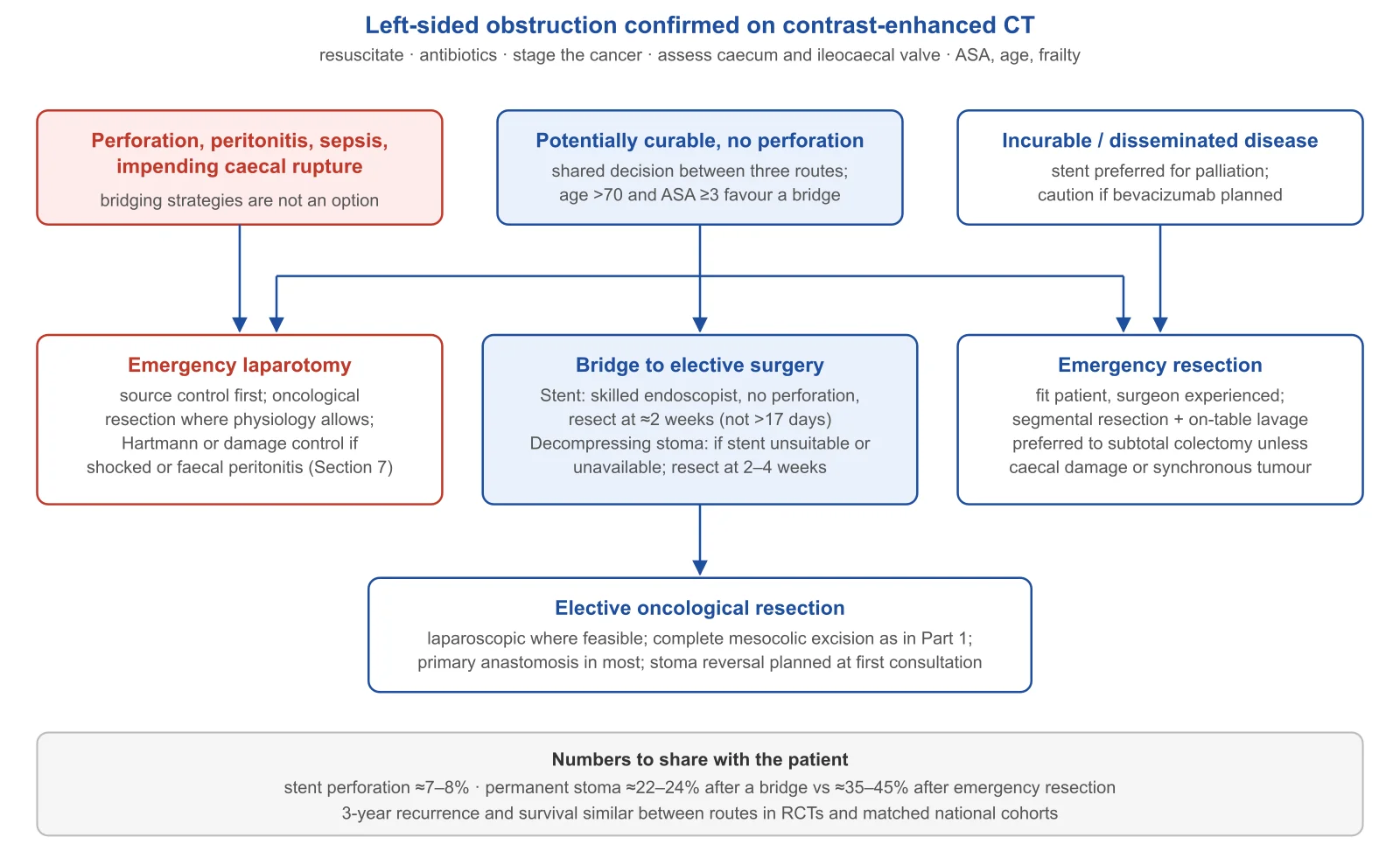
Perforation and Damage-Control Strategies
Perforation at the tumour versus diastatic perforation
Colon cancer perforates in two distinct ways, with different prognoses. Perforation at the tumour results from transmural necrosis and usually produces a contained abscess or localised peritonitis; diastatic perforation occurs proximal to an obstructing tumour, classically in the caecum, and tends to cause free faecal peritonitis in a patient already compromised by days of obstruction [8,54]. In the Taiwanese series, perioperative mortality was 9% for perforation at the cancer, 5% for obstruction alone and 31% for perforation proximal to the cancer (P<0.001), and obstructed or proximally perforated patients had 5-year survival of about 33%[8]. In a Mayo Clinic cohort that matched 41 free and 45 contained perforations to 85 non-perforated controls, perioperative mortality was 19% after free perforation versus 0% after contained perforation and 5% in controls (P=0.038); once perioperative deaths were excluded, 5-year overall survival was similar (55%, 59% and 54%), and perforation itself did not predict long-term survival, whereas age, ASA class, residual disease and stage did [9]. The Erlangen registry reached a comparable conclusion in 52 perforated versus 1,206 non-perforated colon cancers treated with complete mesocolic excision: perforated patients were older and sicker, more often had a Hartmann procedure (P<0.001), had no excess anastomotic leakage (P=1.0), and had cancer-related survival 12.8 percentage points lower, a gap that narrowed to 9.6 points when postoperative deaths were excluded [10].
The oncological cost of perforation is mainly peritoneal. A systematic review of 16 non-randomised studies identified a perforated primary tumour, together with synchronous peritoneal disease and isolated ovarian metastases, as the situations most likely to be followed by peritoneal carcinomatosis; reported incidences across risk groups ranged from 8% to 75%, and the authors judged the evidence quality low [68]. Perforation is therefore both a staging event (tumour perforation through the visceral peritoneum defines pT4a) and a reason to discuss intensified surveillance and, where available, enrolment in trials of peritoneal-directed therapy (addressed in the next part of this series).
Principles of operative management
The WSES guideline frames the task directly: the surgeon must balance life-saving procedures against oncological considerations, and a damage-control approach may be needed in selected cases [54]. In practice the sequence is source control, then resection, then a decision about reconstruction.
- Source control and resuscitation. Peritoneal lavage, removal of faecal contamination and resection of the perforated segment take precedence over lymphadenectomy. Haemodynamic instability was an independent predictor of death and severe morbidity in the French obstructive right-colon cohort [56].
- Resect the tumour with oncological intent whenever physiology allows. Tumours were completely resected in 67% of free perforations in the Mayo cohort, and residual disease was an independent predictor of poor survival [9]. The Erlangen group argues that perforated cancers should receive the same oncological standard as elective cases, including complete mesocolic excision and multivisceral resection when required, provided that surgical quality can be guaranteed [10]. For a diastatic caecal perforation with a distal tumour, this means subtotal colectomy encompassing both the perforation and the cancer [66].
- Choose between anastomosis, protected anastomosis and Hartmann's procedure. The WSES prefers resection with primary anastomosis over Hartmann's procedure in the obstructed patient when the patient's condition and the surgeon's experience allow [54]. In diffuse faecal peritonitis, septic shock, or when a second look is planned, an end colostomy (or, after subtotal colectomy, an end ileostomy) remains the safer choice; the caution box below summarises these triggers. Note that the frequent use of Hartmann's procedure in perforated cases [10] converts into a permanent stoma in a substantial minority, because reversal rates fall with age and comorbidity (Section 6.5)[12].
- Damage control and the open abdomen. In the patient in septic shock with coagulopathy, acidosis and hypothermia, an abbreviated laparotomy (resection without anastomosis, bowel ends stapled and left in the abdomen, temporary abdominal closure) followed by intensive-care resuscitation and planned re-look within 24–48 hours is an accepted strategy [54]. The WSES open-abdomen guideline lists inability to control the source of infection, visceral oedema, a planned re-exploration to complete damage control and abdominal wall disruption as reasons to leave the abdomen open, and recommends fascia-to-fascia closure as soon as the patient can physiologically tolerate it [69]. Evidence for this approach in colon cancer perforation is observational and extrapolated from trauma and diverticular peritonitis.
- Relaparotomy on demand rather than planned. In a Dutch randomised trial of 232 patients with severe secondary peritonitis, an on-demand strategy did not change death or major morbidity (57% versus 65%, P=0.25) but reduced relaparotomies (42% versus 94%), negative relaparotomies (31% versus 66%, P<0.001), intensive-care stay (median 7 versus 11 days, P=0.001), hospital stay (27 versus 35 days, P=0.008) and costs by 23%[70]. Once source control is achieved, re-exploration should be driven by clinical deterioration and imaging, not by the calendar.
Outcomes
Mortality after surgery for perforated colon cancer depends mainly on the type of perforation and the patient's physiology: about 9% for perforation at the tumour and 31% for diastatic perforation in one large series [8], 19% after free perforation in a matched cohort [9], and within the 8.5% 30-day mortality for all non-elective colon cancer resections nationally, where perforation was an independent risk factor [1]. Survivors of the acute episode have long-term survival close to stage-matched non-perforated patients when an R0 resection is achieved [9,10], which is the strongest argument for applying elective oncological standards once the patient is stable. The main long-term costs are a higher rate of peritoneal recurrence [68] and a high probability of a permanent stoma when a Hartmann procedure was performed in an elderly or comorbid patient [12]. For obstruction without perforation, the comparison is more favourable: in the Dutch national cohort, 3-year overall survival after a bridging strategy was 74–79% and after emergency resection 68–73%, with locoregional recurrence of 11–14% in all groups [3,4]. Taken together, the data support a strategy in which the emergency operation is kept as simple as physiology demands, oncological completeness is pursued whenever it is safe, and a definitive, elective-quality resection is scheduled whenever a bridge is possible.
Emergency Colectomy: Choosing the Operation
Emergency resection carries about twice the mortality of elective resection and a far higher stoma rate. When resection cannot be deferred, the surgeon must choose between anastomosis and end stoma and between open and laparoscopic access, in a patient who is often older, dehydrated and septic. This section summarises what the evidence supports for each decision.
Right-sided versus left-sided emergencies
In the Association of Coloproctology of Great Britain and Ireland (ACPGBI) prospective study of 1,046 patients with malignant large-bowel obstruction, 91.7% of operated patients underwent resection and in-hospital mortality was 15.7%; age (OR 1.85 per decade), ASA grade (OR 3.3, 11.7 and 22.2 for grades II, III and IV–V versus I), Dukes stage and urgency of operation (OR 1.6 for urgent and 2.3 for emergency versus scheduled surgery) were independent predictors of death [52]. Urgency was likewise an independent predictor in the ACPGBI national cohort of 8,077 resections (overall mortality 7.5%)[71].
Right-sided obstruction is traditionally managed by resection with primary ileocolic anastomosis, on the assumption that the well-vascularised ileum tolerates an unprepared, dilated colon. Nationwide Dutch ColoRectal Audit data challenge the idea that this is as safe as an elective operation: in 5,056 emergency right-sided resections matched 1:1 to elective resections, anastomotic leakage did not differ, but 90-day mortality was twice as high (9.4% vs 4.2%) and the 90-day complication rate was higher (41.7% vs 33.0%)[72]. The excess reflects physiology and frailty rather than the anastomosis, which argues for resuscitation, senior involvement and, in selected patients, a bridge to surgery for the proximal colon as well; ESGE regards proximal stenting as an option supported only by low-quality evidence [55].
Left-sided obstruction behaves differently: the proximal colon is faecally loaded and distended, the anastomosis is colocolic or colorectal, and the patient is frequently elderly, which is why left-sided emergencies generate most stomas in colon cancer surgery. In the Dutch propensity-matched analysis of 236 decompressing-stoma patients and 472 patients undergoing emergency resection for left-sided obstructive colon cancer, emergency resection resulted in a primary anastomosis in only 40.7% of patients, 90-day mortality of 7.2% (13.7% in patients over 70 years) and a permanent stoma in 42.4%, compared with 1.7%, 3.5% and 23.4% respectively after decompressing stoma followed by elective resection [4]. These figures are the strongest argument for the bridge-to-surgery strategies discussed in Section 6.
Hartmann's procedure, primary anastomosis, or anastomosis with diverting ileostomy
Three operations compete for the left-sided emergency: resection with end colostomy (Hartmann's procedure), resection with primary anastomosis, and resection with primary anastomosis protected by a loop ileostomy. No randomised trial compares them in colon cancer; the randomised evidence comes from perforated diverticulitis and must be transferred with care, because those patients are younger, have no oncological constraint on resection and need no adjuvant chemotherapy.
Three trials point the same way. In 62 patients with Hinchey III–IV perforation randomised to Hartmann's procedure or primary anastomosis with ileostomy, index mortality (13% vs 9%) and morbidity were similar, but stoma reversal was achieved in 90% versus 57% (P=0.005), with fewer serious complications and shorter stay at the reversal operation [73]. In the French DIVERTI trial (n=102), 18-month mortality did not differ (7.7% vs 4.0%), while 96% of primary-anastomosis patients and 65% of Hartmann patients had their stoma reversed (P=0.0001)[74]. The Dutch LADIES trial (n=133; 27% of anastomosis patients received no stoma at all) reported 12-month stoma-free survival of 94.6% after primary anastomosis versus 71.7% after Hartmann's procedure (HR 2.79, 95% CI 1.86–4.18), with similar index morbidity (39% vs 44%) and mortality (6% vs 3%)[38]. A meta-analysis of randomised trials found similar major complications (RR 0.88, 95% CI 0.49–1.55) and mortality (RR 0.58, 0.20–1.70) after primary anastomosis compared with Hartmann's procedure, but a higher probability of being stoma-free at 12 months (RR 1.40, 1.18–1.67) and fewer major complications at the reversal operation (RR 0.26, 0.07–0.89)[39]. The LADIES authors restricted their recommendation to haemodynamically stable, immunocompetent patients younger than 85 years; outside that group Hartmann's procedure remains the default.
The central problem with Hartmann's procedure is that the stoma is often permanent. In a UK audit of 228 Hartmann's procedures (32% for malignancy), only 47% were reversed, at a median of 11 months; of those not reversed, 70% were judged unfit and 30% declined [11]. The Dutch data above give a permanent stoma rate of 42.4% after emergency cancer resection [4]. Reversal is a major operation that competes with adjuvant chemotherapy, and the realistic probability of reversal belongs in the consent discussion.
Guidelines agree in principle. The WSES 2017 guideline accepts primary anastomosis in selected stable patients and reserves Hartmann's procedure for the unstable, septic or high-risk and for faecal peritonitis [54]; the 2022 ASCRS guideline supports resection with or without anastomosis according to patient condition, under the same oncological principles as elective surgery [67]. A diverting ileostomy does not prevent a leak but limits its consequences; the diverticulitis trials used it in most anastomosis patients.
| Option | Typical patient | Leak or index complications | Mortality | Stoma outcome | Evidence |
|---|---|---|---|---|---|
| Hartmann's procedure | Unstable, septic, faecal peritonitis, severe comorbidity, age >85 | No anastomosis; index morbidity similar to anastomosis in RCTs (44% vs 39%) | Similar to anastomosis in RCTs (3–13%) | Reversed in 47–65% of patients; permanent stoma 42% after emergency cancer resection | RCTs in diverticulitis [38,73,74]; cancer cohorts [4,11] |
| Primary anastomosis without diversion | Stable, well-resuscitated, no faecal peritonitis, modest colonic dilatation | Leak risk higher than elective colorectal anastomosis; used in 27% of LADIES anastomosis arm | No excess shown in RCTs | No stoma in most; stoma if leak | RCT subgroup, cohort data [38,54] |
| Primary anastomosis with loop ileostomy | Stable patient with risk factors (steroids, age, purulent peritonitis) | Index morbidity similar to Hartmann's procedure | Similar | Reversal 90–96% at 12–18 months; reversal less morbid than Hartmann reversal (RR 0.26 for major complications) | RCTs in diverticulitis [73,74]; meta-analysis [39] |
Laparoscopy in the emergency setting
Laparoscopic emergency colectomy is feasible in selected patients but has never been tested in an adequately powered randomised trial. A systematic review of 22 studies reported median complication rates of 27.8% versus 48.3% and hospital stay of 10 versus 15 days, at the cost of longer operations [75]. A meta-analysis of 28 observational studies and one randomised trial (7,865 laparoscopic, 55,862 open) found lower mortality (OR 0.44, 95% CI 0.35–0.54) and morbidity (OR 0.53, 0.43–0.65) with laparoscopy, with the caveat that the evidence is almost entirely retrospective and subject to selection bias [76]. In the Dutch nationwide cohort of left-sided obstructive colon cancer, 158 intentional laparoscopic emergency resections matched 1:3 to open resections had fewer 90-day complications (26.6% vs 38.4%; conditional OR 0.59, 95% CI 0.39–0.87), similar 90-day mortality and better 3-year overall survival (81.0% vs 69.4%; HR 0.54, 0.37–0.79)[77]. Only 8% of patients were approached laparoscopically. A dilated, faecally loaded colon, instability and faecal peritonitis remain reasons to operate open; after a decompressing stoma, 57% of Dutch resections were laparoscopic [4].
Frailty, age and the decision to operate
In the NSQIP database, 10,025 patients aged 65 years or older undergoing emergency colorectal resection had 30-day mortality of 15.9% and major morbidity in one-third; although 88% lived independently before surgery, only 45.4% went home directly, and frailty (31.2%; modified frailty index ≥2) independently predicted death, reoperation, institutional discharge and readmission [78]. Thirty-day mortality understates the cost: in 9,397 Dutch stage I–III patients, one-year mortality greatly exceeded 30-day mortality in every age group, while elderly patients who survived the first year had the same cancer-specific survival as younger patients [79].
Two conclusions follow. A decompressing stoma or stent converts a frail emergency patient into a resuscitated elective one, with the largest mortality benefit in those over 70 [4]. For incurable disease or prohibitive risk, ESGE recommends stenting as the preferred palliation of malignant obstruction (strong recommendation, high-quality evidence), with a decompressing stoma when stenting is unsuitable [55]. These choices belong to the patient and family, with explicit discussion of permanent stoma, institutional discharge and death within the first year.
Key points: emergency colectomy
- Emergency resection roughly doubles mortality compared with elective resection, on both sides of the colon; the excess is driven by physiology and frailty, not by the anastomosis itself.
- For left-sided emergencies, Hartmann's procedure and primary anastomosis (with or without ileostomy) have similar index mortality in randomised diverticulitis trials, but Hartmann stomas are permanent in a third to a half of patients.
- Primary anastomosis with diverting ileostomy is reasonable in stable, immunocompetent patients younger than about 85 years; Hartmann's procedure remains the default for the unstable, septic or very frail.
- Laparoscopy is associated with better short-term outcomes in observational data but has not been tested in an adequately powered trial; patient selection explains part of the difference.
- In frail older patients, a bridge to surgery or palliative stenting should be weighed against resection before the decision to operate is taken.
Anastomotic Technique
Anastomotic failure is the complication that most changes recovery, and the technical choices that influence it are made in minutes at the end of the operation. This section reviews the main configurations, the adjuncts intended to reduce leakage, and the measures shown not to help.
Ileocolic anastomosis
Stapled versus hand-sewn. The Cochrane review of seven randomised trials with 1,125 ileocolic anastomoses (441 stapled, 684 hand-sewn) found fewer leaks after stapled anastomosis (11/441 vs 42/684; OR 0.48, 95% CI 0.24–0.95), and in the 825 cancer patients from four trials the difference was larger (4/300 vs 35/525; OR 0.28, 0.10–0.75); no difference was seen in non-cancer patients [13]. The trials are old, but no later randomised evidence has reversed the finding.
Isoperistaltic versus antiperistaltic. The ISOVANTI randomised trial allocated 108 patients to isoperistaltic or antiperistaltic stapled side-to-side anastomosis after laparoscopic right colectomy. Leakage (3.7% vs 5.6%), complications (37.0% vs 40.7%) and chronic diarrhoea at one year (24% vs 31.4%) did not differ; flatus and stool returned slightly sooner after antiperistaltic anastomosis [80]. Orientation can follow surgeon preference.
Intracorporeal versus extracorporeal. In minimally invasive right colectomy the anastomosis can be fashioned inside the abdomen or through the extraction incision. A meta-analysis of five randomised trials (559 patients) found that intracorporeal anastomosis shortened time to first flatus (mean difference −0.71 days, 95% CI −1.12 to −0.31) and first stool (−0.53 days), reduced pain on days 3–5, shortened the incision (−1.52 cm) and reduced wound infection (RR 0.46, 0.23–0.91), with no difference in anastomotic leak, ileus, reoperation, readmission or mortality [14]. A triple-blind trial of 89 robotic right colectomies within an optimised enhanced-recovery pathway, however, found no difference in patient-reported recovery, pain or stay [81]. The most consistent advantage emerges later. In the prospective European MIRCAST study of 1,320 patients treated by high-volume surgeons in 59 hospitals, the 30-day composite of wound infection and major complication did not differ (7.2% extracorporeal vs 7.6% intracorporeal)[82], but at two years incisional hernia occurred in 1.3% after intracorporeal versus 5.7% after extracorporeal anastomosis (OR 0.21, 95% CI 0.09–0.43), with better quality-of-life scores after intracorporeal anastomosis [15]. A meta-analysis of 46 studies with trial sequential analysis confirmed lower incisional hernia (OR 0.29, 0.19–0.44)[83]. MIRCAST was observational, so the hernia difference is plausible but not proven; the COLOR IV trial will compare leak rates and three-year disease-free survival [84].
Colocolic and colorectal anastomosis after left-sided resection
After left-sided resection the anastomosis is usually constructed with a circular stapler by the double-stapling technique. Two anatomical decisions affect its tension and blood supply.
Level of inferior mesenteric artery ligation. High ligation at the aorta gives length and a standard lymphadenectomy; low ligation below the left colic artery preserves blood flow to the descending colon and the superior hypogastric plexus. The HIGHLOW randomised trial (214 patients undergoing laparoscopic anterior resection for rectal cancer) found no difference in anastomotic leak (8.1% high vs 6.7% low) but better continence, fewer obstructive urinary symptoms, better sexual function and better quality of life at nine months after low ligation [85], with no difference in five-year local recurrence, distant recurrence, overall or disease-free survival [86]. The trial concerned rectal cancer; for colon cancer the level of ligation should follow the lymph node principles in Part 1, with low ligation plus apical node dissection an acceptable compromise when perfusion is a concern.
Splenic flexure mobilisation. A meta-analysis of 19 studies with 81,116 patients (mobilisation in 40.7%) found longer operating time (+24.5 minutes) and higher odds of leak (OR 1.19, 95% CI 1.06–1.33)[87]. The association almost certainly reflects confounding by indication, but it does not support routine mobilisation when a tension-free anastomosis can be made without it.
Intraoperative perfusion assessment with indocyanine green
Indocyanine green (ICG) fluorescence angiography shows perfusion of the bowel ends and allows the transection line to be moved. The randomised evidence is more nuanced than early enthusiasm suggested.
PILLAR III randomised 347 patients undergoing low anterior resection (anastomosis within 10 cm of the anal verge) to ICG or standard assessment; it closed early at a third of its planned recruitment, and leakage was 9.0% with ICG versus 9.6% without (adjusted OR 0.85, 95% CI 0.38–1.91)[88]. The Japanese EssentiAL trial randomised 839 patients undergoing minimally invasive rectal cancer surgery: leakage (grades A–C) was 7.6% with ICG versus 11.8% without (RR 0.645, 95% CI 0.422–0.987), clinically relevant leakage (grades B–C) 4.7% versus 8.2%, and reoperation 0.5% versus 2.4%[89]. The Dutch AVOID trial, which enrolled 931 patients undergoing minimally invasive colorectal surgery of all types, found no significant reduction in clinically relevant leakage at 90 days (7% vs 9%; RR 0.77, 95% CI 0.50–1.20)[17]. The European IntAct trial in 698 analysable rectal cancer patients reported clinical leakage of 10% with ICG versus 15% without (adjusted OR 0.667, 95% CI 0.419–1.060; P=0.087), with the difference concentrated in grade B leaks [90]. An updated meta-analysis of ten randomised trials (4,885 patients) found a lower leak rate with ICG overall (OR 0.64) and a seven-fold higher rate of change in surgical plan, with no difference in reoperation; in subgroup analysis the benefit was present for left colon and rectal resections and absent for right colon surgery [16].
ICG therefore changes decisions and probably reduces leakage after left-sided and rectal anastomoses, with the largest trial positive and two others showing non-significant reductions in the same direction; for ileocolic anastomoses no trial or subgroup shows benefit. It is safe and reasonable for left-sided colonic anastomoses, but no substitute for a tension-free, well-perfused anastomosis judged conventionally.
Tests, reinforcement and drains
Air-leak test. A positive test occurs in 1.5–24.7% of colorectal anastomoses and predicts clinical leak (11.4% vs 4.2%, P<0.001); repair or diversion then follows, although meta-analysis could not show that testing itself lowers the overall leak rate [91].
Omentoplasty. A pedicled omental wrap reduced overall (OR 0.43, 95% CI 0.21–0.87) and clinical leak (OR 0.35, 0.15–0.81) in four old randomised trials with 1,067 patients, without reducing reoperation or mortality; the effect was driven by rectal anastomoses [92].
Drains. The Cochrane review of six randomised trials with 1,140 patients found similar mortality (3% vs 4%), clinical leak (2% vs 1%), wound infection (5% vs 5%) and reoperation (6% vs 5%) with and without drains [18]. Drains neither detect nor prevent leaks reliably, and enhanced-recovery guidance advises against routine drainage after colonic resection (Section 13).
| Choice | Comparison | Effect on leak | Other effects | Evidence (authors' judgement of certainty) |
|---|---|---|---|---|
| Ileocolic: stapled vs hand-sewn | 7 RCTs, 1,125 patients | Fewer leaks stapled (OR 0.48, 0.24–0.95); cancer subgroup OR 0.28 | None consistent | Moderate; older trials [13] |
| Ileocolic: iso- vs antiperistaltic | 1 RCT, 108 patients | No difference (3.7% vs 5.6%) | Faster flatus/stool with antiperistaltic | Low [80] |
| Ileocolic: intra- vs extracorporeal | 5 RCTs, 559 patients; MIRCAST n=1,320 | No difference | Faster recovery, less wound infection (RR 0.46); incisional hernia 1.3% vs 5.7% at 2 years (OR 0.21, observational) | Moderate for recovery; low for hernia [14,15] |
| Left-sided: IMA high vs low ligation | HIGHLOW RCT, 214 patients (rectal) | No difference (8.1% vs 6.7%) | Better genitourinary function with low ligation; equal 5-year oncological outcome | Moderate, rectal cancer only [85,86] |
| Left-sided: splenic flexure mobilisation | 19 studies, 81,116 patients | Higher odds of leak (OR 1.19, 1.06–1.33), confounded by indication | +24.5 min operating time | Low [87] |
| ICG perfusion assessment | 10 RCTs, 4,885 patients | Lower overall (OR 0.64); benefit in left colon and rectum, none in right colon | Changes plan in a minority; no effect on reoperation | Moderate for rectal; low for colon [16,17,89,90] |
| Air-leak test | 2016 meta-analysis | Positive test predicts leak (11.4% vs 4.2%) | Guides intraoperative repair or diversion | Low [91] |
| Omentoplasty | 4 RCTs, 1,067 patients | Lower leak (OR 0.43), mainly rectal | No change in reoperation or mortality | Low, old trials [92] |
| Prophylactic drain | 6 RCTs, 1,140 patients | No difference (2% vs 1% clinical leak) | No difference in mortality, infection or reoperation | Moderate [18] |
Anastomotic Leak: Definition, Risk, Prevention, Diagnosis and Management
Definition, grading and incidence
The International Study Group of Rectal Cancer (ISREC) defines an anastomotic leak as a defect of the intestinal wall at the anastomotic site leading to communication between the intra- and extraluminal compartments, and grades severity by its effect on management: grade A requires no change in treatment, grade B requires active intervention without re-laparotomy, and grade C requires re-laparotomy [43]. The definition was written for anterior resection, but it is now applied to colonic anastomoses in audits and trials, and this review uses it throughout. Reporting remains inconsistent: a 2024 systematic review of colorectal cancer trials found that definitions and time frames for leak were often absent, which limits comparison between studies [93].
Incidence depends on the anastomosis and on how hard it is looked for. In the Dutch Surgical Colorectal Audit, leak occurred after 7.5% of 15,667 colonic cancer resections [94]; in the Danish nationwide cohort, after 6.4% of 9,333 [95]; in the Spanish prospective multicentre study of colon resection for cancer, after 8.7% of 3,193, with wide variation between hospitals [96]. Registry series that code leaks directly report lower rates (3.8% in NSQIP [97]; 2.7% in a Michigan population-based study [98]). Site matters: in the Dutch audit of 39,565 colon cancer patients, leak ranged from 4.0% after right hemicolectomy to 15.4% after subtotal colectomy [99], and left hemicolectomy (OR 2.02, 95% CI 1.50–2.72) and sigmoid colectomy (OR 1.69, 1.32–2.17) carried higher risk than right-sided resection in the Danish data [95]. Ileocolic anastomoses are not uniformly safe: the 2015 European Society of Coloproctology snapshot audit of 3,041 right hemicolectomies and ileocaecal resections recorded an 8.1% leak rate, similar after hand-sewn (7.4%) and stapled (8.5%) anastomosis, although after adjustment stapling was associated with higher odds (adjusted OR 1.43, 1.04–1.95)[100]; a Chinese prospective snapshot of 1,854 right hemicolectomies reported 1.4%[101]. Anastomotic technique is discussed in Section 9.
The consequences are large. Mortality after a colonic leak was 16.4% versus 3.1% without a leak in the Dutch audit, and the adjusted risk of death after a leak was twice as high after right as after left colectomy [94]; the Spanish study reported 15.2% versus 1.9% and a median stay of 23 versus 7 days [96]. In NSQIP, leak increased 30-day mortality (6.8% vs 1.6%) and readmission (43.5% vs 8.3%)[97]. The oncological effect is also measurable. A meta-analysis of 34 non-randomised studies (78,434 patients) found that leak was associated with more local recurrence (RR 1.90, 95% CI 1.48–2.44) and worse overall (RR 1.36, 1.24–1.50), cancer-specific (RR 1.41, 1.19–1.68) and disease-free survival (RR 1.40, 1.20–1.63), but not with distant recurrence (RR 1.20, 0.94–1.53)[102]; an earlier meta-analysis of 21,902 patients gave an OR of 1.75 (1.47–2.10) for cancer-specific mortality [103]. In the Danish colon-only cohort of patients alive at 120 days, leak was not associated with local recurrence (adjusted HR 0.78, 0.55–1.12) but was associated with distant recurrence (HR 1.42, 1.13–1.78) and long-term mortality (HR 1.20, 1.01–1.44); in stage III disease it reduced the likelihood of adjuvant chemotherapy (HR 0.58, 0.45–0.74) and delayed it by 16 days [104]. Part of the survival penalty, therefore, is mediated by lost or delayed adjuvant treatment.
Risk factors and risk stratification
A systematic review of 451 studies grouped risk factors into patient, tumour, operative and postoperative domains [105]. Consistently reported preoperative factors are male sex, ASA grade above II, renal disease and comorbidity; tumour-related factors are distal site, size above 3 cm, advanced stage, emergency surgery and metastatic disease; modifiable factors are smoking, obesity, poor nutrition, alcohol excess, immunosuppressants and bevacizumab; intraoperative factors are blood loss or transfusion and operating time above four hours. Stomas reduce the consequences of a leak but not its occurrence [105]. In the classic Danish cohort, smokers had a relative risk of 3.18 (95% CI 1.44–7.00) and alcohol abusers 7.18 (1.20–43.01)[106]. Nationwide and multicentre colonic cohorts confirm these factors with the effect sizes shown in the table; hospital-level variation persists after case-mix adjustment [94–96,98].
| Factor | Direction | Effect size (source population) | Evidence |
|---|---|---|---|
| Male sex | Increased | OR 1.41 (1.12–1.75) Denmark; OR 1.6 Spain | Nationwide cohorts [95,96] |
| Smoking | Increased | RR 3.18 (1.44–7.00) | Prospective cohort [106]; registries [97,98] |
| Alcohol excess | Increased | RR 7.18 (1.20–43.01), wide CI | Prospective cohort [106] |
| Obesity | Increased | OR 2.7 (BMI not stated); BMI >30 in Michigan | Multicentre prospective [96]; population-based [98] |
| Low serum protein / poor nutrition | Increased | OR 0.7 per g/dL rise in total protein | Multicentre prospective [96]; review [105] |
| ASA grade >II, comorbidity | Increased | Independent in Dutch audit | Nationwide audit [94]; review [105] |
| Steroids / immunosuppression | Increased | Independent in NSQIP and Michigan | Registries [97,98] |
| Transfusion / blood loss | Increased | OR 10.27 (6.82–15.45) for transfusion | Nationwide cohort [95]; review [105] |
| Operating time >4 h | Increased | Independent in several series | Review [105]; registries [97,98] |
| Emergency surgery | Increased | Independent in Dutch audit | Nationwide audit [94] |
| Left-sided or extended resection | Increased | OR 2.02 left, 1.69 sigmoid vs right; 15.4% after subtotal colectomy | Nationwide data [95,99] |
| Defunctioning stoma | Lower leak risk in colonic audit; reduces consequences | Small subgroup | Nationwide audit [94]; review [105] |
Risk scores have multiplied faster than their validation. A systematic review identified 31 preoperative or intraoperative leak prediction scores (12 colonic or colorectal, 19 rectal) across 34 studies; heterogeneity precluded meta-analysis, and only 22 scores even defined a leak [107]. A second review of nine scores (Colon Leakage Score, REAL, PROCOLE and others) found limited external validation [108]. The original Colon Leakage Score for left-sided surgery separated leak from non-leak patients (mean 16 vs 8) in a 121-patient test cohort [109]. The ACS NSQIP universal surgical risk calculator predicts composite morbidity and mortality from 21 patient variables with good discrimination (C-statistic 0.944 for mortality, 0.816 for morbidity) but does not model leak specifically [110]. The practical use of these tools is to prompt a conversation about diversion, a staged approach or prehabilitation in high-risk patients, not to decide any single case.
Prevention
Bowel preparation. The evidence has moved in two directions at once. A 2023 Cochrane review of 21 RCTs (5,264 participants) concluded that mechanical bowel preparation plus oral antibiotics, compared with mechanical preparation alone, reduced surgical-site infection (RR 0.56, 95% CI 0.42–0.74; 16 studies) and anastomotic leak (RR 0.60, 0.36–0.99; 10 studies), both moderate certainty, with no effect on mortality or ileus [19]. A network meta-analysis of 60 RCTs (16,314 patients) found that, against intravenous antibiotics alone, adding oral antibiotics reduced surgical-site infection (OR 0.47, 0.32–0.68) and leak (OR 0.63, 0.44–0.90), as did oral antibiotics plus mechanical preparation (leak OR 0.62, 0.41–0.94), whereas mechanical preparation without oral antibiotics gave no benefit [20]. In colon surgery specifically, the ORALEV trial (536 analysed) showed that oral ciprofloxacin and metronidazole the day before surgery, without mechanical preparation, halved surgical-site infection (5% vs 11%; OR 0.41, 0.20–0.80)[111]. The MOBILE trial (396 colectomies), however, found no difference between mechanical plus oral antibiotic preparation and no preparation in surgical-site infection (7% vs 11%; OR 1.65, 0.80–3.40) or dehiscence (4% vs 4%)[112], whereas the double-blind MOBILE2 trial in rectal resection (565 patients) found that adding oral antibiotics to mechanical preparation reduced infection (8.3% vs 16.7%; OR 0.45, 0.27–0.77) and dehiscence (5.8% vs 13.5%; OR 0.39, 0.21–0.72)[113]. The consistent signal across trials is that the oral antibiotic component carries the benefit; whether mechanical preparation adds anything for colonic resection remains uncertain, and the leak reduction is better established for rectal than for colonic anastomoses. Selective decontamination of the digestive tract (SELECT trial, 455 patients) reduced infectious complications (14.9% vs 26.9%; OR 0.48, 0.30–0.76) but not leak significantly (6.1% vs 9.7%; OR 0.61, 0.30–1.22), and the trial was stopped early for futility of the primary endpoint [114]. The microbiome hypothesis, in which collagenase-producing organisms degrade the healing anastomosis, offers a mechanism but no targeted intervention yet [115].
Technique and perfusion. Tension-free, well-perfused bowel with intact mesenteric arcades remains the core of prevention; stapled versus hand-sewn ileocolic technique and indocyanine green perfusion assessment are reviewed in Section 9 and are not repeated here. Anastomotic reinforcement, buttressing and sealants have no consistent randomised support for colonic anastomoses [116]. Prophylactic drains do not prevent or mitigate leaks: the Cochrane review of six RCTs (1,140 patients) found clinical dehiscence of 2% with and 1% without drainage and no difference in mortality, radiological dehiscence or reintervention [18]; an updated meta-analysis of four RCTs (1,120 patients) found clinical leak of 8.5% versus 7.6% (P = 0.57)[117]; and in the rectal GRECCAR 5 trial pelvic sepsis was 16.1% with and 18.0% without a drain [118].
Drugs. Non-steroidal anti-inflammatory drugs are the most debated perioperative exposure. A meta-analysis of seven mainly observational studies associated postoperative NSAID use with leak (OR 1.58, 95% CI 1.23–2.03), driven by non-selective agents (OR 1.79, 1.47–2.18)[119]. In the Washington State SCOAP cohort of 13,082 patients, the adjusted association was modest (OR 1.24, 1.01–1.56) and confined to non-elective surgery (12.3% vs 8.3%)[120]. Against this, the prospective multicentre STARSurg cohort of 5,240 patients found no association after propensity matching (leak 4.8% with vs 6.0% without early NSAIDs; adjusted OR 0.85, 0.58–1.21)[121]. The ERAS Society guideline therefore keeps NSAIDs within multimodal analgesia while acknowledging the uncertainty [122]. No randomised trial has settled the question (authors' judgement: low certainty of harm, with the strongest signal in emergency surgery).
Physiology. Within ERAS, normothermia, avoidance of fluid overload and early feeding are recommended on the basis of general complication data rather than leak-specific trials [122]; the component-level evidence is reviewed in Section 13. Preoperative anaemia should be identified and corrected, ideally with intravenous iron when oral iron cannot work in time, because transfusion is one of the strongest operative associations with leak [95,123]. Smoking cessation and nutritional optimisation address the two most modifiable patient factors [105,106].
Diagnosis
Leaks declare themselves late. In a Swedish cohort the mean interval to diagnosis was 8.8 days (range 2–42), and 25% of initial CT scans in patients who turned out to have a leak were negative [124]. Fever, tachycardia, ileus, new pain, peritonism, abnormal drain fluid and failure to progress on an enhanced recovery pathway are the clinical triggers [105]. Standardised surveillance shortens the delay: in a Dutch before-and-after study, a daily leak score reduced the time to diagnosis from 4 to 1.5 days and leak-related mortality from 39% to 24%, the latter not statistically significant [125].
C-reactive protein is the most useful rule-out test. In a meta-analysis of seven studies (2,483 patients, leak prevalence 9.6%), serum CRP on postoperative days 3, 4 and 5 gave pooled areas under the curve of 0.81, 0.80 and 0.80; the derived cut-offs of 172 mg/L (day 3), 124 mg/L (day 4) and 144 mg/L (day 5) carried a negative predictive value of 97% but low positive predictive value [21]. Procalcitonin performed similarly: in the PREDICS study of 504 patients, values below 2.7 ng/mL on day 3 and 2.3 ng/mL on day 5 had negative predictive values of 96.9% and 98.3%, and combining procalcitonin with CRP on day 5 raised the area under the curve to 0.901 [126]. A low CRP on day 3–5 supports discharge; a rising value should prompt imaging rather than observation.
CT is the confirmatory test but has a meaningful false-negative rate. A systematic review of eight studies (221 scans) estimated sensitivity of 0.68 (95% CI 0.59–0.75) for colonic resection, with poor methodological quality throughout [127]. In a 131-patient series, sensitivity was 71–87% and specificity 84–92%, and rectal contrast raised the positive predictive value from about 40% to 88–100%, with contrast extravasation the most specific sign (97%)[128]. The cost of a false negative is high: in a Dutch series, reintervention after a false-negative CT was delayed by a median of one day and mortality rose from 4.2% to 45.5%[22].
| Test | Timing | Performance | Role | Source |
|---|---|---|---|---|
| Serum CRP | Day 3–5 | AUC 0.80–0.81; cut-offs 172/124/144 mg/L; NPV 97% | Rule-out before discharge | Meta-analysis [21] |
| Procalcitonin | Day 3 and 5 | NPV 96.9% (<2.7 ng/mL day 3), 98.3% (<2.3 ng/mL day 5); AUC 0.86 day 5 | Adjunct to CRP | Prospective study [126] |
| CT with intravenous contrast | On suspicion | Pooled sensitivity 0.68 (0.59–0.75) for colonic resection | Confirmation; localises collections | Systematic review [127] |
| CT with rectal contrast | On suspicion, left-sided anastomoses | Sensitivity 71–87%, specificity 84–92%; PPV rises to 88–100% | Preferred for distal anastomoses | Cohort [128] |
| Standardised daily leak score | Daily from day 1 | Diagnosis delay 4 → 1.5 days | Surveillance protocol | Before–after study [125] |
| Diagnostic laparoscopy or laparotomy | Sepsis with negative or equivocal imaging | Definitive | When CT is negative but clinical suspicion high | Cohort [22] |
Red flags that should not wait for the next ward round
- New tachycardia, fever or hypotension after day 2, especially with rising CRP or a CRP that fails to fall.
- Abdominal pain out of proportion, peritonism, or abdominal distension with ileus beyond day 3–4.
- Purulent, bilious or faeculent fluid from a wound or drain.
- Acute kidney injury, new atrial fibrillation or respiratory deterioration without another explanation; these are often the first sign of a leak in older patients.
- A negative CT does not exclude a leak in a patient with these features; reinterventions delayed after false-negative scans carried markedly higher mortality [22].
Management
Management follows the ISREC grade and the patient's physiology, not the radiological appearance alone (Figure). Grade A leaks, found incidentally on imaging without clinical change, need no specific treatment beyond observation. Grade B leaks, with a contained collection and a stable patient, are treated with antibiotics and, where accessible, percutaneous drainage; in a large training-programme series, 73% of all leaks were managed non-operatively, success was similar for operative (54%) and non-operative (57%) strategies, and 90-day mortality was 3%[129]. Grade C leaks, with generalised peritonitis or organ dysfunction, require re-laparotomy or re-laparoscopy, resuscitation and source control. Intraperitoneal colonic leaks differ from pelvic leaks: in the same series the anastomosis was resected in 91% of operatively managed intraperitoneal leaks, whereas 76% of extraperitoneal leaks were managed by diversion and drainage without disturbing the anastomosis [129]. In the Dutch audit, 81–92% of colonic leaks were managed by reoperation at a median of 4–8 days, with a stoma in 65.5% after right hemicolectomy and 93.0% after sigmoid resection; reoperation after a right-sided leak carried higher mortality (14.4%) than after sigmoid resection (5.6%)[99].
The operative options are, in order of decreasing conservatism: washout, drainage and proximal diversion with the anastomosis left in place; takedown with end stoma (an end ileostomy with mucous fistula after a right-sided leak, or a Hartmann's procedure after a left-sided leak); and resection with redo anastomosis, with or without a diverting stoma, in a stable patient with healthy bowel ends. No randomised trial compares these strategies; the choice is governed by contamination, bowel viability, the patient's physiology and the surgeon's judgement at operation. Endoluminal vacuum therapy, with a weighted success rate of 85.3% (95% CI 80.1–90.5) and stoma reversal in 75.9% in a systematic review of 276 patients, applies to low rectal leaks and stump insufficiency and has no established role for intraperitoneal colonic anastomoses [130].
Timeliness determines survival. "Failure to rescue", the proportion of patients who die after a serious complication, varies between hospitals far more than the complication rate itself: in the Dutch audit of 24,667 patients, severe complications ranged from 19% to 25% across mortality quintiles, but failure to rescue ranged from 9% to 26% (OR 3.0, 95% CI 2.29–3.98)[50]. In 144,542 English resections, reoperation rates were identical (4.8%) in the best and worst mortality quintiles, but death after reoperation was 16.8% versus 11.1%[131]. Leaks will not be eliminated; the quality of care is measured by how quickly they are recognised and controlled.
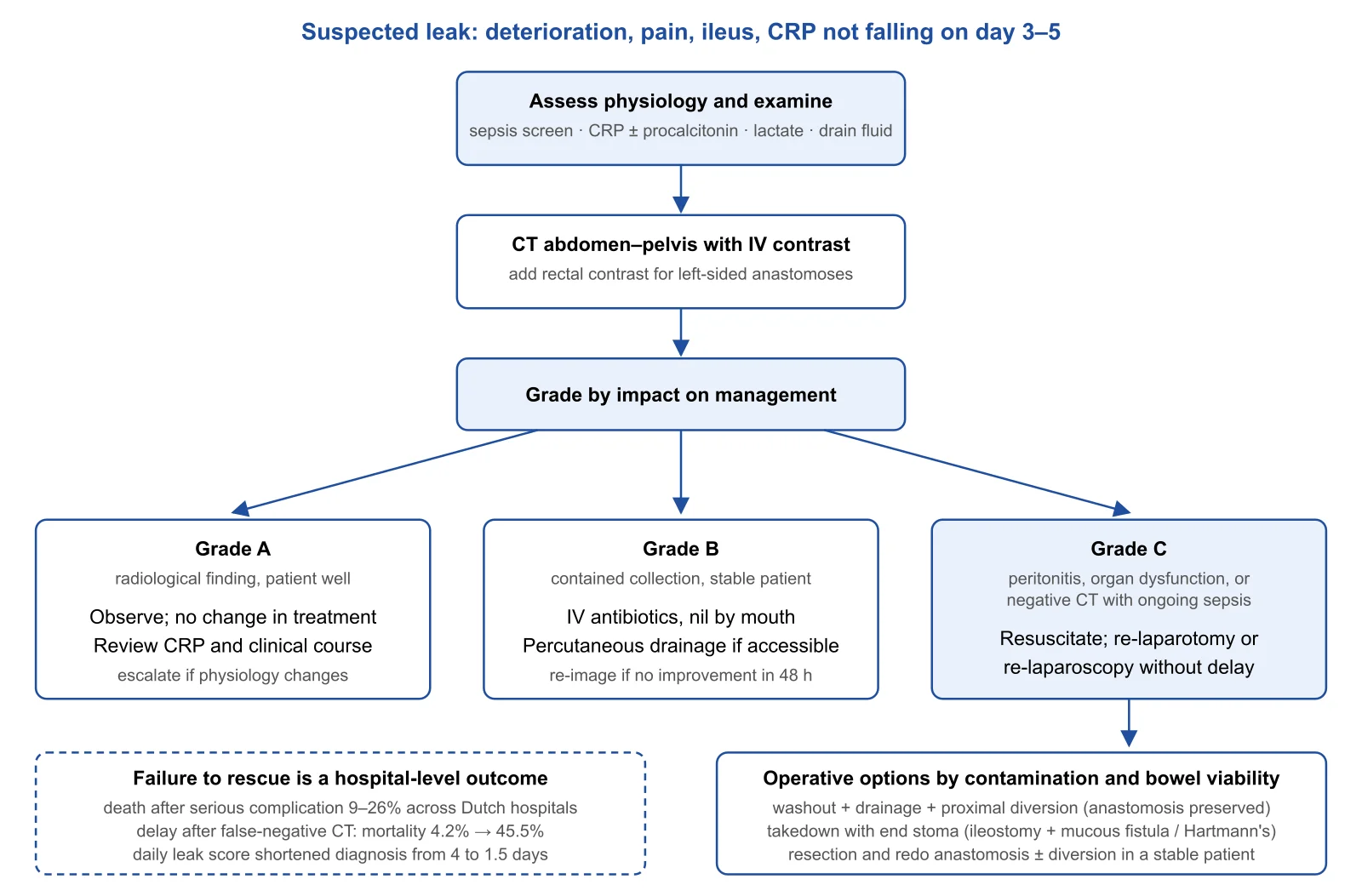
The evidence does not identify a single intervention that eliminates leaks; it identifies a bundle, consisting of oral antibiotic bowel preparation, optimisation of anaemia, nutrition and smoking, a tension-free and well-perfused anastomosis, selective diversion in the highest-risk patients, day 3–5 biomarker surveillance, a low threshold for CT and a lower threshold for reoperation when imaging and physiology disagree.
Stomas in Colon Cancer Surgery
When a stoma is needed
Most elective colon cancer resections end with a primary anastomosis and no stoma; stomas arise from the emergency and high-risk situations described earlier in this review. An end colostomy follows a Hartmann resection for obstructed, perforated or septic left-sided disease. A diverting loop stoma protects an anastomosis at high risk of leakage, typically after left-sided emergency resection or in a malnourished or immunosuppressed patient. A decompressing stoma without resection bridges obstruction when the patient is too unwell for resection or when staging and neoadjuvant treatment are planned [41].
Siting and counselling should be routine whenever a stoma is possible, not only when it is certain. The American Society of Colon and Rectal Surgeons (ASCRS), the Wound, Ostomy and Continence Nurses Society and the American Urological Association jointly recommend preoperative marking by a trained clinician for every patient whose operation may produce a stoma [132,133]. The evidence is observational but consistent: a systematic review of two randomised and 25 non-randomised studies associated marking with fewer stoma-related complications (OR 0.45, 95% CI 0.31–0.65), less appliance leakage (OR 0.14, 0.06–0.37) and fewer skin complications (OR 0.38, 0.29–0.50), at moderate to very low certainty [23]; a prospective comparison of 105 patients found lower complication rates and greater independence in the marked group [134].
Loop ileostomy or loop colostomy for diversion
Loop ileostomy is the default diversion in most centres, but the comparative evidence is thin. The Cochrane review of five trials (334 patients) found less stoma prolapse after loop ileostomy than after loop transverse colostomy (P=0.00001, with significant heterogeneity) and could not clarify any other outcome [135]. A meta-analysis of 12 comparative studies (1,529 patients) confirmed less prolapse (OR 0.21) and less stoma-related sepsis (OR 0.54) with ileostomy, against more obstruction after closure (OR 2.13) and more dehydration (OR 4.61)[136]. The trade is between a local complication that is rarely dangerous (colostomy prolapse) and a systemic one that drives readmission and renal injury (ileostomy dehydration).
| Outcome | Loop ileostomy | Loop colostomy | Source |
|---|---|---|---|
| Stoma prolapse | Lower (OR 0.21) | Higher | Rondelli 2009 [136]; Cochrane 2007 [135] |
| Stoma-related sepsis | Lower (OR 0.54) | Higher | Rondelli 2009 [136] |
| Dehydration | Higher (OR 4.61) | Lower | Rondelli 2009 [136] |
| Obstruction after closure | Higher (OR 2.13) | Lower | Rondelli 2009 [136] |
| Readmission within 30–60 days | 16.9–17%, dehydration the leading cause | Not comparable data | Messaris 2012 [24]; Paquette 2013 [137] |
| Hernia after closure | Lower (OR 0.28 vs colostomy closure) | Higher | Bhangu 2012 [138] |
| Certainty | Low: 5 small RCTs plus observational data | Authors' judgement |
Stoma complications
A meta-analysis of 16 studies (10,520 patients) reported a pooled stoma complication incidence of 35% (range 9–63%), rising to 66% in obese patients and 68% after laparoscopic or emergency stoma formation [139]. The table below summarises the main problems; rates vary with definition and follow-up.
Early complications. Ischaemia, retraction and mucocutaneous separation reflect tension or poor blood supply at construction and are commoner in obese patients and emergency surgery [139]. High output from an ileostomy, usually defined as more than 2,000 mL per day, has the greatest systemic consequence: in a series of 687 stomas it occurred early in 16% of ileostomies and jejunostomies, about half settling spontaneously and the rest needing ongoing treatment, usually because of a short small-bowel remnant [44]. Readmission after loop ileostomy was 16.9% within 60 days in a series of 603 patients, with dehydration the commonest cause (43% of readmissions) and postoperative diuretics the only independent risk factor [24]; another review found a 17% 30-day readmission rate for dehydration or renal failure, with age over 50 predicting renal failure [137]. Management rests on early recognition, restriction of hypotonic fluids, oral glucose–electrolyte solution, loperamide (with codeine or proton-pump inhibition where needed) and early review after discharge; output diaries and structured discharge pathways are the practical means of lowering readmission, although the evidence for them is observational [44,133].
Late complications. Parastomal hernia is the dominant long-term problem of an end colostomy, with reported rates of 4.0–48.1% for end colostomies, 0–30.8% for loop colostomies, 1.8–28.3% for end ileostomies and 0–6.2% for loop ileostomies, rising for years after formation [45]. Prophylactic mesh at end colostomy formation is the most studied prevention and the trials disagree. The Dutch PREVENT trial found hernia in 4.5% (3/67) with retromuscular polypropylene mesh versus 24.2% (16/66) without at one year (P=0.0011), with no excess infection or cost [140]. The Swedish STOMAMESH trial (232 patients) found no difference in clinical (P=0.866) or radiological (P=0.748) hernia at one year and a 36-minute longer operation [26], and the French GRECCAR 7 trial (200 patients) found clinical hernia in 28% without and 31% with mesh at two years (OR 1.15, 95% CI 0.62–2.13)[27]. The Cochrane review of 10 trials (844 participants) pooled a reduction with mesh (RR 0.53, 95% CI 0.43–0.66) at low certainty, with no difference in reoperation (RR 0.90, 0.50–1.64) or stoma-related infection (RR 0.89, 0.32–2.50)[25]. The European Hernia Society guideline, written before the negative trials, strongly recommends a synthetic non-absorbable mesh at end colostomy construction and makes no recommendation for other stomas [141]. Mesh probably reduces hernia in some settings, but the two largest trials were negative and the effect depends on mesh position, technique and hernia definition; the choice should be discussed rather than applied by default (authors' judgement). Prolapse is mainly a colostomy problem and stenosis follows ischaemia or retraction; both are managed by appliance review and, when persistent, local revision [45,136].
| Complication | Reported incidence | Main risk factors | Management |
|---|---|---|---|
| Any stoma complication | 35% pooled (9–63%)[139] | Obesity, emergency surgery, no preoperative marking | Marking, stoma nurse follow-up |
| High output (>2,000 mL/day) | 16% of ileostomies early [44] | Short remnant, diuretics, sepsis | Fluid restriction, oral rehydration solution, loperamide, early review |
| Readmission for dehydration or renal failure | 16.9–17%[24,137] | Diuretics, age >50, laparoscopic approach | Output diary, discharge pathway, intravenous fluids if needed |
| Parastomal hernia (end colostomy) | 4.0–48.1%[45] | Time since formation, obesity | Support garment; repair for symptoms; prophylactic mesh debated |
| Prolapse | Higher after loop colostomy (OR 0.21 for ileostomy)[136] | Loop colostomy, obesity | Reduction; revision if recurrent |
| Incisional hernia after closure | 7% clinically reported overall; 30–35% in dedicated studies [138] | Colostomy closure (ileostomy OR 0.28 vs colostomy), obesity | Mesh reinforcement at closure (see 11.4) |
Reversal of temporary stomas
Timing of loop ileostomy closure. The EASY trial randomised 127 patients after rectal resection to closure 8–13 days after surgery, once clinical and CT examination had excluded leakage, or after 12 weeks; the mean number of complications over 12 months was 1.2 versus 2.9 (P<0.0001)[142]. Pooled data are less reassuring: a meta-analysis of 11 randomised trials (932 patients) found that early closure increased anastomotic leakage (OR 2.32, P=0.013), particularly within two weeks (OR 2.12, P=0.047), without reducing overall complications, and concluded that routine early closure cannot be recommended [143]. These data come from rectal cancer but are the best guide for a protected colonic anastomosis; they support early closure only where leakage has been excluded by imaging and the patient is well. Closure during adjuvant chemotherapy appears safe: a meta-analysis of four studies (436 patients) found no difference in complications (OR 1.39, 95% CI 0.82–2.36) or leakage (OR 2.80, 0.47–16.56)[144], and a cohort of 220 patients found no difference in survival [145]; waiting for chemotherapy to finish pushed median time to closure from 133 to 197 days in an older series [146].
Technique of closure. The HASTA trial (337 patients) found no difference between stapled and hand-sewn closure in 30-day bowel obstruction (10.3% vs 16.6%; OR 1.72, 95% CI 0.89–3.31) or leakage (3.0% vs 1.8%), with stapling 15 minutes faster [147]. Incisional hernia at the former stoma site is under-recognised: the reported rate across 34 studies was 7%, but in three studies designed to look for it the clinical rate was 30% and the clinical-plus-radiological rate 35%, about half needing repair, with lower risk after ileostomy than colostomy closure (OR 0.28, 95% CI 0.12–0.65)[138]. The ROCSS trial (790 patients) showed that a biological mesh at closure reduced clinically detectable hernia at two years from 20% to 12% (adjusted RR 0.62, 95% CI 0.43–0.90) and radiological hernia at one year from 21% to 9%, without excess wound infection [28]; at 5–8 years reinterventions remained fewer with mesh (incidence rate ratio 0.55, 0.31–0.97)[148].
Hartmann reversal is a second major operation performed less often than patients expect. In a British audit of 228 Hartmann procedures (32% for malignancy), only 47% were reversed, at a median of 11 months, with 21% overall and 3.7% major morbidity; of the unreversed, 70% were high risk or unfit and 30% declined [11]. A review of 35 mostly retrospective studies (6,249 patients) found a mean reversal rate of 44%, morbidity 16.3% (range 3–50%) and mortality 1%, with lower morbidity in laparoscopic (12.2%) than open (20.3%) series [149]; a propensity-matched comparison found less ileus after laparoscopic reversal (4.8% vs 22.2%, P=0.004)[150]. A Hartmann colostomy should therefore be assumed permanent in about half of patients, which strengthens the case for primary anastomosis with diversion when physiology allows (authors' judgement).
Locally Advanced (T4b) Disease and Multivisceral Resection
Definition, frequency and the en bloc principle
In the eighth TNM edition, T4a denotes tumour perforating the visceral peritoneum and T4b tumour that invades or adheres to adjacent organs or structures [46]. Adherence and invasion cannot be distinguished at operation: histological infiltration of the attached organ was present in 44% of curative multivisceral resections in a Heidelberg series of 201 patients, where intraoperative assessment of curability was unreliable [29], and in 55% of a Nuremberg series of 173 [30]. Every adhesion between a colon cancer and a neighbouring organ should therefore be resected en bloc. Dividing the adhesion instead has been associated with worse survival since the 1980s: five-year survival was 61% after en bloc resection but 23% when adherent organs were separated, against 55% for standard colectomy of non-adherent tumours [31]. In a SEER analysis of 8,380 patients with adherent colorectal cancer only 33.3% had a multivisceral resection, which was associated with better survival in colon cancer (HR 0.89, 95% CI 0.83–0.96) without extra early mortality [151]. Locally advanced disease is not rare: 12% of 1,937 stage II colorectal cancers in a German registry were T4 [152], and the Dutch national audit found R0 rates of 99%, 91% and 87% for non-locally advanced, locally advanced without and with multivisceral resection, with complicated courses in 17%, 25% and 29%[41].
Principles of surgery for T4b colon cancer
- Treat every adhesion as malignant: roughly 44–55% are, and the surgeon cannot tell which [29,30].
- Resect en bloc with a margin; do not separate the tumour from the attached organ [31].
- R0 status is the strongest determinant of long-term survival [40].
- Stage with contrast CT, discuss at a multidisciplinary meeting and assemble the surgical team (urology, plastic, hepatopancreatobiliary) before the operation, not during it [41].
- Six weeks of preoperative oxaliplatin-based chemotherapy increases complete resection and reduces two-year recurrence in operable locally advanced disease [32]; for mismatch repair-deficient tumours, neoadjuvant checkpoint inhibition produces pathological responses in almost all patients [33].
Outcomes of multivisceral resection
Multivisceral resection carries higher morbidity than standard colectomy but, when complete, survival close to stage-matched standard resection. In the Heidelberg series complications occurred in 33% and death in 7.5%; after curative resection local recurrence was 11% and five-year survival 51%, and neither histological infiltration nor the number of organs resected affected prognosis, whereas blood loss, age over 64 and stage did [29]. The Erlangen series reported R0 resection in 93.1%, morbidity 25.8%, mortality 6.9%, five-year cancer-related survival of 80.7% after R0 resection and no five-year survivors after R1 or R2 resection [153]. A systematic review of 22 studies (1,575 patients, 36.2% colon) found mortality 4.2%, morbidity 41.5% and five-year survival 50.3%, with R0 resection the strongest predictor [40].
Minimally invasive surgery for T4 disease is reported mainly in selected observational series. A meta-analysis of 13 cohort studies (1,217 laparoscopic, 1,357 open) found pooled R0 rates of 0.96 in both groups and no difference in three- or five-year survival, but multivisceral resections were commoner in the open groups [154]; a meta-analysis restricted to pT4 (five studies, 1,268 patients) likewise found no difference in overall survival (HR 1.28, 95% CI 0.94–1.72) or positive margins (OR 1.16, 0.58–2.32), slightly more nodes with open surgery (mean difference 2.26) and a pooled conversion rate of 18.6%[155]. Minimally invasive surgery is reasonable for selected T4a and limited T4b disease in experienced hands, conversion must be undertaken freely to secure en bloc resection, and bulky multi-organ involvement remains an open operation in most centres (authors' judgement).
Strategy by involved organ
| Organ or structure | Usual procedure | Reported outcomes | Notes |
|---|---|---|---|
| Small bowel | En bloc segmental resection | Commonest site (31.6% in Erlangen)[153] | Rarely limits R0 |
| Abdominal wall | Full-thickness en bloc excision, primary or mesh/flap reconstruction | 15.5% of multivisceral resections [153] | Contaminated field favours absorbable or biological mesh; plastic surgery input for large defects |
| Urinary bladder | Partial cystectomy with primary closure; cystectomy and diversion for trigone involvement | 63 patients: morbidity 18%, mortality 1.5%, invasion in 54%; 5-year survival 72% node-negative vs 27% node-positive [156] | Primary closure in 48/63; diversion needed in 10 |
| Duodenum or pancreatic head (right colon) | En bloc right colectomy with pancreaticoduodenectomy | Systematic review, 106 patients: R0 95.5%, complications 52.4%, 3 deaths, 5-year survival 66.3%[157] | High morbidity; 5-year survival 84.9% stage IIC vs 46.4% IIIC |
| Stomach, spleen or pancreatic tail (splenic flexure) | En bloc gastric wedge or distal pancreatosplenectomy | Series data only; included in pooled multivisceral outcomes [40] | Pancreatic fistula and splenectomy sepsis prophylaxis |
| Ureter | Segmental resection with reimplantation or ureteroureterostomy | Case series; included in pooled outcomes [40] | Preoperative stenting when invasion suspected |
| Uterus, adnexa | En bloc hysterectomy or oophorectomy | Prophylactic oophorectomy RCT: no occult ovarian metastases in 77 women; no significant survival benefit [158] | Resect when adherent; routine prophylactic oophorectomy not supported |
| Liver (direct invasion) | En bloc non-anatomical resection | Included in pooled multivisceral outcomes [40] | Distinguish contiguous invasion (T4b) from metastasis (M1) |
Two points deserve emphasis. Bladder involvement, usually from sigmoid tumours, is resectable by partial cystectomy with primary closure in most patients (48 of 63 in one series, with diversion in ten), and the extravesical margin rather than the bladder resection determines prognosis [156]. Pancreaticoduodenectomy for right-sided tumours is worthwhile but costly in morbidity: a systematic review of 106 patients found R0 resection in 95.5%, complications in 52.4%, three deaths and 66.3% five-year survival [157], and a pooled analysis of 81 patients 30-day mortality of 3.7% and five-year survival of 55.2%[159]. These operations belong in centres with hepatopancreatobiliary expertise.
Neoadjuvant treatment for locally advanced colon cancer
The FOxTROT trial randomised 1,053 patients with radiologically staged locally advanced (T3–4) operable colon cancer to six weeks of preoperative oxaliplatin–fluoropyrimidine chemotherapy before surgery, with the remainder of the course given afterwards, or to surgery followed by the full postoperative course. Neoadjuvant treatment was deliverable (96% started, 87% completed), 4.3% needed expedited surgery for obstruction, and serious postoperative complications were fewer rather than more. It produced marked downstaging, raised the histopathologically complete resection rate from 89% to 94% (P<0.001) and reduced residual or recurrent disease at two years from 21.5% to 16.9% (rate ratio 0.72, 95% CI 0.54–0.98; P=0.037); panitumumab added nothing and mismatch repair-deficient tumours gained little [32]. The French phase II PRODIGE 22 trial (104 analysed patients) found that perioperative FOLFOX produced regression (TRG1–2 44% vs 8%, P<0.001) without increasing major pathological response (8%) or morbidity, and CT overstaged 33% of the control arm [160]; at 54 months no survival endpoint differed [161].
For mismatch repair-deficient (dMMR) tumours the picture is different. In NICHE, preoperative ipilimumab and nivolumab produced a pathological response in 20 of 20 dMMR tumours but only 4 of 15 proficient tumours [162]. In NICHE-2 (115 patients with locally advanced dMMR colon cancer), 98% had timely surgery, grade 3–4 immune-related adverse events occurred in 4%, and among 111 evaluable patients 98% had a pathological response, 95% a major response and 68% a complete response, with no recurrence at a median of 26 months [33]. Mismatch repair status should therefore be known before any neoadjuvant decision.
Guideline positions are converging but not identical. The NCCN colon cancer guideline lists neoadjuvant systemic therapy as an option for resectable clinical T4b disease and, for dMMR tumours, preoperative checkpoint-inhibitor immunotherapy, with FOLFOX or CAPEOX plus atezolizumab now a preferred adjuvant regimen for dMMR stage III disease after the ATOMIC trial (exact guideline wording not independently verified in this review)[163]. The ESMO localised colon cancer guideline of 2020 predates the mature FOxTROT and NICHE-2 data [164], and its wording on neoadjuvant chemotherapy for cT4b disease could not be independently verified for this review. Two cautions apply: CT staging of T4 disease is imperfect, so a neoadjuvant policy will treat some patients who do not need it, and the FOxTROT benefit was a reduction in two-year recurrence of about 4.6 percentage points, real but modest.
Preoperative planning
Contrast-enhanced CT is the staging tool but its local accuracy is limited: a meta-analysis of 13 studies found pooled sensitivity 90% and specificity 69% for T3–4 invasion, 77% and 70% for deeper (T3cd–T4) invasion, and sensitivity of only 71% for nodal disease [165], and in a Dutch nationwide comparison of 38,915 patients clinical–pathological T-stage agreement was 59% (sensitivity 80%, specificity 76% for T3–4)[166]. A CT report of organ invasion should therefore trigger multidisciplinary discussion, mismatch repair testing of the biopsy and assembly of the surgical team, but not by itself commit a patient to extended resection or neoadjuvant treatment without senior radiological review. The Dutch audit found guideline-concordant imaging in more than 90% and multidisciplinary discussion in at least 80% of locally advanced cases, yet neoadjuvant chemotherapy in only 4.0% of elective cT4 cases, and identified specialisation, centralisation and better use of neoadjuvant strategies as the route to higher R0 rates [41]. Counselling should cover the likelihood that an attached organ will be removed, the possibility of a stoma or urinary diversion, the morbidity of the specific extended resection and the survival that complete resection makes possible.
Enhanced Recovery After Surgery: Component-Level Evidence
What the pathway as a whole achieves
Enhanced recovery after surgery (ERAS) is a bundle of some twenty perioperative interventions that aim to blunt the stress response, keep patients fed, mobile and euvolaemic, and remove tubes, drains and catheters early. The most cited pooled estimate comes from 16 randomised trials with 2,376 colorectal patients: ERAS shortened hospital stay by a mean of 2.28 days (95% CI −3.09 to −1.47) and reduced overall morbidity (RR 0.60, 95% CI 0.46–0.76), driven almost entirely by non-surgical complications (RR 0.40, 0.27–0.61) rather than surgical ones (RR 0.76, 0.54–1.08), without increasing readmission [34]. The ERAS Society's international registry adds a dose–response signal: in 2,352 elective resections from 13 centres, each increment in protocol compliance was associated with fewer complications (OR 0.69) and shorter stay, and the components that remained independently associated with outcome were laparoscopic access, restrictive intravenous fluids, preoperative carbohydrate loading and total intravenous anaesthesia, whereas intraoperative epidural analgesia was associated with longer stay [35]. In a cohort of 911 patients, adherence of 70% or more was associated with lower 5-year cancer-specific mortality (HR 0.58, 95% CI 0.39–0.88), an observational association, not proof that ERAS treats cancer [167]. The ERAS Society's colorectal guideline was updated in 2025 and remains the reference document for the components summarised below [47].
Two caveats apply. Most ERAS trials predate routine laparoscopy, so part of the benefit reflects open-surgery comparators; and the bundle is tested as a package, so the isolated effect of many components is weak or unknown. The table below separates components with trial evidence of their own from those included by consensus.
Component by component
Prehabilitation. Multimodal prehabilitation (exercise, nutrition, psychological support) has one positive multicentre RCT: in 251 patients with colorectal cancer, four weeks of prehabilitation reduced severe complications (Comprehensive Complication Index >20) from 29.7% to 17.1% (OR 0.47, 95% CI 0.26–0.87) and medical complications from 27.3% to 15.4%, although the primary functional end point, 6-minute walk distance at 4 weeks, did not differ significantly (+15.6 m, 95% CI −1.4 to 32.6)[168]. An earlier trial restricted to frail patients found no difference in the Comprehensive Complication Index between prehabilitation and postoperative rehabilitation (adjusted mean difference −3.2, 95% CI −11.8 to 5.3)[169]. Prehabilitation helps patients who can complete it; it is unproven in the frailest.
Carbohydrate loading. The Cochrane review of 19 trials (1,351 participants) found a reduction in stay of 0.30 days (95% CI −0.56 to −0.04) that disappeared when only placebo-controlled trials were pooled (−0.13 days, 95% CI −0.38 to 0.12); the evidence was graded very low [170]. Carbohydrate drinks are cheap and safe; the honest summary is "probably little effect".
Bowel preparation and antibiotics. Section 10 discusses bowel preparation in detail; the ERAS-relevant conclusions are that intravenous prophylaxis is non-negotiable (260 trials, 43,451 participants; RR for wound infection 0.34, 95% CI 0.28–0.41 versus none), that adding oral antibiotics to intravenous prophylaxis reduces wound infection further (RR 0.56, 0.43–0.74)[171], and that the trial evidence for mechanical preparation itself is mixed: in the MOBILE trial of elective colectomy, mechanical and oral antibiotic preparation did not reduce surgical site infection compared with no preparation (7% vs 11%, P = 0.17)[112], whereas in MOBILE2, confined to rectal resection, adding oral antibiotics to mechanical preparation reduced infection from 16.7% to 8.3% (OR 0.45, 95% CI 0.27–0.77) and anastomotic dehiscence from 13.5% to 5.8%[113].
Thromboprophylaxis. Pharmacological prophylaxis is standard. For cancer surgery the question is duration: seven RCTs with 1,728 participants showed that continuing low-molecular-weight heparin for about four weeks after discharge reduced venous thromboembolism from 13.2% to 5.3% (OR 0.38, 95% CI 0.26–0.54), with no excess of bleeding (3.4% vs 2.8%, OR 1.10, 0.67–1.81)[172]. Most events were screening-detected, so the symptomatic benefit is smaller than the headline numbers; the American Society of Colon and Rectal Surgeons nevertheless endorses extended prophylaxis after cancer surgery [173].
Antiemesis and analgesia. Multimodal antiemetic prophylaxis according to risk score is recommended by consensus guidance [174]. Opioid-sparing analgesia is the pivot of the pathway, but the components differ in evidence. Epidural analgesia, once mandatory, does not improve recovery after laparoscopic colorectal surgery: a randomised trial within an ERAS pathway found medical recovery at a median of 5 days with epidural versus 4 days with patient-controlled opioid analgesia (P = 0.082)[175], consistent with the registry finding that epidurals prolong stay [35]. Intravenous lidocaine infusion is popular but the Cochrane review (CD009642) found moderate-certainty evidence that it does not produce a clinically relevant reduction in pain at 24–48 hours, and very low certainty for any effect on ileus (RR 0.37, 95% CI 0.15–0.87)[176]. Transversus abdominis plane blocks with scheduled paracetamol and non-steroidal anti-inflammatory drugs are reasonable defaults; the leak concern with the latter is addressed in Section 10.
Fluids. Restrictive intraoperative fluid was the strongest single registry correlate of fewer complications (OR 0.35)[35]. Doppler-guided goal-directed therapy adds little once fluids are restricted: 11 trials with 1,113 colorectal patients showed no reduction in morbidity (RR 0.90, 95% CI 0.75–1.08) or stay (mean difference 0.01 days)[177].
Tubes and drains. Routine nasogastric decompression delays return of bowel function and increases pulmonary complications (33 trials, 5,240 patients) and should be selective, not routine [178]. Routine pelvic or abdominal drains after colonic anastomosis have no protective effect and are not recommended by the ERAS Society guideline [47].
Feeding and bowel recovery. Feeding within 24 hours shortens stay by 1.95 days (95% CI −2.99 to −0.91) across 16 trials, with no increase in anastomotic leak (RR 0.78, 0.38–1.61), wound infection or pneumonia; the certainty is low because trials were small and heterogeneous (I² 81%)[179]. Chewing gum, pooled across 81 studies, brings forward first flatus by about 12.5 hours and first bowel movement by 18 hours in colorectal subgroups and shortens stay by about one day, but the trials are small and of poor quality [180]. Postoperative coffee shortened time to first defaecation by 15.0 hours (95% CI −17.8 to −12.3) in six RCTs of 416 colorectal patients [181]. Alvimopan reduced ileus (OR 0.57, 95% CI 0.48–0.67) and stay (−1.08 days) in a pooled analysis of 26 mostly observational studies, but not in the minimally invasive subgroup, and it is unlicensed in many countries [182].
Mobilisation. Early mobilisation is universal in ERAS protocols, yet the two randomised trials that tested staff-facilitated mobilisation inside an ERAS pathway found that it increased time out of bed without improving pulmonary function, complications or recovery [183,184].
Catheters and discharge. Catheter removal on day 1 after colonic surgery and discharge against functional criteria (eating, oral analgesia, mobile, passing flatus or stool) are consensus items [47].
| Component | Recommendation | Best evidence | Effect size / comment |
|---|---|---|---|
| Multimodal prehabilitation | Offer to patients able to complete 4 weeks | RCT n=251 [168]; RCT in frail n=110 [169] | Severe complications 17.1% vs 29.7% (OR 0.47); no benefit shown in frail patients |
| Carbohydrate loading | Reasonable; low expectation | Cochrane 19 trials [170] | −0.30 days stay; nil vs placebo; very low certainty |
| IV antibiotic prophylaxis ± oral antibiotics | Mandatory; add oral antibiotics | Cochrane 260 trials [171] | Wound infection RR 0.34 vs none; RR 0.56 oral+IV vs IV |
| Mechanical bowel preparation | Not required for colectomy | MOBILE RCT [112] | SSI 7% vs 11%, P=0.17 |
| Extended LMWH (4 weeks) | After cancer resection | Cochrane 7 trials [172] | VTE 5.3% vs 13.2% (OR 0.38); no excess bleeding |
| Epidural analgesia | Not for laparoscopic surgery | RCT [175]; registry [35] | Recovery 5 vs 4 days (NS); longer stay in registry |
| IV lidocaine | Optional | Cochrane [176] | No clinically relevant analgesia at 24–48 h (moderate certainty) |
| Restrictive IV fluids | Recommended | Registry [35] | Complications OR 0.35 |
| Doppler-guided fluid therapy | Not routinely | Meta-analysis 11 RCTs [177] | Morbidity RR 0.90 (NS) |
| No routine nasogastric tube | Recommended | Cochrane 33 trials [178] | Earlier bowel function; fewer pulmonary complications |
| Early oral feeding (<24 h) | Recommended | Cochrane 17 trials [179] | Stay −1.95 days; leak RR 0.78 (NS); low certainty |
| Chewing gum / coffee | Low-cost adjuncts | Cochrane [180]; 6 RCTs [181] | Bowel movement 18 h earlier (gum); defaecation 15 h earlier (coffee) |
| Alvimopan | Where licensed, open surgery | Pooled 26 studies [182] | Ileus OR 0.57; no benefit in minimally invasive subgroup |
| Facilitated early mobilisation | Default practice | 2 RCTs [183,184] | No improvement in outcomes beyond usual care |
Complications: Taxonomy and Management
How complications are graded and compared
The Clavien–Dindo classification grades a complication by the treatment it requires, from grade I (no intervention beyond simple measures) to grade IV (organ failure) and V (death); it was validated in 6,336 patients and has been adopted across surgical specialties [48,185]. Because a patient may suffer several complications, the Comprehensive Complication Index converts all graded events into a single score from 0 (uneventful) to 100 (death), and it is now the primary end point in many trials, including the prehabilitation studies cited above [49].
Hospital mortality after major surgery depends less on how often complications occur than on whether they are recognised and treated. In the landmark analysis of 84,730 patients in the American College of Surgeons National Surgical Quality Improvement Program, hospitals in the highest and lowest mortality quintiles had similar major complication rates (18.2% vs 16.2%), but death after a major complication was 21.4% versus 12.5%[51]. The same pattern holds in colorectal cancer: across 92 Dutch hospitals and 25,591 patients, "failure to rescue" ranged from 0% to 39%, and hospitals treating more than 200 cases a year had lower rates in univariate but not multivariable analysis [186]. This is the strongest argument for structured escalation, early imaging and senior review when recovery deviates from the expected trajectory.
Overall morbidity and mortality
Population data set the baseline. In England between 1998 and 2006, 30-day mortality after colorectal cancer resection was 6.7% overall, falling to 5.8% by 2006, but 14.9% after emergency resection and 15.0% (95% CI 14.1–15.9) in patients over 80 [187]. More recent nationwide Danish data give a 90-day mortality of 5.3% across 32,927 resections, and 19–20% after acute surgery [188,189]. Thirty-day figures understate the toll; 90-day mortality is now the audit standard. In selected, mostly elective ERAS populations, morbidity is about 25–40% and 30-day mortality 1–3%[34,35]; the figure that matters to a patient depends on age, urgency and fitness.
Specific complications
Surgical site infection remains the most common complication, at roughly 7–15% in audited series; a meta-analysis of 13 cohort studies with 8,515 patients found that care bundles (typically antibiotic timing, normothermia, glucose control, wound protectors and glove change) reduced infection from 15.1% to 7.0% (RR 0.55, 95% CI 0.39–0.77)[190]. Implementation is the difficulty: in one prospective study only 19% of cases received the full bundle and infection did not fall [191].
Postoperative ileus lacks a universal definition; the consensus from a systematic review and international survey proposes "prolonged" ileus when nausea, vomiting, abdominal distension or absence of flatus and stool persist beyond day 4 [192]. Pooled incidence after colorectal resection is about 10% (10.3% in cohort studies, 10.2% in randomised trials)[193]; open surgery (OR 4.47), conversion (OR 4.83), male sex and rectal resection are independent predictors [194]. Management is supportive, with a low threshold for CT to exclude leak or obstruction when ileus persists beyond a week.
Bleeding. Anastomotic bleeding occurred in 0.8% of 9,870 colorectal cancer resections in one series; initial endoscopic haemostasis, usually with clips, succeeded in 81% and was more likely when bleeding presented within 5 days [195]. Intra-abdominal abscess without a demonstrable leak is managed as a contained leak (Section 10).
Ureteric injury occurred in 0.28% of 2.17 million US colorectal procedures; rectal cancer, adhesions and metastatic disease increased the risk, right colectomy carried the lowest (OR 0.43), and injury was associated with higher mortality (OR 1.45) and 3.65 days' longer stay [196]. Prophylactic ureteric stents did not reduce injury in a meta-analysis of 11 observational studies with 71,784 patients (0.66% vs 0.8%, OR 1.45, 95% CI 0.43–4.87), but they lengthened operations by about 25 minutes and were associated with more acute kidney injury (1.7% vs 0.56%)[197]; their value is intraoperative recognition in re-operative or inflamed fields. Flank pain, rising creatinine or urine in a drain should prompt CT urography.
Splenic injury during mobilisation of the splenic flexure occurred in 0.96% of 975,825 US colorectal resections and led to splenectomy in 85%; transverse (OR 5.30) and left colectomy (OR 5.08) were the principal predictors [198]. Most are capsular tears from traction; prevention is release of the splenocolic attachments before retraction [199].
Chyle leak follows lymphatic disruption during high ligation or extended lymphadenectomy; after D3 resection it occurred in 3.8% of 7,167 patients [200]. In a review of 426 cases almost all resolved with dietary modification, drainage and, where needed, somatostatin analogues; three needed surgery [201].
Wound dehiscence and incisional hernia. Pooled incisional hernia after midline laparotomy is 12.8% at a mean of two years and higher with longer follow-up [202]. Two technical measures have randomised support. The STITCH trial showed that small-bite closure (5 mm bites, 5 mm apart) reduced hernia at 1 year from 21% to 13% (adjusted OR 0.52, 95% CI 0.31–0.87)[203]. In the PRIMA trial of high-risk patients, prophylactic mesh reduced hernia at 5 years from 53.4% with suture alone to 24.7% with onlay (HR 0.39, 95% CI 0.25–0.61) and 29.8% with sublay mesh (HR 0.49, 0.31–0.76)[204]; most surgeons reserve mesh for high-risk patients because of seroma and infection. Minimally invasive access is the most effective prevention, although the extraction site remains a hernia site.
Venous thromboembolism. Symptomatic events occur in roughly 1–3% within 90 days of colorectal cancer surgery, but screening ultrasound detects far more: 11.2% at 30 days in a prospective Chinese cohort of 1,836 patients, almost all distal deep vein thrombosis [205]. Extended prophylaxis is discussed in Section 13.
Cardiopulmonary complications, delirium and urinary retention. Pneumonia and cardiac events dominate mortality in older patients and are the category ERAS reduces most [34]. Postoperative delirium affected 14.1% of 311 patients aged 75 or older after laparoscopic colorectal cancer surgery, predicted by age, prior delirium or dementia and organ-space infection [206], and 15.8% in a recent prospective series [207]; prevention is multicomponent (orientation, sleep, mobilisation, avoiding sedative and anticholinergic drugs, prompt treatment of pain and infection). Urinary retention after catheter removal is managed by recatheterisation, not by delaying removal in everyone.
Readmission within 30 days occurs in 9–25% of colorectal resections; the most consistent predictors are older age, comorbidity, preoperative immunosuppression, in-hospital complications and discharge to a non-home setting [208]. Dehydration from a new ileostomy, ileus, wound infection and abscess account for most returns; a telephone call in the first week after discharge is a cheap safeguard.
| Complication | Typical incidence | Key risk factors | Prevention / management | Evidence |
|---|---|---|---|---|
| Surgical site infection | 7–15% | Open surgery, obesity, contamination, hypothermia | Care bundle (RR 0.55); oral + IV antibiotics | Cohort meta-analysis [190]; Cochrane [171] |
| Prolonged ileus | ≈10% | Open surgery, conversion, male sex, opioids | Opioid-sparing analgesia, early feeding, gum, coffee; CT if >7 days | Meta-analysis [193]; cohort [194] |
| Anastomotic bleeding | ≈0.8% | Stapled anastomosis, anticoagulation | Endoscopic clipping (81% initial success) | Series n=9,870 [195] |
| Ureteric injury | ≈0.3% | Rectal/left-sided surgery, adhesions, metastatic disease | Identification; stents aid recognition, not prevention | Registry [196]; meta-analysis [197] |
| Splenic injury | ≈1% | Transverse and left colectomy, malignancy | Release attachments before traction; preserve spleen where possible | Registry [198]; cohort [199] |
| Chyle leak | ≈4% after D3 | Extended lymphadenectomy, open surgery | Diet modification, drainage, somatostatin analogue; surgery rarely | Cohort [200]; review [201] |
| Incisional hernia (midline) | ≈13% at 2 y; >50% at 5 y in high-risk | Obesity, wound infection, large-bite closure | Small bites (OR 0.52); prophylactic mesh in high-risk (HR 0.39–0.49) | RCTs [203,204] |
| Venous thromboembolism | 1–3% symptomatic; ≈11% screened | Cancer, age, immobility, open surgery | In-hospital plus 4-week LMWH (OR 0.38) | Cochrane [172]; cohort [205] |
| Delirium (≥75 y) | 14–16% | Age, dementia, infection, pain, sleep disruption | Multicomponent prevention; treat precipitants | Cohorts [206,207] |
| 30-day readmission | 9–25% | Age, comorbidity, complications, non-home discharge | Early post-discharge contact; stoma output monitoring | Systematic review [208] |
Functional Outcomes, Quality of Life and Survivorship
Bowel function after colectomy
Patients are often told that colon resection leaves bowel function unchanged; the data say otherwise. After right hemicolectomy, loss of the ileocaecal valve and terminal ileum increases the delivery of bile acids to the colon; in outpatients investigated for chronic diarrhoea, bile acid malabsorption was present in 50.9% of 373 patients and previous ileal resection or right hemicolectomy for non-Crohn's indications multiplied the odds about eightfold (OR 7.94, 99% CI 1.02–61.6)[209]. British Society of Gastroenterology guidance recommends that persistent watery diarrhoea after right-sided resection be investigated for bile acid diarrhoea, by SeHCAT scanning where available or by a therapeutic trial, and treated with a bile acid sequestrant such as colestyramine or colesevelam [210].
After sigmoid resection, the picture resembles a mild form of the low anterior resection syndrome. In a multicentre Dutch survey of 412 responders, about one in five patients after sigmoid cancer resection reported major low anterior resection syndrome scores, compared with about nine in ten after low rectal resection [211]; a Turkish cohort of 276 rectal and sigmoid resections found major symptoms in 27.2% overall [212]. Urgency and clustering respond to bulking agents, loperamide and pelvic floor retraining, and improve over the first year.
Quality of life and the stoma
Quality-of-life scores (EORTC QLQ-C30 and QLQ-CR29) fall after surgery and in most domains return to baseline between three and twelve months, sooner after minimally invasive surgery. A stoma is the single largest determinant of impaired quality of life after colorectal cancer surgery: a systematic review of 14 studies found that living with a colostomy reduced overall quality of life in every study, with sexual problems, depressive feelings, gas, appearance, clothing, travel and fatigue the most frequent complaints [213]. Section 11 covers stoma decisions; the survivorship messages are specialist stoma nursing from the preoperative visit and a reversal date agreed early.
Long-term physical consequences
Adhesions. Small-bowel obstruction from any cause follows about 9% of abdominal operations, with adhesions responsible for most [214]. Laparoscopic access roughly halves the burden: in the Scottish SCAR cohort of 72,270 patients, directly adhesion-related readmission occurred in 1.7% after laparoscopic versus 4.3% after open surgery (HR 0.68, 95% CI 0.60–0.77)[215], and in 16,524 colorectal operations the figures were 2.4% versus 7.5%[216].
Incisional hernia (Section 14) affects half of high-risk patients closed with suture alone by five years [204].
Urogenital and sexual function. Autonomic injury is a rectal problem, but left-sided colectomy with high ligation of the inferior mesenteric artery passes close to the superior hypogastric plexus. Older series after sigmoid resection reported loss of ejaculation in 46% of previously potent men with preserved erection and mild urinary dysfunction in 10%[217]; a 2023 series of 91 patients after laparoscopic rectal or sigmoid resection found that urinary scores improved while male and female sexual scores worsened, with age under 60 and complications predicting erectile dysfunction [218]. Nerve-sparing dissection (Part 1 of this series) is the prevention; the problem should be asked about, because patients rarely volunteer it. Fertility is rarely affected by colonic surgery itself; counselling concerns chemotherapy and pelvic adhesions.
Survivorship care
Surveillance. The American Society of Clinical Oncology endorsement of the Cancer Care Ontario guideline recommends, for stage II–III disease, history and examination with CEA every 3–6 months for 5 years, annual CT of the chest and abdomen for 3 years, and colonoscopy at one year then every 3–5 years [219]. The trials that tested intensity tell a consistent story: more frequent testing finds more recurrences and leads to more salvage surgery but does not lengthen survival. In COLOFOL (2,509 patients, stage II–III), 5-year overall mortality was 13.0% with high-frequency and 14.1% with low-frequency testing (risk difference 1.1%, 95% CI −1.6 to 3.8)[220]; in FACS (1,202 patients), CEA or CT follow-up increased curative-intent surgery for recurrence from 2.3% to 6.6–8.0% without reducing mortality [221]; in the stepped-wedge CEAwatch trial of 3,223 patients, intensified CEA-triggered imaging increased the odds of curative-intent treatment of recurrence (OR 2.84, 95% CI 1.38–5.86) but overall survival did not differ (HR 0.73, 95% CI 0.46–1.17)[222,223]. The Cochrane synthesis of 19 trials gives high-certainty evidence that intensive follow-up doubles salvage surgery (RR 1.98, 95% CI 1.53–2.56) and does not improve overall survival (HR 0.91, 95% CI 0.80–1.04)[36]. A moderate schedule is justified by the chance of resectable recurrence, not by a survival guarantee.
Lifestyle and secondary prevention. Physical activity is the best-supported modifiable factor. In CALGB 89803, stage III patients reporting 18 or more metabolic-equivalent hours per week after treatment had about half the recurrence or death of those reporting less than 3 (HR 0.51–0.55)[224], and the CHALLENGE randomised trial has now converted this association into causal evidence: in 889 patients after adjuvant chemotherapy, a 3-year structured exercise programme improved 5-year disease-free survival from 73.9% to 80.3% (HR 0.72, 95% CI 0.55–0.94) and 8-year overall survival from 83.2% to 90.3% (HR 0.63, 0.43–0.94)[37]. Aspirin has moved from epidemiology to a biomarker-selected trial: in ALASCCA, 626 patients with PI3K-pathway-altered stage I–III colorectal cancer were randomised to 160 mg aspirin or placebo for 3 years, and recurrence fell from 14.1% to 7.7% in PIK3CA hotspot mutations (HR 0.49, 95% CI 0.24–0.98) and from 16.8% to 7.7% in other PI3K pathway alterations (HR 0.42, 0.21–0.83)[225]. Aspirin is not indicated for unselected patients; the ADD-ASPIRIN and ASCOLT trials in unselected populations had not reported definitive results at the time of this review. Diet, weight and smoking advice follow general survivorship guidance.
Psychosocial support and return to work. Fear of recurrence, body image after stoma, fatigue and oxaliplatin neuropathy are the symptoms most often unaddressed in surgical clinics. Employment falls in the first year after diagnosis [226]; older age, stoma, chemotherapy, complications and physically demanding work predict delayed return, whereas supportive employers and graded return help [227]. Survivorship care should include a written treatment summary, a named contact and a work and rehabilitation plan alongside the surveillance schedule.
Clinical Guidelines
The recommendations below are those cited in the body of this review; wording is paraphrased from the source and the strength or level is given as the source states it. Guidelines whose full text could not be accessed are listed with that limitation.
| Body, year | Topic | Recommendation (paraphrased) | Strength or level as stated | Source |
|---|---|---|---|---|
| ESGE 2020 | Left-sided obstruction, curable | Discuss stent as bridge to surgery as an alternative to emergency resection in shared decision-making; resect about 2 weeks after stenting | Strong, high quality; timing weak, low quality | [55] |
| ESGE 2020 | Palliation of obstruction | Stent preferred over surgery; caution with planned bevacizumab | Strong, high quality | [6,55] |
| ESGE 2020 | Decompressing stoma; proximal obstruction | Decompressing stoma is a valid bridge when stenting is not possible; proximal stenting may be considered | Weak, low quality | [55] |
| WSES 2017 | Obstruction and perforation | Contrast CT for all; right colectomy with anastomosis for proximal obstruction; stent advantageous where available; primary anastomosis preferred over Hartmann when patient and surgeon allow; damage control in selected perforations | Guideline consensus with graded statements | [54] |
| WSES 2018 | Open abdomen | Leave open for uncontrolled sepsis, visceral oedema or planned re-exploration; close fascia as soon as physiology allows | Guideline consensus | [69] |
| ASCRS 2022 | Colon cancer, emergencies | Resection with or without anastomosis according to patient condition, under the same oncological principles as elective surgery | Full text not reviewed line by line; wording not quoted | [67] |
| ASCRS 2022; WOCN/AUA/ASCRS 2021 | Ostomy | Preoperative stoma site marking by a trained clinician for every patient whose operation may produce a stoma; structured counselling and follow-up | Position statement; guideline full text paywalled | [132,133] |
| ASCRS 2018 | Thromboprophylaxis | Extended (about 4 weeks) low-molecular-weight heparin after colorectal cancer resection | Guideline recommendation | [173] |
| ERAS Society 2018, 2025 | Perioperative care | Multimodal opioid-sparing analgesia including NSAIDs; restrictive fluids; no routine drains or nasogastric tubes; early feeding; catheter removal day 1; functional discharge criteria | Component-level grading in the guideline | [47,122] |
| EHS 2018 | Parastomal hernia | Synthetic non-absorbable mesh at end colostomy construction; no recommendation for other stomas (written before the negative STOMAMESH and GRECCAR 7 trials) | Strong | [141] |
| NCCN v2.2026 | Locally advanced colon cancer | Neoadjuvant systemic therapy an option for resectable cT4b; preoperative checkpoint inhibition for dMMR tumours | Guideline behind login; wording not independently verified | [163] |
| ESMO 2020 | Localised colon cancer | Predates mature FOxTROT and NICHE-2 data; cited for scope only | Full text not accessible | [164] |
| ASCO/CCO 2013 | Surveillance | CEA every 3–6 months for 5 years, annual chest and abdominal CT for 3 years, colonoscopy at 1 year then every 3–5 years for stage II–III | Guideline endorsement | [219] |
Where guidelines disagree, the disagreement is about stents and about mesh. ESGE gives stenting its strongest recommendation on the basis of the randomised trials and national cohorts [55], while WSES, writing earlier, still describes the long-term oncological effect as under analysis [54]. The European Hernia Society recommends prophylactic mesh at end colostomy [141], but two of the three largest randomised trials published since found no benefit [26,27].
Evidence Gaps
- No randomised trial compares a stent with a decompressing stoma as a bridge for left-sided obstruction; the only head-to-head data are propensity-matched [7].
- No randomised trial compares Hartmann's procedure, primary anastomosis and anastomosis with diversion in colon cancer; the randomised evidence is from perforated diverticulitis and is transferred by analogy [38,39].
- Laparoscopic emergency colectomy has never been tested in an adequately powered randomised trial; observational advantages are confounded by selection [76,77].
- Anastomotic leak is defined and timed inconsistently across trials, which prevents reliable comparison of leak rates and of preventive interventions [93].
- Whether mechanical bowel preparation adds anything to oral antibiotics for colonic (as opposed to rectal) resection is unresolved; MOBILE and MOBILE2 point in different directions [112,113].
- Indocyanine green perfusion assessment has no demonstrated benefit for ileocolic anastomoses, and the colon-specific effect for left-sided anastomoses rests on subgroup and pooled data rather than a dedicated trial [16,17].
- Postoperative NSAIDs and leakage: observational signals conflict and no randomised trial has settled the question [119,121].
- Early closure of a diverting ileostomy and prophylactic mesh at colostomy formation each have positive and negative randomised trials; patient selection and technique are the unexplained variables [26,140,142,143].
- CT overstages T4 disease in about a third of patients, so any neoadjuvant policy for cT4b treats some patients unnecessarily; no trial has compared neoadjuvant treatment with upfront surgery in radiologically defined T4b disease specifically [32,165,166].
- Most enhanced recovery components have weak isolated evidence; facilitated early mobilisation, carbohydrate loading and intravenous lidocaine have failed to show benefit in trials despite universal inclusion [170,176,183].
- Functional outcomes after colectomy (bile acid diarrhoea after right-sided resection, urgency after sigmoid resection) are rarely measured and have no randomised treatment evidence [209,211].
Scenario-Based Decision Framework
The framework below condenses Sections 6 to 15 into the five presentations that determine the first surgical decision. It assumes contrast-enhanced CT staging, resuscitation and early antibiotics for every emergency, and a multidisciplinary discussion for every elective case. Patient preference, surgeon experience and local availability of stenting and intensive care shape the choice at each branch.
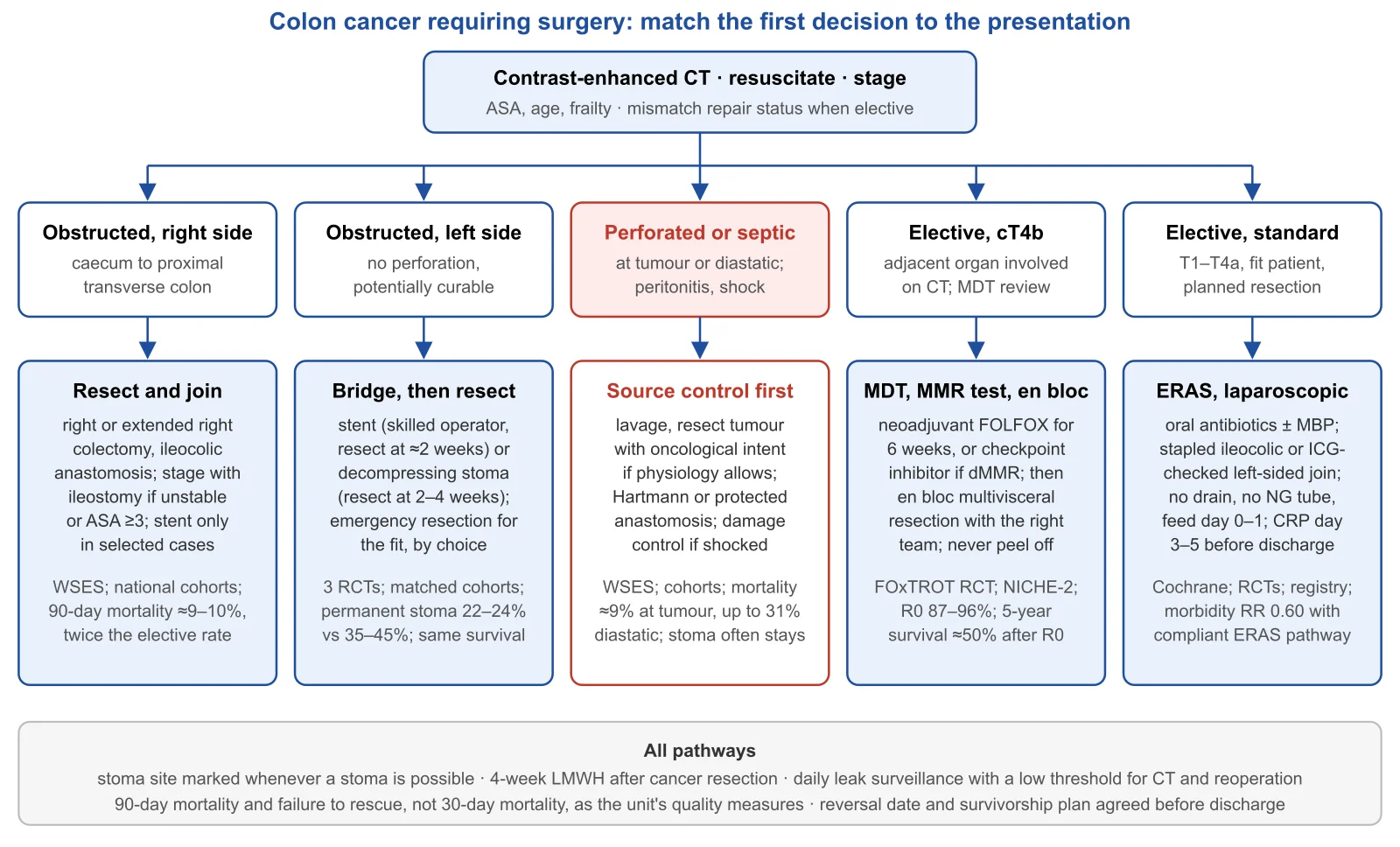
| Scenario | Reasonable options | Evidence and limitations | Recovery and stoma considerations | Findings that change the recommendation |
|---|---|---|---|---|
| Obstructed right-sided or transverse tumour | Right or extended right colectomy with ileocolic anastomosis; staged resection with end ileostomy if unstable or ASA ≥3 | WSES guideline; French cohort of 776 (leak 14%, mortality 10%); no RCT [54,56] | Anastomosis in ≈82%; 90-day mortality twice the elective rate (9.4% vs 4.2%)[72] | Haemodynamic instability, caecal ischaemia → no anastomosis; incurable disease → proximal stent or bypass |
| Obstructed left-sided tumour, potentially curable, no perforation | Stent as bridge (resect ≈2 weeks); decompressing stoma (resect 2–4 weeks); emergency resection in the fit | 3 RCTs and meta-analysis [2,5]; matched national cohorts [3,4]; no RCT of stent vs stoma | Primary anastomosis 70–88% after a bridge vs 41–54% at emergency resection; permanent stoma 22–24% vs 35–45% | Perforation or impending caecal rupture → emergency surgery; no skilled endoscopist → stoma; planned bevacizumab → avoid stent |
| Obstructed, incurable or prohibitive operative risk | Palliative stent; decompressing stoma if stent unsuitable | ESGE strong recommendation; meta-analysis of 4 RCTs [55,63] | Permanent stoma 14% after stent vs 84% after surgery; similar survival | Perforation; stent failure; bevacizumab-containing therapy (perforation 12.5%)[6] |
| Perforation at the tumour, contained | Resection with oncological intent; anastomosis if stable, otherwise Hartmann's or protected anastomosis | Matched cohort and registry data; no RCT [9,10] | Mortality ≈9%; 5-year survival near stage-matched if R0 | Faecal peritonitis, shock, coagulopathy → damage control, no anastomosis [54,69] |
| Diastatic (caecal) perforation with distal tumour | Subtotal colectomy encompassing perforation and tumour; end ileostomy if unstable | Trial of subtotal vs segmental resection; perforation cohorts [8,66] | Mortality up to 31%; subtotal colectomy predicts permanent stoma and frequent stools [12] | Stable patient with limited contamination → ileosigmoid anastomosis; shock → staged |
| Left-sided emergency resection: reconstruction | Primary anastomosis with loop ileostomy in stable, immunocompetent patients younger than about 85; Hartmann's otherwise | RCTs in perforated diverticulitis, transferred [38,39,73,74] | Stoma reversal 90–96% after protected anastomosis vs 47–65% after Hartmann's [11] | Faecal peritonitis, vasopressors, oedematous bowel, inexperienced setting → Hartmann's |
| High-risk anastomosis, elective (male, obese, smoker, steroids, left-sided, transfusion) | Optimise anaemia, nutrition and smoking; oral antibiotic preparation; consider diversion; CRP day 3–5 surveillance | Cohort and registry risk factors; Cochrane and network meta-analysis of bowel preparation [19,20,105] | Leak 4% right to 15% subtotal; mortality after leak 15–16%[94,99] | Rising CRP, tachycardia, ileus → CT; negative CT with sepsis → reoperation [22] |
| Elective cT4b on CT | MDT review, mismatch repair testing; neoadjuvant chemotherapy (FOxTROT) or checkpoint inhibition if dMMR; en bloc multivisceral resection | RCT (FOxTROT), phase II (NICHE-2), systematic reviews of multivisceral resection [32,33,40] | Morbidity 25–42%, mortality 4–7%; 5-year survival ≈50% after R0; organ-specific risks (urinary diversion, pancreatic fistula)[29,153,157] | CT overstaging (≈33%) → senior radiology review before extended resection; pMMR with limited gain → discuss modest benefit |
| Temporary stoma in place after resection | Loop ileostomy closure after leak excluded by imaging, during adjuvant chemotherapy if needed; mesh reinforcement at closure | RCT (EASY) and meta-analysis with conflicting findings; ROCSS RCT [28,142,143] | Dehydration readmission ≈17%; incisional hernia at closure site 30% without mesh | Any sign of leak → delay closure; Hartmann colostomy → counsel that about half are never reversed |
| After discharge, stage II–III | Moderate surveillance (CEA, annual CT, colonoscopy at 1 year); structured exercise; aspirin only in PI3K-altered tumours within trial-derived criteria | RCTs of follow-up intensity; CHALLENGE; ALASCCA [36,37,225] | Bowel function and stoma dominate quality of life; return to work delayed by stoma and complications [213,227] | Watery diarrhoea after right-sided resection → test or treat for bile acid diarrhoea [210] |
This matrix supports shared decision-making; it does not prescribe treatment for an individual without clinical examination.
Conclusions
- Non-elective colon cancer surgery carries two to three times the mortality of elective surgery, and the excess is driven by physiology and frailty rather than by the anastomosis; converting an emergency into an elective operation is the most effective single intervention available [1,4,72].
- For left-sided obstruction without perforation, a stent or a decompressing stoma as a bridge halves the permanent stoma rate with no measurable loss of 3-year oncological outcome; the choice between them depends on local expertise and the patient's tolerance of a temporary stoma [2,3,7].
- Perforated cancer is treated by source control and, whenever physiology allows, oncological resection; survivors of an R0 resection approach stage-matched survival, so the elective standard should be applied once the patient is stable [9,10].
- Hartmann's procedure remains the safe default in the unstable or septic patient, but about half of such stomas are never reversed; primary anastomosis with diverting ileostomy is reasonable in stable, immunocompetent patients and leads to stoma reversal in 90–96%[11,38,39].
- Leak prevention rests on a bundle rather than a single device: oral antibiotic preparation, correction of anaemia and nutrition, a tension-free well-perfused anastomosis (with indocyanine green assessment for left-sided joins), no routine drains, and selective diversion; detection rests on day 3–5 C-reactive protein, a low threshold for CT and a lower one for reoperation when imaging and physiology disagree [16,19,21,22].
- Every patient who may receive a stoma should be marked and counselled beforehand, warned about dehydration after ileostomy, offered an early reversal plan once leakage is excluded, and given mesh reinforcement at closure; prophylactic mesh at end colostomy is a discussion, not a default [23–25,28].
- An adhesion to an adjacent organ is resected en bloc without exception, and radiologically locally advanced disease should now be discussed for neoadjuvant chemotherapy, or immunotherapy when mismatch repair-deficient, before the operation is planned [31–33].
- Enhanced recovery reduces medical complications and stay in proportion to compliance; after discharge, intensive surveillance does not prolong survival but structured exercise does, and survivorship care should address bowel function, stoma, work and fear of recurrence as deliberately as it addresses recurrence itself [34–37].
Appendix A. Verification Notes and Limitations of This Review
- Bakker IS, Snijders HS, Grossmann I, Karsten TM, Havenga K, Wiggers T, et al. High mortality rates after nonelective colon cancer resection: results of a national audit. Colorectal Dis. 2016;18(6):612-21. doi:10.1111/codi.13262. PMID: 26749028.
- Arezzo A, Passera R, Lo Secco G, Verra M, Bonino MA, Targarona E, et al. Stent as bridge to surgery for left-sided malignant colonic obstruction reduces adverse events and stoma rate compared with emergency surgery: results of a systematic review and meta-analysis of randomized controlled trials. Gastrointest Endosc. 2017;86(3):416-26. doi:10.1016/j.gie.2017.03.1542. PMID: 28392363.
- Amelung FJ, Borstlap WAA, Consten ECJ, Veld JV, van Halsema EE, Bemelman WA, et al. Propensity score-matched analysis of oncological outcome between stent as bridge to surgery and emergency resection in patients with malignant left-sided colonic obstruction. Br J Surg. 2019;106(8):1075-86. doi:10.1002/bjs.11172. PMID: 31074507.
- Veld JV, Amelung FJ, Borstlap WAA, van Halsema EE, Consten ECJ, Dekker JWT, et al. Decompressing stoma as bridge to elective surgery is an effective strategy for left-sided obstructive colon cancer: a national, propensity-score matched study. Ann Surg. 2020;272(5):738-43. doi:10.1097/SLA.0000000000004173. PMID: 32833768.
- CReST Collaborative Group. Colorectal Endoscopic Stenting Trial (CReST) for obstructing left-sided colorectal cancer: randomized clinical trial. Br J Surg. 2022;109(11):1073-80. doi:10.1093/bjs/znac141. PMID: 35986684.
- van Halsema EE, van Hooft JE, Small AJ, Baron TH, García-Cano J, Cheon JH, et al. Perforation in colorectal stenting: a meta-analysis and a search for risk factors. Gastrointest Endosc. 2014;79(6):970-82.e7. doi:10.1016/j.gie.2013.11.038. PMID: 24650852.
- Veld JV, Amelung FJ, Borstlap WAA, van Halsema EE, Consten ECJ, Siersema PD, et al. Comparison of decompressing stoma vs stent as a bridge to surgery for left-sided obstructive colon cancer. JAMA Surg. 2020;155(3):206-15. doi:10.1001/jamasurg.2019.5466. PMID: 31913422.
- Chen HS, Sheen-Chen SM. Obstruction and perforation in colorectal adenocarcinoma: an analysis of prognosis and current trends. Surgery. 2000;127(4):370-6. doi:10.1067/msy.2000.104674. PMID: 10776426.
- Zielinski MD, Merchea A, Heller SF, You YN. Emergency management of perforated colon cancers: how aggressive should we be? J Gastrointest Surg. 2011;15(12):2232-8. doi:10.1007/s11605-011-1674-8. PMID: 21913040.
- Daniels M, Merkel S, Agaimy A, Hohenberger W. Treatment of perforated colon carcinomas-outcomes of radical surgery. Int J Colorectal Dis. 2015;30(11):1505-13. doi:10.1007/s00384-015-2336-1. PMID: 26248792.
- Hallam S, Mothe BS, Tirumulaju R. Hartmann's procedure, reversal and rate of stoma-free survival. Ann R Coll Surg Engl. 2018;100(4):301-307. doi:10.1308/rcsann.2018.0006. PMID: 29484943.
- Zamaray B, Veld JV, Burghgraef TA, Brohet R, van Westreenen HL, van Hooft JE, et al. Risk factors for a permanent stoma after resection of left-sided obstructive colon cancer - a prediction model. Eur J Surg Oncol. 2023;49(4):738-46. doi:10.1016/j.ejso.2022.12.008. PMID: 36641294.
- Choy PY, Bissett IP, Docherty JG, Parry BR, Merrie A, Fitzgerald A. Stapled versus handsewn methods for ileocolic anastomoses. Cochrane Database Syst Rev. 2011;(9):CD004320. doi:10.1002/14651858.CD004320.pub3. PMID: 21901690.
- Zhang H, Sun N, Fu Y, Zhao C. Intracorporeal versus extracorporeal anastomosis in laparoscopic right colectomy: updated meta-analysis of randomized controlled trials. BJS Open. 2021;5(6):zrab133. doi:10.1093/bjsopen/zrab133. PMID: 34964826.
- Gómez Ruiz M; MIRCAST study group. Relationship between anastomotic technique, incisional hernia, and quality of life: the Minimally Invasive Right Colectomy Anastomosis STudy (MIRCAST). Br J Surg. 2025;112(12):znaf250. doi:10.1093/bjs/znaf250. PMID: 41355692.
- Maroli A, Paoluzzi Tomada E, Foppa C, Carvello M, Ris F, Hompes R, et al. Indocyanine green fluorescence to prevent anastomotic leak in colorectal surgery: an updated systematic review and meta-analysis of randomized controlled trials. Surg Endosc. 2026;40(3):1815-27. doi:10.1007/s00464-026-12592-0. PMID: 41611909.
- Faber RA, Meijer RPJ, Droogh DHM, Jongbloed JJ, Bijlstra OD, Boersma F, et al. Indocyanine green near-infrared fluorescence bowel perfusion assessment to prevent anastomotic leakage in minimally invasive colorectal surgery (AVOID): a multicentre, randomised, controlled, phase 3 trial. Lancet Gastroenterol Hepatol. 2024;9(10):924-34. doi:10.1016/S2468-1253(24)00198-5. PMID: 39151436.
- Jesus EC, Karliczek A, Matos D, Castro AA, Atallah AN. Prophylactic anastomotic drainage for colorectal surgery. Cochrane Database Syst Rev. 2004;2004(4):CD002100. doi:10.1002/14651858.CD002100.pub2. PMID: 15495028.
- Willis MA, Toews I, Soltau SL, Kalff JC, Meerpohl JJ, Vilz TO. Preoperative combined mechanical and oral antibiotic bowel preparation for preventing complications in elective colorectal surgery. Cochrane Database Syst Rev. 2023;2(2):CD014909. doi:10.1002/14651858.CD014909.pub2. PMID: 36748942.
- Tan J, Ryan EJ, Davey MG, McHugh FT, Creavin B, Whelan MC, et al. Mechanical bowel preparation and antibiotics in elective colorectal surgery: network meta-analysis. BJS Open. 2023;7(3):zrad040. doi:10.1093/bjsopen/zrad040. PMID: 37257059.
- Singh PP, Zeng IS, Srinivasa S, Lemanu DP, Connolly AB, Hill AG. Systematic review and meta-analysis of use of serum C-reactive protein levels to predict anastomotic leak after colorectal surgery. Br J Surg. 2014;101(4):339-46. doi:10.1002/bjs.9354. PMID: 24311257.
- Marres CCM, van de Ven AWH, Leijssen LGJ, Verbeek PCM, Bemelman WA, Buskens CJ. Colorectal anastomotic leak: delay in reintervention after false-negative computed tomography scan is a reason for concern. Tech Coloproctol. 2017;21(9):709-14. doi:10.1007/s10151-017-1689-6. PMID: 28929306.
- Ambe PC, Kugler CM, Breuing J, Grohmann E, Friedel J, Hess S, et al. The effect of preoperative stoma site marking on risk of stoma-related complications in patients with intestinal ostomy: a systematic review and meta-analysis. Colorectal Dis. 2022;24(8):904-917. doi:10.1111/codi.16118. PMID: 35297146.
- Messaris E, Sehgal R, Deiling S, Koltun WA, Stewart D, McKenna K, et al. Dehydration is the most common indication for readmission after diverting ileostomy creation. Dis Colon Rectum. 2012;55(2):175-180. doi:10.1097/DCR.0b013e31823d0ec5. PMID: 22228161.
- Jones HG, Rees M, Aboumarzouk OM, Brown J, Cragg J, Billings P, et al. Prosthetic mesh placement for the prevention of parastomal herniation. Cochrane Database Syst Rev. 2018;7:CD008905. doi:10.1002/14651858.CD008905.pub3. PMID: 30027652.
- Odensten C, Strigård K, Rutegård J, Dahlberg M, Ståhle U, Gunnarsson U, et al. Use of prophylactic mesh when creating a colostomy does not prevent parastomal hernia: a randomized controlled trial-STOMAMESH. Ann Surg. 2019;269(3):427-431. doi:10.1097/SLA.0000000000002542. PMID: 29064900.
- Prudhomme M, Rullier E, Lakkis Z, Cotte E, Panis Y, Meunier B, et al. End colostomy with or without mesh to prevent a parastomal hernia (GRECCAR 7): a prospective, randomized, double blinded, multicentre trial. Ann Surg. 2021;274(6):928-934. doi:10.1097/SLA.0000000000004371. PMID: 33201089.
- Reinforcement of Closure of Stoma Site (ROCSS) Collaborative and West Midlands Research Collaborative. Prophylactic biological mesh reinforcement versus standard closure of stoma site (ROCSS): a multicentre, randomised controlled trial. Lancet. 2020;395(10222):417-426. doi:10.1016/S0140-6736(19)32637-6. PMID: 32035551.
- Lehnert T, Methner M, Pollok A, Schaible A, Hinz U, Herfarth C. Multivisceral resection for locally advanced primary colon and rectal cancer: an analysis of prognostic factors in 201 patients. Ann Surg. 2002;235(2):217-225. doi:10.1097/00000658-200202000-00009. PMID: 11807361.
- Gebhardt C, Meyer W, Ruckriegel S, Meier U. Multivisceral resection of advanced colorectal carcinoma. Langenbecks Arch Surg. 1999;384(2):194-199. doi:10.1007/s004230050191. PMID: 10328174.
- Hunter JA, Ryan JA Jr, Schultz P. En bloc resection of colon cancer adherent to other organs. Am J Surg. 1987;154(1):67-71. doi:10.1016/0002-9610(87)90292-3. PMID: 2440334.
- Morton D, Seymour M, Magill L, Handley K, Glasbey J, Glimelius B, et al. Preoperative chemotherapy for operable colon cancer: mature results of an international randomized controlled trial. J Clin Oncol. 2023;41(8):1541-1552. doi:10.1200/JCO.22.00046. PMID: 36657089.
- Chalabi M, Verschoor YL, Tan PB, Balduzzi S, Van Lent AU, Grootscholten C, et al. Neoadjuvant immunotherapy in locally advanced mismatch repair-deficient colon cancer. N Engl J Med. 2024;390(21):1949-1958. doi:10.1056/NEJMoa2400634. PMID: 38838311.
- Greco M, Capretti G, Beretta L, Gemma M, Pecorelli N, Braga M. Enhanced recovery program in colorectal surgery: a meta-analysis of randomized controlled trials. World J Surg. 2014;38(6):1531-41. doi:10.1007/s00268-013-2416-8. PMID: 24368573.
- ERAS Compliance Group. The impact of enhanced recovery protocol compliance on elective colorectal cancer resection: results from an international registry. Ann Surg. 2015;261(6):1153-9. doi:10.1097/SLA.0000000000001029. PMID: 25671587.
- Jeffery M, Hickey BE, Hider PN. Follow-up strategies for patients treated for non-metastatic colorectal cancer. Cochrane Database Syst Rev. 2019;(9):CD002200. doi:10.1002/14651858.CD002200.pub4. PMID: 31483854.
- Courneya KS, Vardy JL, O'Callaghan CJ, et al. Structured exercise after adjuvant chemotherapy for colon cancer. N Engl J Med. 2025;393(1):13-25. doi:10.1056/NEJMoa2502760. PMID: 40450658.
- Lambrichts DPV, Vennix S, Musters GD, Mulder IM, Swank HA, Hoofwijk AGM, et al. Hartmann's procedure versus sigmoidectomy with primary anastomosis for perforated diverticulitis with purulent or faecal peritonitis (LADIES): a multicentre, parallel-group, randomised, open-label, superiority trial. Lancet Gastroenterol Hepatol. 2019;4(8):599-610. doi:10.1016/S2468-1253(19)30174-8. PMID: 31178342.
- Acuna SA, Wood T, Chesney TR, Dossa F, Wexner SD, Quereshy FA, et al. Operative strategies for perforated diverticulitis: a systematic review and meta-analysis. Dis Colon Rectum. 2018;61(12):1442-53. doi:10.1097/DCR.0000000000001149. PMID: 30371549.
- Mohan HM, Evans MD, Larkin JO, Beynon J, Winter DC. Multivisceral resection in colorectal cancer: a systematic review. Ann Surg Oncol. 2013;20(9):2929-2936. doi:10.1245/s10434-013-2967-9. PMID: 23666095.
- Klaver CE, Gietelink L, Bemelman WA, Wouters MW, Wiggers T, Tollenaar RA, et al. Locally advanced colon cancer: evaluation of current clinical practice and treatment outcomes at the population level. J Natl Compr Canc Netw. 2017;15(2):181-190. doi:10.6004/jnccn.2017.0019. PMID: 28188188.
- Veld JV, Beek KJ, Consten ECJ, Ter Borg F, van Westreenen HL, Bemelman WA, et al. Definition of large bowel obstruction by primary colorectal cancer: a systematic review. Colorectal Dis. 2021;23(4):787-804. doi:10.1111/codi.15479. PMID: 33305454.
- Rahbari NN, Weitz J, Hohenberger W, Heald RJ, Moran B, Ulrich A, et al. Definition and grading of anastomotic leakage following anterior resection of the rectum: a proposal by the International Study Group of Rectal Cancer. Surgery. 2010;147(3):339-51. doi:10.1016/j.surg.2009.10.012. PMID: 20004450.
- Baker ML, Williams RN, Nightingale JM. Causes and management of a high-output stoma. Colorectal Dis. 2011;13(2):191-197. doi:10.1111/j.1463-1318.2009.02107.x. PMID: 19888956.
- Carne PW, Robertson GM, Frizelle FA. Parastomal hernia. Br J Surg. 2003;90(7):784-793. doi:10.1002/bjs.4220. PMID: 12854101.
- Weiser MR. AJCC 8th edition: colorectal cancer. Ann Surg Oncol. 2018;25(6):1454-1455. doi:10.1245/s10434-018-6462-1. PMID: 29616422.
- Gustafsson UO, Scott MJ, Hubner M, et al. Guidelines for perioperative care in elective colorectal surgery: Enhanced Recovery After Surgery (ERAS) Society recommendations 2025. Surgery. 2025;184:109397. doi:10.1016/j.surg.2025.109397. PMID: 40783294.
- Dindo D, Demartines N, Clavien PA. Classification of surgical complications: a new proposal with evaluation in a cohort of 6336 patients and results of a survey. Ann Surg. 2004;240(2):205-13. doi:10.1097/01.sla.0000133083.54934.ae. PMID: 15273542.
- Slankamenac K, Graf R, Barkun J, Puhan MA, Clavien PA. The comprehensive complication index: a novel continuous scale to measure surgical morbidity. Ann Surg. 2013;258(1):1-7. doi:10.1097/SLA.0b013e318296c732. PMID: 23728278.
- Henneman D, Snijders HS, Fiocco M, van Leersum NJ, Kolfschoten NE, Wiggers T, et al. Hospital variation in failure to rescue after colorectal cancer surgery: results of the Dutch Surgical Colorectal Audit. Ann Surg Oncol. 2013;20(7):2117-23. doi:10.1245/s10434-013-2896-7. PMID: 23417434.
- Ghaferi AA, Birkmeyer JD, Dimick JB. Variation in hospital mortality associated with inpatient surgery. N Engl J Med. 2009;361(14):1368-75. doi:10.1056/NEJMsa0903048. PMID: 19797283.
- Tekkis PP, Kinsman R, Thompson MR, Stamatakis JD; Association of Coloproctology of Great Britain and Ireland. The Association of Coloproctology of Great Britain and Ireland study of large bowel obstruction caused by colorectal cancer. Ann Surg. 2004;240(1):76-81. doi:10.1097/01.sla.0000130723.81866.75. PMID: 15213621.
- Burghgraef TA, Bakker IS, Veld JV, Wijsmuller AR, Amelung FJ, Bemelman WA, et al. Predicting mortality within 90 days of first intervention in patients with left-sided obstructive colon cancer. Dis Colon Rectum. 2023;66(10):1309-18. doi:10.1097/DCR.0000000000002382. PMID: 35522790.
- Pisano M, Zorcolo L, Merli C, Cimbanassi S, Poiasina E, Ceresoli M, et al. 2017 WSES guidelines on colon and rectal cancer emergencies: obstruction and perforation. World J Emerg Surg. 2018;13:36. doi:10.1186/s13017-018-0192-3. PMID: 30123315.
- van Hooft JE, Veld JV, Arnold D, Beets-Tan RGH, Everett S, Götz M, et al. Self-expandable metal stents for obstructing colonic and extracolonic cancer: European Society of Gastrointestinal Endoscopy (ESGE) Guideline - Update 2020. Endoscopy. 2020;52(5):389-407. doi:10.1055/a-1140-3017. PMID: 32259849.
- Mege D, Manceau G, Beyer-Berjot L, Bridoux V, Lakkis Z, Venara A, et al. Surgical management of obstructive right-sided colon cancer at a national level: results of a multicenter study of the French Surgical Association in 776 patients. Eur J Surg Oncol. 2018;44(10):1522-31. doi:10.1016/j.ejso.2018.06.027. PMID: 30041941.
- van Hooft JE, Bemelman WA, Oldenburg B, Marinelli AW, Lutke Holzik MF, Grubben MJ, et al. Colonic stenting versus emergency surgery for acute left-sided malignant colonic obstruction: a multicentre randomised trial. Lancet Oncol. 2011;12(4):344-52. doi:10.1016/S1470-2045(11)70035-3. PMID: 21398178.
- Arezzo A, Balague C, Targarona E, Borghi F, Giraudo G, Ghezzo L, et al. Colonic stenting as a bridge to surgery versus emergency surgery for malignant colonic obstruction: results of a multicentre randomised controlled trial (ESCO trial). Surg Endosc. 2017;31(8):3297-305. doi:10.1007/s00464-016-5362-3. PMID: 27924392.
- Spannenburg L, Sanchez Gonzalez M, Brooks A, Wei S, Li X, Liang X, et al. Surgical outcomes of colonic stents as a bridge to surgery versus emergency surgery for malignant colorectal obstruction: a systematic review and meta-analysis of high quality prospective and randomised controlled trials. Eur J Surg Oncol. 2020;46(8):1404-14. doi:10.1016/j.ejso.2020.04.052. PMID: 32418754.
- Sloothaak DA, van den Berg MW, Dijkgraaf MG, Fockens P, Tanis PJ, van Hooft JE, et al. Oncological outcome of malignant colonic obstruction in the Dutch Stent-In 2 trial. Br J Surg. 2014;101(13):1751-7. doi:10.1002/bjs.9645. PMID: 25298250.
- Gorissen KJ, Tuynman JB, Fryer E, Wang L, Uberoi R, Jones OM, et al. Local recurrence after stenting for obstructing left-sided colonic cancer. Br J Surg. 2013;100(13):1805-9. doi:10.1002/bjs.9297. PMID: 24227368.
- Veld JV, Kumcu A, Amelung FJ, Borstlap WAA, Consten ECJ, Dekker JWT, et al. Time interval between self-expandable metal stent placement or creation of a decompressing stoma and elective resection of left-sided obstructive colon cancer. Endoscopy. 2021;53(9):905-13. doi:10.1055/a-1308-1487. PMID: 33339059.
- Ribeiro IB, Bernardo WM, Martins BDC, de Moura DTH, Baba ER, Josino IR, et al. Colonic stent versus emergency surgery as treatment of malignant colonic obstruction in the palliative setting: a systematic review and meta-analysis. Endosc Int Open. 2018;6(5):E558-67. doi:10.1055/a-0591-2883. PMID: 29756013.
- Amelung FJ, Mulder CL, Verheijen PM, Draaisma WA, Siersema PD, Consten EC. Acute resection versus bridge to surgery with diverting colostomy for patients with acute malignant left sided colonic obstruction: systematic review and meta-analysis. Surg Oncol. 2015;24(4):313-21. doi:10.1016/j.suronc.2015.10.003. PMID: 26690820.
- Veld JV, Amelung FJ, Borstlap WAA, van Halsema EE, Consten ECJ, Siersema PD, et al. Changes in management of left-sided obstructive colon cancer: national practice and guideline implementation. J Natl Compr Canc Netw. 2019;17(12):1512-20. doi:10.6004/jnccn.2019.7326. PMID: 31805533.
- The SCOTIA Study Group. Single-stage treatment for malignant left-sided colonic obstruction: a prospective randomized clinical trial comparing subtotal colectomy with segmental resection following intraoperative irrigation. Br J Surg. 1995;82(12):1622-7. doi:10.1002/bjs.1800821211. PMID: 8548221.
- Vogel JD, Felder SI, Bhama AR, Hawkins AT, Langenfeld SJ, Shaffer VO, et al. The American Society of Colon and Rectal Surgeons Clinical Practice Guidelines for the Management of Colon Cancer. Dis Colon Rectum. 2022;65(2):148-77. doi:10.1097/DCR.0000000000002323. PMID: 34775402.
- Honoré C, Goéré D, Souadka A, Dumont F, Elias D. Definition of patients presenting a high risk of developing peritoneal carcinomatosis after curative surgery for colorectal cancer: a systematic review. Ann Surg Oncol. 2013;20(1):183-92. doi:10.1245/s10434-012-2473-5. PMID: 23090572.
- Coccolini F, Roberts D, Ansaloni L, Ivatury R, Gamberini E, Kluger Y, et al. The open abdomen in trauma and non-trauma patients: WSES guidelines. World J Emerg Surg. 2018;13:7. doi:10.1186/s13017-018-0167-4. PMID: 29434652.
- van Ruler O, Mahler CW, Boer KR, Reuland EA, Gooszen HG, Opmeer BC, et al. Comparison of on-demand vs planned relaparotomy strategy in patients with severe peritonitis: a randomized trial. JAMA. 2007;298(8):865-72. doi:10.1001/jama.298.8.865. PMID: 17712070.
- Tekkis PP, Poloniecki JD, Thompson MR, Stamatakis JD. Operative mortality in colorectal cancer: prospective national study. BMJ. 2003;327(7425):1196-201. doi:10.1136/bmj.327.7425.1196. PMID: 14630754.
- Kertzman BAJ, Amelung FJ, Burghgraef TA, Consten ECJ, Draaisma WA. Outcomes after elective versus emergency resection for right-sided colon cancer: a propensity score-matched analysis. Dis Colon Rectum. 2025;68(6):753-63. doi:10.1097/DCR.0000000000003680. PMID: 40418694.
- Oberkofler CE, Rickenbacher A, Raptis DA, Lehmann K, Villiger P, Buchli C, et al. A multicenter randomized clinical trial of primary anastomosis or Hartmann's procedure for perforated left colonic diverticulitis with purulent or fecal peritonitis. Ann Surg. 2012;256(5):819-26. doi:10.1097/SLA.0b013e31827324ba. PMID: 23095627.
- Bridoux V, Regimbeau JM, Ouaissi M, Mathonnet M, Mauvais F, Houivet E, et al. Hartmann's procedure or primary anastomosis for generalized peritonitis due to perforated diverticulitis: a prospective multicenter randomized trial (DIVERTI). J Am Coll Surg. 2017;225(6):798-805. doi:10.1016/j.jamcollsurg.2017.09.004. PMID: 28943323.
- Harji DP, Griffiths B, Burke D, Sagar PM. Systematic review of emergency laparoscopic colorectal resection. Br J Surg. 2014;101(1):e126-33. doi:10.1002/bjs.9348. PMID: 24285040.
- Warps AK, Zwanenburg ES, Dekker JWT, Tollenaar RAEM, Bemelman WA, Hompes R, et al. Laparoscopic versus open colorectal surgery in the emergency setting: a systematic review and meta-analysis. Ann Surg Open. 2021;2(3):e097. doi:10.1097/AS9.0000000000000097. PMID: 37635817.
- Zwanenburg ES, Veld JV, Amelung FJ, Borstlap WAA, Dekker JWT, Hompes R, et al. Short- and long-term outcomes after laparoscopic emergency resection of left-sided obstructive colon cancer: a nationwide propensity score-matched analysis. Dis Colon Rectum. 2023;66(6):774-84. doi:10.1097/DCR.0000000000002364. PMID: 35522731.
- Simon HL, Reif de Paula T, Profeta da Luz MM, Nemeth SK, Moug SJ, Keller DS. Frailty in older patients undergoing emergency colorectal surgery: USA National Surgical Quality Improvement Program analysis. Br J Surg. 2020;107(10):1363-71. doi:10.1002/bjs.11770. PMID: 32639045.
- Dekker JW, van den Broek CB, Bastiaannet E, van de Geest LG, Tollenaar RA, Liefers GJ. Importance of the first postoperative year in the prognosis of elderly colorectal cancer patients. Ann Surg Oncol. 2011;18(6):1533-9. doi:10.1245/s10434-011-1671-x. PMID: 21445672.
- Ibáñez N, Abrisqueta J, Luján J, Hernández Q, Rufete MD, Parrilla P. Isoperistaltic versus antiperistaltic ileocolic anastomosis. Does it really matter? Results from a randomised clinical trial (ISOVANTI). Surg Endosc. 2019;33(9):2850-7. doi:10.1007/s00464-018-6580-7. PMID: 30426254.
- Dohrn N, Yikilmaz H, Laursen M, Khesrawi F, Clausen FB, Sørensen F, et al. Intracorporeal versus extracorporeal anastomosis in robotic right colectomy: a multicenter, triple-blind, randomized clinical trial. Ann Surg. 2022;276(5):e294-e301. doi:10.1097/SLA.0000000000005254. PMID: 35129520.
- Gómez Ruiz M, Espin-Basany E, Spinelli A, Cagigas Fernández C, Bollo Rodriguez J, Enriquez Navascues JM, et al. Early outcomes from the Minimally Invasive Right Colectomy Anastomosis study (MIRCAST). Br J Surg. 2023;110(9):1153-60. doi:10.1093/bjs/znad077. PMID: 37289913.
- Perivoliotis K, Tzovaras G, Tepetes K, Baloyiannis I. Comparison of intracorporeal and extracorporeal anastomosis in laparoscopic right colectomy: an updated meta-analysis and trial sequential analysis. Updates Surg. 2024;76(2):375-96. doi:10.1007/s13304-023-01737-8. PMID: 38216794.
- Wu S, Wei P, Gao J, Shu W, Zhao H, Bonjer H, et al. COLOR IV: a multicenter randomized clinical trial comparing intracorporeal and extracorporeal ileocolic anastomosis after laparoscopic right colectomy for colon cancer. Surg Endosc. 2025;39(2):1182-90. doi:10.1007/s00464-024-11412-7. PMID: 39733171.
- Mari GM, Crippa J, Cocozza E, Berselli M, Livraghi L, Carzaniga P, et al. Low ligation of inferior mesenteric artery in laparoscopic anterior resection for rectal cancer reduces genitourinary dysfunction: results from a randomized controlled trial (HIGHLOW trial). Ann Surg. 2019;269(6):1018-24. doi:10.1097/SLA.0000000000002947. PMID: 31082897.
- Mari G, Santambrogio G, Crippa J, Cirocchi R, Origi M, Achilli P, et al. 5 year oncological outcomes of the HIGHLOW randomized clinical trial. Eur J Surg Oncol. 2023;49(3):641-6. doi:10.1016/j.ejso.2022.10.017. PMID: 36335077.
- Emile SH, Dourado J, Rogers P, Horesh N, Garoufalia Z, Gefen R, et al. Splenic flexure mobilization in left-sided colonic and rectal resections: a meta-analysis and meta-regression of factors associated with anastomotic leak and operative time. Colorectal Dis. 2024;26(7):1332-45. doi:10.1111/codi.16983. PMID: 38757843.
- Jafari MD, Pigazzi A, McLemore EC, Mutch MG, Haas E, Rasheid SH, et al. Perfusion assessment in left-sided/low anterior resection (PILLAR III): a randomized, controlled, parallel, multicenter study assessing perfusion outcomes with PINPOINT near-infrared fluorescence imaging in low anterior resection. Dis Colon Rectum. 2021;64(8):995-1002. doi:10.1097/DCR.0000000000002007. PMID: 33872284.
- Watanabe J, Takemasa I, Kotake M, Noura S, Kimura K, Suwa H, et al. Blood perfusion assessment by indocyanine green fluorescence imaging for minimally invasive rectal cancer surgery (EssentiAL trial): a randomized clinical trial. Ann Surg. 2023;278(4):e688-e694. doi:10.1097/SLA.0000000000005907. PMID: 37218517.
- Jayne D, Croft J, Corrigan N, Quirke P, Cahill RA, Ainsworth G, et al. Intraoperative fluorescence angiography with indocyanine green to prevent anastomotic leak in rectal cancer surgery (IntAct): an unblinded, multicentre, randomised controlled trial. Lancet Gastroenterol Hepatol. 2025;10(9):806-17. doi:10.1016/S2468-1253(25)00101-3. PMID: 40690925.
- Wu Z, van de Haar RC, Sparreboom CL, Boersema GS, Li Z, Ji J, et al. Is the intraoperative air leak test effective in the prevention of colorectal anastomotic leakage? A systematic review and meta-analysis. Int J Colorectal Dis. 2016;31(8):1409-17. doi:10.1007/s00384-016-2616-4. PMID: 27294661.
- Sahebally SM, Chan E, Azmir A, Lu CT, Doudle M, Naik A. Omentoplasty to reduce anastomotic leak in colorectal surgery: a meta-analysis. ANZ J Surg. 2022;92(7-8):1651-7. doi:10.1111/ans.17553. PMID: 35170188.
- Heuvelings DJI, Mollema O, van Kuijk SMJ, Kimman ML, Boutros M, Francis N, et al. Quality of Reporting on Anastomotic Leaks in Colorectal Cancer Trials: A Systematic Review. Dis Colon Rectum. 2024;67(11):1383-1401. doi:10.1097/DCR.0000000000003475. PMID: 39111814.
- Bakker IS, Grossmann I, Henneman D, Havenga K, Wiggers T. Risk factors for anastomotic leakage and leak-related mortality after colonic cancer surgery in a nationwide audit. Br J Surg. 2014;101(4):424-32. doi:10.1002/bjs.9395. PMID: 24536013.
- Krarup PM, Jorgensen LN, Andreasen AH, Harling H; Danish Colorectal Cancer Group. A nationwide study on anastomotic leakage after colonic cancer surgery. Colorectal Dis. 2012;14(10):e661-7. doi:10.1111/j.1463-1318.2012.03079.x. PMID: 22564292.
- Frasson M, Flor-Lorente B, Rodriguez JL, Granero-Castro P, Hervas D, Alvarez Rico MA, et al. Risk factors for anastomotic leak after colon resection for cancer: multivariate analysis and nomogram from a multicentric, prospective, national study with 3193 patients. Ann Surg. 2015;262(2):321-30. doi:10.1097/SLA.0000000000000973. PMID: 25361221.
- Midura EF, Hanseman D, Davis BR, Atkinson SJ, Abbott DE, Shah SA, et al. Risk factors and consequences of anastomotic leak after colectomy: a national analysis. Dis Colon Rectum. 2015;58(3):333-8. doi:10.1097/DCR.0000000000000249. PMID: 25664712.
- Nikolian VC, Kamdar NS, Regenbogen SE, Morris AM, Byrn JC, Suwanabol PA, et al. Anastomotic leak after colorectal resection: a population-based study of risk factors and hospital variation. Surgery. 2017;161(6):1619-27. doi:10.1016/j.surg.2016.12.033. PMID: 28238345.
- Warps AK, Dekker JWT, Tanis PJ, Tollenaar RAEM. An evaluation of short-term outcomes after reoperations for anastomotic leakage in colon cancer patients. Int J Colorectal Dis. 2022;37(1):113-22. doi:10.1007/s00384-021-03996-6. PMID: 34559290.
- 2015 European Society of Coloproctology collaborating group. The relationship between method of anastomosis and anastomotic failure after right hemicolectomy and ileo-caecal resection: an international snapshot audit. Colorectal Dis. 2017;19(8). doi:10.1111/codi.13646. PMID: 28263043.
- Gao J, Gu X, Pang M, Zhang H, Lian Y, Zhou L, et al. Risk factors for anastomotic leak and postoperative morbidity after right hemicolectomy for colon cancer: results from a prospective, multi-centre, snapshot study in China. Br J Surg. 2024;111(1):znad316. doi:10.1093/bjs/znad316. PMID: 37943801.
- Ha GW, Kim JH, Lee MR. Oncologic impact of anastomotic leakage following colorectal cancer surgery: a systematic review and meta-analysis. Ann Surg Oncol. 2017;24(11):3289-99. doi:10.1245/s10434-017-5881-8. PMID: 28608118.
- Mirnezami A, Mirnezami R, Chandrakumaran K, Sasapu K, Sagar P, Finan P. Increased local recurrence and reduced survival from colorectal cancer following anastomotic leak: systematic review and meta-analysis. Ann Surg. 2011;253(5):890-9. doi:10.1097/SLA.0b013e3182128929. PMID: 21394013.
- Krarup PM, Nordholm-Carstensen A, Jorgensen LN, Harling H. Anastomotic leak increases distant recurrence and long-term mortality after curative resection for colonic cancer: a nationwide cohort study. Ann Surg. 2014;259(5):930-8. doi:10.1097/SLA.0b013e3182a6f2fc. PMID: 24045445.
- McDermott FD, Heeney A, Kelly ME, Steele RJ, Carlson GL, Winter DC. Systematic review of preoperative, intraoperative and postoperative risk factors for colorectal anastomotic leaks. Br J Surg. 2015;102(5):462-79. doi:10.1002/bjs.9697. PMID: 25703524.
- Sorensen LT, Jorgensen T, Kirkeby LT, Skovdal J, Vennits B, Wille-Jorgensen P. Smoking and alcohol abuse are major risk factors for anastomotic leakage in colorectal surgery. Br J Surg. 1999;86(7):927-31. doi:10.1046/j.1365-2168.1999.01165.x. PMID: 10417567.
- Venn ML, Hooper RL, Pampiglione T, Morton DG, Nepogodiev D, Knowles CH. Systematic review of preoperative and intraoperative colorectal anastomotic leak prediction scores (ALPS). BMJ Open. 2023;13(7):e073085. doi:10.1136/bmjopen-2023-073085. PMID: 37463818.
- Litchinko A, Buchs N, Balaphas A, Toso C, Liot E, Meurette G, et al. Score prediction of anastomotic leak in colorectal surgery: a systematic review. Surg Endosc. 2024;38(4):1723-30. doi:10.1007/s00464-024-10705-1. PMID: 38418633.
- Dekker JW, Liefers GJ, de Mol van Otterloo JC, Putter H, Tollenaar RA. Predicting the risk of anastomotic leakage in left-sided colorectal surgery using a colon leakage score. J Surg Res. 2011;166(1):e27-34. doi:10.1016/j.jss.2010.11.004. PMID: 21195424.
- Bilimoria KY, Liu Y, Paruch JL, Zhou L, Kmiecik TE, Ko CY, et al. Development and evaluation of the universal ACS NSQIP surgical risk calculator: a decision aid and informed consent tool for patients and surgeons. J Am Coll Surg. 2013;217(5):833-42.e1-3. doi:10.1016/j.jamcollsurg.2013.07.385. PMID: 24055383.
- Espin Basany E, Solis-Pena A, Pellino G, Kreisler E, Fraccalvieri D, Muinelo-Lorenzo M, et al. Preoperative oral antibiotics and surgical-site infections in colon surgery (ORALEV): a multicentre, single-blind, pragmatic, randomised controlled trial. Lancet Gastroenterol Hepatol. 2020;5(8):729-38. doi:10.1016/S2468-1253(20)30075-3. PMID: 32325012.
- Koskenvuo L, Lehtonen T, Koskensalo S, Rasilainen S, Klintrup K, Ehrlich A, et al. Mechanical and oral antibiotic bowel preparation versus no bowel preparation for elective colectomy (MOBILE): a multicentre, randomised, parallel, single-blinded trial. Lancet. 2019;394(10201):840-8. doi:10.1016/S0140-6736(19)31269-3. PMID: 31402112.
- Koskenvuo L, Lunkka P, Varpe P, Hyoty M, Satokari R, Haapamaki C, et al. Morbidity after mechanical bowel preparation and oral antibiotics prior to rectal resection: the MOBILE2 randomized clinical trial. JAMA Surg. 2024;159(6):606-14. doi:10.1001/jamasurg.2024.0184. PMID: 38506889.
- Abis GSA, Stockmann HBAC, Bonjer HJ, van Veenendaal N, van Doorn-Schepens MLM, Budding AE, et al. Randomized clinical trial of selective decontamination of the digestive tract in elective colorectal cancer surgery (SELECT trial). Br J Surg. 2019;106(4):355-63. doi:10.1002/bjs.11117. PMID: 30802304.
- Gaines S, Shao C, Hyman N, Alverdy JC. Gut microbiome influences on anastomotic leak and recurrence rates following colorectal cancer surgery. Br J Surg. 2018;105(2):e131-41. doi:10.1002/bjs.10760. PMID: 29341151.
- Chadi SA, Fingerhut A, Berho M, DeMeester SR, Fleshman JW, Hyman NH, et al. Emerging trends in the etiology, prevention, and treatment of gastrointestinal anastomotic leakage. J Gastrointest Surg. 2016;20(12):2035-51. doi:10.1007/s11605-016-3255-3. PMID: 27638764.
- Podda M, Di Saverio S, Davies RJ, Atzeni J, Balestra F, Virdis F, et al. Prophylactic intra-abdominal drainage following colorectal anastomoses. A systematic review and meta-analysis of randomized controlled trials. Am J Surg. 2020;219(1):164-74. doi:10.1016/j.amjsurg.2019.05.006. PMID: 31138400.
- Denost Q, Rouanet P, Faucheron JL, Panis Y, Meunier B, Cotte E, et al. To drain or not to drain infraperitoneal anastomosis after rectal excision for cancer: the GRECCAR 5 randomized trial. Ann Surg. 2017;265(3):474-80. doi:10.1097/SLA.0000000000001991. PMID: 27631776.
- Modasi A, Pace D, Godwin M, Smith C, Curtis B. NSAID administration post colorectal surgery increases anastomotic leak rate: systematic review/meta-analysis. Surg Endosc. 2019;33(3):879-85. doi:10.1007/s00464-018-6355-1. PMID: 29998389.
- Hakkarainen TW, Steele SR, Bastaworous A, Dellinger EP, Farrokhi E, Farjah F, et al. Nonsteroidal anti-inflammatory drugs and the risk for anastomotic failure: a report from Washington State's Surgical Care and Outcomes Assessment Program (SCOAP). JAMA Surg. 2015;150(3):223-8. doi:10.1001/jamasurg.2014.2239. PMID: 25607250.
- STARSurg Collaborative. Perioperative nonsteroidal anti-inflammatory drugs (NSAID) administration and acute kidney injury (AKI) in major gastrointestinal surgery: a prospective, multicenter, propensity matched cohort study. Ann Surg. 2022;275(5):904-10. doi:10.1097/SLA.0000000000004314. PMID: 33074883.
- Gustafsson UO, Scott MJ, Hubner M, Nygren J, Demartines N, Francis N, et al. Guidelines for perioperative care in elective colorectal surgery: Enhanced Recovery After Surgery (ERAS) Society recommendations: 2018. World J Surg. 2019;43(3):659-95. doi:10.1007/s00268-018-4844-y. PMID: 30426190.
- Munoz M, Acheson AG, Auerbach M, Besser M, Habler O, Kehlet H, et al. International consensus statement on the peri-operative management of anaemia and iron deficiency. Anaesthesia. 2017;72(2):233-47. doi:10.1111/anae.13773. PMID: 27996086.
- Gessler B, Eriksson O, Angenete E. Diagnosis, treatment, and consequences of anastomotic leakage in colorectal surgery. Int J Colorectal Dis. 2017;32(4):549-56. doi:10.1007/s00384-016-2744-x. PMID: 28070659.
- den Dulk M, Noter SL, Hendriks ER, Brouwers MA, van der Vlies CH, Oostenbroek RJ, et al. Improved diagnosis and treatment of anastomotic leakage after colorectal surgery. Eur J Surg Oncol. 2009;35(4):420-6. doi:10.1016/j.ejso.2008.04.009. PMID: 18585889.
- Giaccaglia V, Salvi PF, Antonelli MS, Nigri G, Pirozzi F, Casagranda B, et al. Procalcitonin reveals early dehiscence in colorectal surgery: the PREDICS study. Ann Surg. 2016;263(5):967-72. doi:10.1097/SLA.0000000000001365. PMID: 26528879.
- Kornmann VN, Treskes N, Hoonhout LH, Bollen TL, van Ramshorst B, Boerma D. Systematic review on the value of CT scanning in the diagnosis of anastomotic leakage after colorectal surgery. Int J Colorectal Dis. 2013;28(4):437-45. doi:10.1007/s00384-012-1623-3. PMID: 23239374.
- Kauv P, Benadjaoud S, Curis E, Boulay-Coletta I, Loriau J, Zins M. Anastomotic leakage after colorectal surgery: diagnostic accuracy of CT. Eur Radiol. 2015;25(12):3543-51. doi:10.1007/s00330-015-3795-z. PMID: 25925357.
- Blumetti J, Chaudhry V, Cintron JR, Park JJ, Marecik S, Harrison JL, et al. Management of anastomotic leak: lessons learned from a large colon and rectal surgery training program. World J Surg. 2014;38(4):985-91. doi:10.1007/s00268-013-2340-y. PMID: 24305917.
- Shalaby M, Emile S, Elfeki H, Sakr A, Wexner SD, Sileri P. Systematic review of endoluminal vacuum-assisted therapy as salvage treatment for rectal anastomotic leakage. BJS Open. 2019;3(2):153-60. doi:10.1002/bjs5.50124. PMID: 30957061.
- Almoudaris AM, Burns EM, Mamidanna R, Bottle A, Aylin P, Vincent C, et al. Value of failure to rescue as a marker of the standard of care following reoperation for complications after colorectal resection. Br J Surg. 2011;98(12):1775-83. doi:10.1002/bjs.7648. PMID: 22034183.
- Wound, Ostomy, and Continence Nurses Society, American Urological Association, American Society of Colon and Rectal Surgeons. WOCN Society, AUA, and ASCRS position statement on preoperative stoma site marking for patients undergoing ostomy surgery. J Wound Ostomy Continence Nurs. 2021;48(6):533-536. doi:10.1097/WON.0000000000000820. PMID: 34781309.
- Davis BR, Valente MA, Goldberg JE, Lightner AL, Feingold DL, Paquette IM. The American Society of Colon and Rectal Surgeons clinical practice guidelines for ostomy surgery. Dis Colon Rectum. 2022;65(10):1173-1190. doi:10.1097/DCR.0000000000002498. PMID: 35616386.
- Person B, Ifargan R, Lachter J, Duek SD, Kluger Y, Assalia A. The impact of preoperative stoma site marking on the incidence of complications, quality of life, and patient's independence. Dis Colon Rectum. 2012;55(7):783-787. doi:10.1097/DCR.0b013e31825763f0. PMID: 22706131.
- Güenaga KF, Lustosa SA, Saad SS, Saconato H, Matos D. Ileostomy or colostomy for temporary decompression of colorectal anastomosis. Cochrane Database Syst Rev. 2007;(1):CD004647. doi:10.1002/14651858.CD004647.pub2. PMID: 17253517.
- Rondelli F, Reboldi P, Rulli A, Barberini F, Guerrisi A, Izzo L, et al. Loop ileostomy versus loop colostomy for fecal diversion after colorectal or coloanal anastomosis: a meta-analysis. Int J Colorectal Dis. 2009;24(5):479-488. doi:10.1007/s00384-009-0662-x. PMID: 19219439.
- Paquette IM, Solan P, Rafferty JF, Ferguson MA, Davis BR. Readmission for dehydration or renal failure after ileostomy creation. Dis Colon Rectum. 2013;56(8):974-979. doi:10.1097/DCR.0b013e31828d02ba. PMID: 23838866.
- Bhangu A, Nepogodiev D, Futaba K; West Midlands Research Collaborative. Systematic review and meta-analysis of the incidence of incisional hernia at the site of stoma closure. World J Surg. 2012;36(5):973-983. doi:10.1007/s00268-012-1474-7. PMID: 22362042.
- Dellafiore F, Caruso R, Bonavina L, Udugampolage NS, Villa G, Russo S, et al. Risk factors and pooled incidence of intestinal stoma complications: systematic review and meta-analysis. Curr Med Res Opin. 2022;38(7):1103-1113. doi:10.1080/03007995.2022.2081455. PMID: 35608158.
- Brandsma HT, Hansson BM, Aufenacker TJ, van Geldere D, Lammeren FM, Mahabier C, et al. Prophylactic mesh placement during formation of an end-colostomy reduces the rate of parastomal hernia: short-term results of the Dutch PREVENT-trial. Ann Surg. 2017;265(4):663-669. doi:10.1097/SLA.0000000000001903. PMID: 27471840.
- Antoniou SA, Agresta F, Garcia Alamino JM, Berger D, Berrevoet F, Brandsma HT, et al. European Hernia Society guidelines on prevention and treatment of parastomal hernias. Hernia. 2018;22(1):183-198. doi:10.1007/s10029-017-1697-5. PMID: 29134456.
- Danielsen AK, Park J, Jansen JE, Bock D, Skullman S, Wedin A, et al. Early closure of a temporary ileostomy in patients with rectal cancer: a multicenter randomized controlled trial. Ann Surg. 2017;265(2):284-290. doi:10.1097/SLA.0000000000001829. PMID: 27322187.
- Emile SH, Horesh N, Garoufalia Z, Gefen R, Ray-Offor E, Wexner SD. Outcomes of early versus standard closure of diverting ileostomy after proctectomy: meta-analysis and meta-regression analysis of randomized controlled trials. Ann Surg. 2024;279(4):613-619. doi:10.1097/SLA.0000000000006109. PMID: 37788345.
- Hajibandeh S, Hajibandeh S, Sarma DR, East J, Zaman S, Mankotia R, et al. Meta-analysis of temporary loop ileostomy closure during or after adjuvant chemotherapy following rectal cancer resection: the dilemma remains. Int J Colorectal Dis. 2019;34(7):1151-1159. doi:10.1007/s00384-019-03321-2. PMID: 31129697.
- Choi YJ, Kwak JM, Ha N, Lee TH, Baek SJ, Kim J, et al. Clinical outcomes of ileostomy closure according to timing during adjuvant chemotherapy after rectal cancer surgery. Ann Coloproctol. 2019;35(4):187-193. doi:10.3393/ac.2018.10.18.1. PMID: 31487766.
- Lordan JT, Heywood R, Shirol S, Edwards DP. Following anterior resection for rectal cancer, defunctioning ileostomy closure may be significantly delayed by adjuvant chemotherapy: a retrospective study. Colorectal Dis. 2007;9(5):420-422. doi:10.1111/j.1463-1318.2006.01178.x. PMID: 17504338.
- Löffler T, Rossion I, Bruckner T, Diener MK, Koch M, von Frankenberg M, et al. HAnd Suture Versus STApling for Closure of Loop Ileostomy (HASTA Trial): results of a multicenter randomized trial (DRKS00000040). Ann Surg. 2012;256(5):828-835. doi:10.1097/SLA.0b013e318272df97. PMID: 23095628.
- Reinforcement of Closure of Stoma Site (ROCSS) Collaborative and West Midlands Research Collaborative. Long-term cost-effectiveness of insertion of a biological mesh during stoma-site closure: 5-8-year follow-up of the ROCSS RCT. Br J Surg. 2024;111(8):znae159. doi:10.1093/bjs/znae159. PMID: 39129618.
- van de Wall BJ, Draaisma WA, Schouten ES, Broeders IA, Consten EC. Conventional and laparoscopic reversal of the Hartmann procedure: a review of literature. J Gastrointest Surg. 2010;14(4):743-752. doi:10.1007/s11605-009-1084-3. PMID: 19936852.
- Lee KY, Lee J, Oh ST, Lee CS, Kim NS, Song JM, et al. Postoperative effects of laparoscopic Hartmann reversal: a multicenter propensity score matched study. PLoS One. 2023;18(6):e0286562. doi:10.1371/journal.pone.0286562. PMID: 37267375.
- Govindarajan A, Coburn NG, Kiss A, Rabeneck L, Smith AJ, Law CH. Population-based assessment of the surgical management of locally advanced colorectal cancer. J Natl Cancer Inst. 2006;98(20):1474-1481. doi:10.1093/jnci/djj396. PMID: 17047196.
- Teufel A, Gerken M, Hartl J, Itzel T, Fichtner-Feigl S, Stroszczynski C, et al. Benefit of adjuvant chemotherapy in patients with T4 UICC II colon cancer. BMC Cancer. 2015;15:419. doi:10.1186/s12885-015-1404-9. PMID: 25985893.
- Croner RS, Merkel S, Papadopoulos T, Schellerer V, Hohenberger W, Goehl J. Multivisceral resection for colon carcinoma. Dis Colon Rectum. 2009;52(8):1381-1386. doi:10.1007/DCR.0b013e3181ab580b. PMID: 19617748.
- Klaver CEL, Kappen TM, Borstlap WAA, Bemelman WA, Tanis PJ. Laparoscopic surgery for T4 colon cancer: a systematic review and meta-analysis. Surg Endosc. 2017;31(12):4902-4912. doi:10.1007/s00464-017-5544-7. PMID: 28432461.
- Feinberg AE, Chesney TR, Acuna SA, Sammour T, Quereshy FA. Oncologic outcomes following laparoscopic versus open resection of pT4 colon cancer: a systematic review and meta-analysis. Dis Colon Rectum. 2017;60(1):116-125. doi:10.1097/DCR.0000000000000641. PMID: 27926565.
- Winter DC, Walsh R, Lee G, Kiely D, O'Riordain MG, O'Sullivan GC. Local involvement of the urinary bladder in primary colorectal cancer: outcome with en bloc resection. Ann Surg Oncol. 2007;14(2):441-446. doi:10.1245/s10434-006-9144-3. PMID: 17058126.
- Khalili M, Daniels L, Gleeson EM, Grandhi N, Thandoni A, Burg F, et al. Pancreaticoduodenectomy outcomes for locally advanced right colon cancers: a systematic review. Surgery. 2019;166(2):223-229. doi:10.1016/j.surg.2019.04.020. PMID: 31182232.
- Young-Fadok TM, Wolff BG, Nivatvongs S, Metzger PP, Ilstrup DM. Prophylactic oophorectomy in colorectal carcinoma: preliminary results of a randomized, prospective trial. Dis Colon Rectum. 1998;41(3):277-283. doi:10.1007/BF02237479. PMID: 9514421.
- Li D, Si X, Wan T, Zhou Y. A pooled analysis of en bloc right hemicolectomy with pancreaticoduodenectomy for locally advanced right-sided colon cancer. Int J Colorectal Dis. 2018;33(6):819-822. doi:10.1007/s00384-018-2997-7. PMID: 29500486.
- Karoui M, Rullier A, Piessen G, Legoux JL, Barbier E, De Chaisemartin C, et al. Perioperative FOLFOX 4 versus FOLFOX 4 plus cetuximab versus immediate surgery for high-risk stage II and III colon cancers: a phase II multicenter randomized controlled trial (PRODIGE 22). Ann Surg. 2020;271(4):637-645. doi:10.1097/SLA.0000000000003454. PMID: 31356278.
- Karoui M, Gallois C, Piessen G, Legoux JL, Barbier E, De Chaisemartin C, et al. Does neoadjuvant FOLFOX chemotherapy improve the prognosis of high-risk stage II and III colon cancers? Three years' follow-up results of the PRODIGE 22 phase II randomized multicentre trial. Colorectal Dis. 2021;23(6):1357-1369. doi:10.1111/codi.15585. PMID: 33580623.
- Chalabi M, Fanchi LF, Dijkstra KK, Van den Berg JG, Aalbers AG, Sikorska K, et al. Neoadjuvant immunotherapy leads to pathological responses in MMR-proficient and MMR-deficient early-stage colon cancers. Nat Med. 2020;26(4):566-576. doi:10.1038/s41591-020-0805-8. PMID: 32251400.
- National Comprehensive Cancer Network. NCCN Clinical Practice Guidelines in Oncology: Colon Cancer. Version 2.2026. Plymouth Meeting, PA: NCCN; 2026. Available at: https://www.nccn.org/guidelines.
- Argilés G, Tabernero J, Labianca R, Hochhauser D, Salazar R, Iveson T, et al. Localised colon cancer: ESMO Clinical Practice Guidelines for diagnosis, treatment and follow-up. Ann Oncol. 2020;31(10):1291-1305. doi:10.1016/j.annonc.2020.06.022. PMID: 32702383.
- Nerad E, Lahaye MJ, Maas M, Nelemans P, Bakers FC, Beets GL, et al. Diagnostic accuracy of CT for local staging of colon cancer: a systematic review and meta-analysis. AJR Am J Roentgenol. 2016;207(5):984-995. doi:10.2214/AJR.15.15785. PMID: 27490941.
- Shkurti J, van den Berg K, van Erning FN, Lahaye MJ, Beets-Tan RGH, Nederend J. Diagnostic accuracy of CT for local staging of colon cancer: a nationwide study in the Netherlands. Eur J Cancer. 2023;193:113314. doi:10.1016/j.ejca.2023.113314. PMID: 37729742.
- Gustafsson UO, Oppelstrup H, Thorell A, Nygren J, Ljungqvist O. Adherence to the ERAS protocol is associated with 5-year survival after colorectal cancer surgery: a retrospective cohort study. World J Surg. 2016;40(7):1741-7. doi:10.1007/s00268-016-3460-y. PMID: 26913728.
- Molenaar CJL, Minnella EM, Coca-Martinez M, et al. Effect of multimodal prehabilitation on reducing postoperative complications and enhancing functional capacity following colorectal cancer surgery: the PREHAB randomized clinical trial. JAMA Surg. 2023;158(6):572-81. doi:10.1001/jamasurg.2023.0198. PMID: 36988937.
- Carli F, Bousquet-Dion G, Awasthi R, et al. Effect of multimodal prehabilitation vs postoperative rehabilitation on 30-day postoperative complications for frail patients undergoing resection of colorectal cancer: a randomized clinical trial. JAMA Surg. 2020;155(3):233-42. doi:10.1001/jamasurg.2019.5474. PMID: 31968063.
- Smith MD, McCall J, Plank L, Herbison GP, Soop M, Nygren J. Preoperative carbohydrate treatment for enhancing recovery after elective surgery. Cochrane Database Syst Rev. 2014;(8):CD009161. doi:10.1002/14651858.CD009161.pub2. PMID: 25121931.
- Nelson RL, Gladman E, Barbateskovic M. Antimicrobial prophylaxis for colorectal surgery. Cochrane Database Syst Rev. 2014;(5):CD001181. doi:10.1002/14651858.CD001181.pub4. PMID: 24817514.
- Felder S, Rasmussen MS, King R, et al. Prolonged thromboprophylaxis with low molecular weight heparin for abdominal or pelvic surgery. Cochrane Database Syst Rev. 2019;(8):CD004318. doi:10.1002/14651858.CD004318.pub5. PMID: 31449321.
- Fleming F, Gaertner W, Ternent CA, et al. The American Society of Colon and Rectal Surgeons clinical practice guideline for the prevention of venous thromboembolic disease in colorectal surgery. Dis Colon Rectum. 2018;61(1):14-20. doi:10.1097/DCR.0000000000000982. PMID: 29219916.
- Gan TJ, Belani KG, Bergese S, et al. Fourth consensus guidelines for the management of postoperative nausea and vomiting. Anesth Analg. 2020;131(2):411-48. doi:10.1213/ANE.0000000000004833. PMID: 32467512.
- Hübner M, Blanc C, Roulin D, Winiker M, Gander S, Demartines N. Randomized clinical trial on epidural versus patient-controlled analgesia for laparoscopic colorectal surgery within an enhanced recovery pathway. Ann Surg. 2015;261(4):648-53. doi:10.1097/SLA.0000000000000838. PMID: 25119117.
- Weibel S, Jelting Y, Pace NL, et al. Continuous intravenous perioperative lidocaine infusion for postoperative pain and recovery in adults. Cochrane Database Syst Rev. 2018;(6):CD009642. doi:10.1002/14651858.CD009642.pub3. PMID: 29864216.
- Rollins KE, Mathias NC, Lobo DN. Meta-analysis of goal-directed fluid therapy using transoesophageal Doppler monitoring in patients undergoing elective colorectal surgery. BJS Open. 2019;3(5):606-16. doi:10.1002/bjs5.50188. PMID: 31592512.
- Nelson R, Edwards S, Tse B. Prophylactic nasogastric decompression after abdominal surgery. Cochrane Database Syst Rev. 2007;(3):CD004929. doi:10.1002/14651858.CD004929.pub3. PMID: 17636780.
- Herbert G, Perry R, Andersen HK, et al. Early enteral nutrition within 24 hours of lower gastrointestinal surgery versus later commencement for length of hospital stay and postoperative complications. Cochrane Database Syst Rev. 2019;(7):CD004080. doi:10.1002/14651858.CD004080.pub4. PMID: 31329285.
- Short V, Herbert G, Perry R, et al. Chewing gum for postoperative recovery of gastrointestinal function. Cochrane Database Syst Rev. 2015;(2):CD006506. doi:10.1002/14651858.CD006506.pub3. PMID: 25914904.
- Zhu J, Wang J, Tan J, et al. Effect of coffee consumption on postoperative ileus after colorectal surgery: a meta-analysis of randomized controlled trials. Gastroenterol Res Pract. 2022;2022:8029600. doi:10.1155/2022/8029600. PMID: 35721823.
- Murtaza R, Clarke O, Rahman A, et al. Effect of alvimopan on postoperative ileus and length of hospital stay in patients undergoing bowel resection: a systematic review and meta-analysis. Am Surg. 2024;90(12):3272-83. doi:10.1177/00031348241265149. PMID: 39031053.
- Fiore JF Jr, Castelino T, Pecorelli N, et al. Ensuring early mobilization within an enhanced recovery program for colorectal surgery: a randomized controlled trial. Ann Surg. 2017;266(2):223-31. doi:10.1097/SLA.0000000000002114. PMID: 27997472.
- Balvardi S, Pecorelli N, Castelino T, et al. Impact of facilitation of early mobilization on postoperative pulmonary outcomes after colorectal surgery: a randomized controlled trial. Ann Surg. 2021;273(5):868-75. doi:10.1097/SLA.0000000000003919. PMID: 32324693.
- Clavien PA, Barkun J, de Oliveira ML, et al. The Clavien-Dindo classification of surgical complications: five-year experience. Ann Surg. 2009;250(2):187-96. doi:10.1097/SLA.0b013e3181b13ca2. PMID: 19638912.
- Henneman D, van Leersum NJ, Ten Berge M, et al. Failure-to-rescue after colorectal cancer surgery and the association with three structural hospital factors. Ann Surg Oncol. 2013;20(11):3370-6. doi:10.1245/s10434-013-3037-z. PMID: 23732859.
- Morris EJ, Taylor EF, Thomas JD, et al. Thirty-day postoperative mortality after colorectal cancer surgery in England. Gut. 2011;60(6):806-13. doi:10.1136/gut.2010.232181. PMID: 21486939.
- Vogelsang RP, Klein MF, Gögenur I. Prediction of 90-day mortality after surgery for colorectal cancer using standardized nationwide quality-assurance data. BJS Open. 2021;5(3):zrab023. doi:10.1093/bjsopen/zrab023. PMID: 33963368.
- Degett TH, Vogelsang RP, Lindblad M, et al. Prediction of the postoperative 90-day mortality after acute colorectal cancer surgery: development and temporal validation of the ACORCA model. Int J Colorectal Dis. 2021;36(9):1873-83. doi:10.1007/s00384-021-03950-6. PMID: 33982139.
- Tanner J, Padley W, Assadian O, Leaper D, Kiernan M, Edmiston C. Do surgical care bundles reduce the risk of surgical site infections in patients undergoing colorectal surgery? A systematic review and cohort meta-analysis of 8,515 patients. Surgery. 2015;158(1):66-77. doi:10.1016/j.surg.2015.03.009. PMID: 25920911.
- Tanner J, Kiernan M, Hilliam R, et al. Effectiveness of a care bundle to reduce surgical site infections in patients having open colorectal surgery. Ann R Coll Surg Engl. 2016;98(4):270-4. doi:10.1308/rcsann.2016.0072. PMID: 26924481.
- Vather R, Trivedi S, Bissett I. Defining postoperative ileus: results of a systematic review and global survey. J Gastrointest Surg. 2013;17(5):962-72. doi:10.1007/s11605-013-2148-y. PMID: 23377782.
- Wolthuis AM, Bislenghi G, Fieuws S, de Buck van Overstraeten A, Boeckxstaens G, D'Hoore A. Incidence of prolonged postoperative ileus after colorectal surgery: a systematic review and meta-analysis. Colorectal Dis. 2016;18(1):O1-9. doi:10.1111/codi.13210. PMID: 26558477.
- Wolthuis AM, Bislenghi G, Lagae S, Fieuws S, Boeckxstaens G, D'Hoore A. Preoperative risk factors for prolonged postoperative ileus after colorectal resection. Int J Colorectal Dis. 2017;32(6):883-90. doi:10.1007/s00384-017-2824-6. PMID: 28444506.
- Liu W, Zhou J, Lu X, et al. Endoscopic management of postoperative anastomotic bleeding in patients with colorectal cancer. Int J Colorectal Dis. 2020;35(9):1703-9. doi:10.1007/s00384-020-03614-x. PMID: 32458392.
- Halabi WJ, Jafari MD, Nguyen VQ, et al. Ureteral injuries in colorectal surgery: an analysis of trends, outcomes, and risk factors over a 10-year period in the United States. Dis Colon Rectum. 2014;57(2):179-86. doi:10.1097/DCR.0000000000000033. PMID: 24401879.
- Pompeu BF, Pasqualotto E, Marcolin P, et al. Prophylactic ureteral stent in colorectal surgery: a meta-analysis and systematic review. Int Urol Nephrol. 2025;57(2):301-12. doi:10.1007/s11255-024-04224-0. PMID: 39379754.
- Masoomi H, Carmichael JC, Mills S, Ketana N, Dolich MO, Stamos MJ. Predictive factors of splenic injury in colorectal surgery: data from the Nationwide Inpatient Sample, 2006-2008. Arch Surg. 2012;147(4):324-9. doi:10.1001/archsurg.2011.1010. PMID: 22184130.
- Merchea A, Dozois EJ, Wang JK, Larson DW. Anatomic mechanisms for splenic injury during colorectal surgery. Clin Anat. 2012;25(2):212-7. doi:10.1002/ca.21221. PMID: 21800366.
- Lin Y, Chen Z, Wang Y, et al. Prediction of prolonged resolution of chylous ascites after radical D3 resection for colorectal cancer: a population-based experience from a high-volume center. Eur J Surg Oncol. 2022;48(1):204-10. doi:10.1016/j.ejso.2021.08.028. PMID: 34462143.
- Ng ZQ, Han M, Beh HN, Keelan S. Chylous ascites in colorectal surgery: a systematic review. World J Gastrointest Surg. 2021;13(6):585-96. doi:10.4240/wjgs.v13.i6.585. PMID: 34194616.
- Bosanquet DC, Ansell J, Abdelrahman T, et al. Systematic review and meta-regression of factors affecting midline incisional hernia rates: analysis of 14,618 patients. PLoS One. 2015;10(9):e0138745. doi:10.1371/journal.pone.0138745. PMID: 26389785.
- Deerenberg EB, Harlaar JJ, Steyerberg EW, et al. Small bites versus large bites for closure of abdominal midline incisions (STITCH): a double-blind, multicentre, randomised controlled trial. Lancet. 2015;386(10000):1254-60. doi:10.1016/S0140-6736(15)60459-7. PMID: 26188742.
- Van den Dop LM, Sneiders D, Yurtkap Y, et al. Prevention of incisional hernia with prophylactic onlay and sublay mesh reinforcement vs. primary suture only in midline laparotomies (PRIMA): long-term outcomes of a multicentre, double-blind, randomised controlled trial. Lancet Reg Health Eur. 2024;36:100787. doi:10.1016/j.lanepe.2023.100787. PMID: 38188275.
- Wei Q, Wei ZQ, Jing CQ, et al. Incidence, prevention, risk factors, and prediction of venous thromboembolism in Chinese patients after colorectal cancer surgery: a prospective, multicenter cohort study. Int J Surg. 2023;109(10):3003-12. doi:10.1097/JS9.0000000000000553. PMID: 37338597.
- Tei M, Wakasugi M, Kishi K, Tanemura M, Akamatsu H. Incidence and risk factors of postoperative delirium in elderly patients who underwent laparoscopic surgery for colorectal cancer. Int J Colorectal Dis. 2016;31(1):67-73. doi:10.1007/s00384-015-2335-2. PMID: 26243471.
- Cui X, et al. A prospective nested case-control study of risk factors for postoperative delirium in elderly patients with colorectal cancer. Clin Interv Aging. 2025;20:639-48. doi:10.2147/CIA.S507668. PMID: 40417053.
- Damle RN, Alavi K. Risk factors for 30-d readmission after colorectal surgery: a systematic review. J Surg Res. 2016;200(1):200-7. doi:10.1016/j.jss.2015.06.052. PMID: 26216748.
- Gracie DJ, Kane JS, Mumtaz S, Scarsbrook AF, Chowdhury FU, Ford AC. Prevalence of, and predictors of, bile acid malabsorption in outpatients with chronic diarrhea. Neurogastroenterol Motil. 2012;24(11):983-e538. doi:10.1111/j.1365-2982.2012.01953.x. PMID: 22765392.
- Arasaradnam RP, Brown S, Forbes A, et al. Guidelines for the investigation of chronic diarrhoea in adults: British Society of Gastroenterology, 3rd edition. Gut. 2018;67(8):1380-99. doi:10.1136/gutjnl-2017-315909. PMID: 29653941.
- van Heinsbergen M, Janssen-Heijnen ML, Leijtens JW, Slooter GD, Konsten JL. Bowel dysfunction after sigmoid resection underestimated: multicentre study on quality of life after rectal and sigmoid cancer surgery. Eur J Surg Oncol. 2018;44(8):1261-7. doi:10.1016/j.ejso.2018.05.003. PMID: 29778617.
- Benli S, Çolak T, Türkmenoğlu MÖ. Factors influencing anterior/low anterior resection syndrome after rectal or sigmoid resections. Turk J Med Sci. 2021;51(2):623-30. doi:10.3906/sag-2007-145. PMID: 33078605.
- Vonk-Klaassen SM, de Vocht HM, den Ouden ME, Eddes EH, Schuurmans MJ. Ostomy-related problems and their impact on quality of life of colorectal cancer ostomates: a systematic review. Qual Life Res. 2016;25(1):125-33. doi:10.1007/s11136-015-1050-3. PMID: 26123983.
- ten Broek RP, Issa Y, van Santbrink EJ, et al. Burden of adhesions in abdominal and pelvic surgery: systematic review and met-analysis. BMJ. 2013;347:f5588. doi:10.1136/bmj.f5588. PMID: 24092941.
- Krielen P, Stommel MWJ, Pargmae P, et al. Adhesion-related readmissions after open and laparoscopic surgery: a retrospective cohort study (SCAR update). Lancet. 2020;395(10217):33-41. doi:10.1016/S0140-6736(19)32636-4. PMID: 31908284.
- Krielen P, van den Beukel BA, Stommel MWJ, et al. Adhesion-related readmissions after open and laparoscopic colorectal surgery in 16 524 patients. Colorectal Dis. 2022;24(4):520-9. doi:10.1111/codi.16024. PMID: 34919765.
- Tomoda H, Furusawa M. Sexual and urinary dysfunction following surgery for sigmoid colon cancer. Jpn J Surg. 1985;15(5):355-60. doi:10.1007/BF02469930. PMID: 4079142.
- Laohawiriyakamol S, Wanichsuwan W, Boonpipattanapong T, et al. Urogenital dysfunction after laparoscopic surgery for rectal or sigmoid colon cancer. Asian J Surg. 2023;46(1):492-500. doi:10.1016/j.asjsur.2022.06.004. PMID: 35717291.
- Meyerhardt JA, Mangu PB, Flynn PJ, et al. Follow-up care, surveillance protocol, and secondary prevention measures for survivors of colorectal cancer: American Society of Clinical Oncology clinical practice guideline endorsement. J Clin Oncol. 2013;31(35):4465-70. doi:10.1200/JCO.2013.50.7442. PMID: 24220554.
- Wille-Jørgensen P, Syk I, Smedh K, et al. Effect of more vs less frequent follow-up testing on overall and colorectal cancer-specific mortality in patients with stage II or III colorectal cancer: the COLOFOL randomized clinical trial. JAMA. 2018;319(20):2095-103. doi:10.1001/jama.2018.5623. PMID: 29800179.
- Primrose JN, Perera R, Gray A, et al. Effect of 3 to 5 years of scheduled CEA and CT follow-up to detect recurrence of colorectal cancer: the FACS randomized clinical trial. JAMA. 2014;311(3):263-70. doi:10.1001/jama.2013.285718. PMID: 24430319.
- Verberne CJ, Zhan Z, van den Heuvel E, et al. Intensified follow-up in colorectal cancer patients using frequent carcino-embryonic antigen (CEA) measurements and CEA-triggered imaging: results of the randomized "CEAwatch" trial. Eur J Surg Oncol. 2015;41(9):1188-96. doi:10.1016/j.ejso.2015.06.008. PMID: 26184850.
- Verberne CJ, Zhan Z, van den Heuvel ER, et al. Survival analysis of the CEAwatch multicentre clustered randomized trial. Br J Surg. 2017;104(8):1069-77. doi:10.1002/bjs.10535. PMID: 28376235.
- Meyerhardt JA, Heseltine D, Niedzwiecki D, et al. Impact of physical activity on cancer recurrence and survival in patients with stage III colon cancer: findings from CALGB 89803. J Clin Oncol. 2006;24(22):3535-41. doi:10.1200/JCO.2006.06.0863. PMID: 16822843.
- Martling A, Glimelius B, Nilsson PJ, et al. Low-dose aspirin for PI3K-altered localized colorectal cancer. N Engl J Med. 2025;393(11):1051-64. doi:10.1056/NEJMoa2504650. PMID: 40961426.
- Cocchiara RA, Sciarra I, D'Egidio V, et al. Return to work in patients with colorectal cancer: a systematic review. Epidemiol Prev. 2019;43(2-3):171-6. doi:10.19191/EP19.2-3.P171.056. PMID: 31293136.
- den Bakker CM, Anema JR, Zaman AGNM, et al. Prognostic factors for return to work and work disability among colorectal cancer survivors; a systematic review. PLoS One. 2018;13(8):e0200720. doi:10.1371/journal.pone.0200720. PMID: 30110333.