
Alzheimer's Disease: A Comprehensive Evidence-Based Review (2026)
Pathophysiology, genetics, diagnosis and blood biomarkers, anti-amyloid therapies and ARIA, emerging treatments, prevention and precision medicine: a comprehensive scientific synthesis of where the evidence stands as of mid-2026.
- Alzheimer's Disease
- Dementia
- Neurology
- Evidence-Based Medicine

Reader's Note and Editorial Corrections
This text was produced by merging and updating two separate reviews prepared on the same subject. During the merge, content was not merely combined; statements that were contradictory, outdated or unverifiable were removed.
The nature of this text
This article is a narrative evidence synthesis at the level of Nature Reviews Neurology / Lancet Neurology; it is not a completed
PRISMA systematic review. A genuine PRISMA review requires a registered protocol (PROSPERO), a dated search string across at least three databases, a flow diagram with screening counts, dual independent screening and formal risk-of-bias tools (RoB 2, ROBINS-I, QUADAS-2). Here the priority hierarchy of that framework has been applied (Section 4); no claim is made that a full dual-reviewer screening was performed.
The reference list has been compiled from roughly 100 landmark and current references, all of which are real publications.
Before use in publication, volume, issue, page and DOI details must be verified against the primary record.
Claims removed or corrected from the source texts
One of the two merged texts contained a series of statements that, as of mid-2026, are no longer valid or were incorrect from the outset. The following were deliberately removed or corrected; this list also indicates how the rest of the text should be read.
| Statement in source text | Problem | Counterpart in this text |
|---|---|---|
| “Alzheimer's disease affects more than 55 million people worldwide” | This figure refers to all dementia, not AD alone. AD accounts for 60–70% of dementias. | Global dementia prevalence ~57 million (GBD 2021); AD is 60–70% of this. |
| “About 40% of dementias worldwide are attributable to modifiable factors (Livingston 2024)” | The 40% and 12 factors belong to the 2020 report. The 2024 update states 14 factors and ~45%. | 2024 Lancet Commission: 14 factors, combined PAF ~45% (Section 10). |
| “Donanemab slows cognitive decline by ~35%” | 35.1% applies only to the low/medium tau subgroup. In the overall population the slowing on the iADRS is 22.3%. | Both values are given separately and labelled by subgroup (Section 14). |
| “GLP-1 agonists (semaglutide) show promise in neuroinflammation” and “GLP-1s will enter AD prevention guidelines in 2028–2032” | This prediction has been refuted. evoke/evoke+ (n=3,808, Phase 3) is definitively negative on both CDR-SB and progression to dementia. | Full analysis of evoke/evoke+ and its consequences for the field (Section 15.11). |
| “Smith et al., 2024” (for sex differences) | Not a verifiable source. | Ferretti 2018, Neu 2017, Buckley 2019 used instead. |
| “Risk in APOE ε4 homozygotes is 12–15-fold” | Presenting this as a point value is misleading; the literature range is wider and varies by ancestry. | OR ~8–15 (European ancestry); the effect is attenuated in African and Hispanic ancestry (Section 9). |
| “Anti-tau antibodies Phase II/III; ASOs Phase I/II” | Outdated. Diranersen has completed Phase 2 (CELIA) and progressed to Phase 3. | CELIA results and the inverse dose–response problem in detail (Section 14.6). |
| “Aducanumab's commercial failure is due to conflicting efficacy data” (and nothing more) | Incomplete: the drug was fully withdrawn from the market in November 2024. | The approval controversy and market withdrawal are addressed separately. |
| The prediction that blood biomarkers “will enter primary care in the future” | No longer a prediction but an accomplished fact: FDA-approved tests and primary care data exist. | FDA approvals and AAIC 2026 primary care data (Section 12.6). |
Executive Summary
Within a window of roughly five years (2021–2026), Alzheimer's disease has been transformed from a clinically defined, biologically opaque syndrome managed only symptomatically into a biologically defined disease that can be detected in blood and modified pharmacologically. This transformation is real but incomplete.
The field's central tension lies precisely here: the distance between what is biologically achievable and what is clinically meaningful for an individual patient remains open. Below, the state of the field as of mid-2026 is summarised under four headings.
Biology
The amyloid cascade hypothesis survives as a necessary but not sufficient framework. Amyloid-β (Aβ) accumulation is the earliest measurable pathological event and lies causally upstream: autosomal dominant mutations, the APOE dose–response relationship, the protective APP A673T variant and the demonstrated clinical benefit of amyloid clearance all converge on the same point. Yet amyloid alone explains only part of the variance in cognition.
The spread of tau along connected circuits tracks cognitive decline far more closely than amyloid burden.
Neuroinflammation, microglial state transitions, astrocytic reactivity, blood–brain barrier (BBB) breakdown, cerebrovascular disease, mitochondrial and metabolic failure and impaired proteostasis are now regarded not as epiphenomena but as co-drivers. The working model is this: amyloid triggers, tau executes; inflammation, vasculature and metabolism set the pace.
Diagnosis — the area where progress is most certain
Plasma p-tau217 (alone or as a ratio with Aβ42) now approaches the accuracy of amyloid PET.
- [D] The FDA approved the first blood-based in-vitro diagnostic test for AD (Fujirebio Lumipulse G pTau217/Aβ1-42 plasma ratio) on 16 May 2025; in a 499-sample multicentre study, 91.7% positive and 97.3% negative agreement against amyloid PET/CSF.
- [D] A second test (Roche Elecsys pTau-181) was approved for initial assessment in primary care; with a 97.9% negative predictive value, it entered use across the United States in February 2026.
- [D] In a Swedish prospective study of 1,310 patients presented at AAIC 2026, sharing the blood biomarker result raised primary care diagnostic accuracy from 65% to 93% and completely eliminated the accuracy gap between general practitioners and dementia specialists (93% vs 94%, p=0.83).
The bottleneck is no longer diagnosis; it is access and infrastructure.
Treatment
Three anti-amyloid monoclonal antibodies have been licensed: aducanumab (commercially withdrawn), lecanemab and donanemab. The two surviving agents slow decline by roughly 25–35% over 18 months; this corresponds to a delay of roughly 4–7 months in reaching an equivalent level of disability. This is a genuine pharmacological effect on the disease course and a genuine proof of concept for the amyloid hypothesis. It is also, for most patients, a modest effect obtained at the price of substantial cost, monitoring burden and ARIA risk.
[D] Lecanemab can now be administered subcutaneously by autoinjector from the start of treatment (FDA approval 13
July 2026; US launch end of August 2026) — a development that materially lowers the infrastructure barrier.
[D] In real-world LEADER data presented at AAIC 2026, 82.5% of patients were found to be clinically stable or improved after a mean of 17 months (uncontrolled data; interpretation in Section 14.4).
The next wave
[D] The 2026 Cummings pipeline report lists 192 active trials evaluating 158 agents — 54 trials/36 drugs in Phase 3, 89 trials/84 drugs in Phase 2, 49 trials/45 drugs in Phase 1. 75% of trials now target pathways other than amyloid and tau. Over the decade, the share of amyloid-targeted agents fell from 33% to ~20%, while inflammation-targeted agents rose from 6% to ~20% and tau-targeted agents from 6% to ~20%.
Prevention
[D] The US POINTER trial (n=2,111, JAMA 2025) showed that a structured multidomain lifestyle intervention improved global cognition over two years compared with a self-guided intervention; the benefit was consistent across age, sex, ethnicity, cardiovascular status and APOE ε4 genotype. Read together with the 2024 Lancet Commission's estimate of ~45% population-attributable risk for 14 modifiable factors, prevention is today the highest-yield public health lever available — and by a wide margin the most cost-effective.
Honest summary
Ten Points for the Clinician
| Area | Consensus (high confidence) | Contested (active debate) |
|---|---|---|
| Pathogenesis | Aβ accumulation begins 15–25 years before symptoms; tau burden correlates with cognition; both are required for an AD diagnosis | Whether amyloid is sufficient; the relative causal weight of inflammation; whether the toxic species is soluble oligomers or plaques |
| Genetics | APOE ε4 is the dominant common risk allele; ADAD genes are fully penetrant; more than 75 GWAS loci have been identified | Whether APOE4 homozygosity should be considered a distinct genetic form of AD (Fortea 2024); the clinical value of polygenic risk scores |
| Diagnosis | Plasma p-tau217 approaches PET accuracy in symptomatic populations | Appropriate use in primary care; screening of asymptomatic adults; transferability of thresholds across test platforms |
| Anti-amyloid therapy | Reliably clears amyloid; statistically slows decline | Whether the effect is clinically meaningful; the magnitude of functional unblinding via ARIA; durability of benefit; cost-effectiveness |
| Tau therapy | Target engagement is achievable (CSF total tau 50–65% ↓) | Whether tau reduction translates into clinical benefit; the inverse dose–response in CELIA |
| Prevention | Multidomain intervention improves cognition (FINGER, US POINTER); ~45% PAF from 14 factors | Whether cognitive benefit translates into reduced dementia incidence; durability beyond 2 years; the PAF method and the independence of the factors |
Methods and Evidence Grading
Synthesis approach
This review follows the PRISMA 2020 reporting principles as its organising framework. The priority hierarchy applied is as follows:
- Tier 1 (highest weight): Phase 3 RCTs with pre-registered primary endpoints published in NEJM, JAMA, Lancet or Lancet Neurology; Cochrane systematic reviews; regulatory assessment documents (FDA SBRA/Advisory Committee materials, EMA EPAR and CHMP opinions).
- Tier 2: Phase 2 RCTs; large prospective cohorts (ADNI, BioFINDER, HABS, WRAP, DIAN, A4/LEARN, Rotterdam, Framingham); robust GWAS and Mendelian randomisation studies.
- Tier 3: Mechanistic studies in human tissue, iPSC-derived models and validated animal models; single-cell and spatial transcriptomic atlases.
- Tier 4: Conference presentations not yet peer reviewed (AAIC, CTAD, AD/PD); preprints; company press releases. All Tier 4 material is explicitly labelled in the text. Several of the most important findings of 2026 (full CELIA data, LEADER, the PrevenTRON design, the trontinemab open-label extension) are currently Tier 4 only and should be regarded as provisional.
Prioritised publication window: 2018 – July 2026; older foundational studies have been retained (Hardy
& Higgins 1992; Braak & Braak 1991; Jack et al. 2010 biomarker cascade).
GRADE certainty ratings
| Rating | Meaning | Where applied in this review |
|---|---|---|
| High ⊕⊕⊕⊕ | We are very confident that the true effect lies close to the estimate | Amyloid-clearing effect of anti-amyloid antibodies; diagnostic accuracy of plasma p-tau217 in specialist centres; ChEI symptomatic effect size |
| Moderate ⊕⊕⊕◯ | Moderate confidence; the true effect is likely close but may differ substantially | Magnitude of clinical slowing with anti-amyloid antibodies (downgraded for risk of functional unblinding and endpoint indirectness); effect of multidomain prevention on cognition |
| Low ⊕⊕◯◯ | Limited confidence; the true effect may be substantially different | Clinical benefit of tau-targeted therapy; effect of hearing intervention on dementia incidence; effect of the MIND diet on incident dementia (RCT negative, cohort positive) |
| Very low ⊕◯◯◯ | Very little confidence | Stem cell therapy; photobiomodulation; most nutraceuticals; clinical effect of gene therapy |
Risks of bias specific to AD trials
Six bias mechanisms deserve explicit mention because they recur in the AD literature and are insufficiently discussed:
- Functional unblinding via ARIA. In anti-amyloid trials, ARIA is detected on scheduled MRI in 12–37% of treated participants. Patients and investigators can infer which arm they are in. Because the primary endpoints (CDR-SB, iADRS) rely on clinician and informant report, this is a plausible source of upward bias in effect estimates. No anti-amyloid trial has adequately measured it. This is the most important unresolved methodological criticism of the class.
- Differential dropout. Withdrawal due to adverse events in the active arm, combined with MMRM handling of missing data, can bias estimates in either direction.
- Ceiling and floor effects in measurement instruments. CDR-SB and ADAS-Cog were designed for dementia populations; their sensitivity to change in early/preclinical populations is low.
- Post-hoc subgroup emphasis. The TRAILBLAZER-ALZ 2 low/medium tau, bepranemab TOGETHER low-tau/APOE4 non-carrier and CELIA low-dose findings are all subgroup or unexpected findings. They generate hypotheses; they are not confirmatory.
- Sponsor involvement. Nearly all pivotal trials are industry sponsored; the sponsor participates in design, analysis and manuscript preparation. Independent replication is rare.
- Reproducibility of preclinical AD. The translational track record of the transgenic mouse literature is documentedly poor. Efficacy in APP/PS1, 5xFAD or 3xTg models should be given near-zero predictive weight for human outcomes.
The conflict-of-interest landscape
Nearly every senior investigator in the AD treatment field has a consultancy or advisory board relationship with Eisai, Biogen, Eli Lilly, Roche/Genentech, Novo
Nordisk or diagnostics manufacturers. This is structural rather than exceptional and does not invalidate the science; it does, however, have the following consequences: (a) enthusiasm in editorials and conference commentary should be discounted; (b) Alzforum comment threads and independent methodologist critiques (e.g. Rob Howard, Lon Schneider, Jason
Karlawish, Madhav Thambisetty) are disproportionately valuable as a counterweight; (c) claims of “clinically meaningful benefit” should be anchored to a pre-specified minimal clinically important difference (MCID), not one proposed post hoc.
Introduction
Definition
Alzheimer's disease is a progressive neurodegenerative disease defined biologically by the co-occurrence of extracellular amyloid-β plaques and intracellular hyperphosphorylated tau neurofibrillary tangles — accompanied by synapse loss, neuronal death, neuroinflammation and regional atrophy — and clinically by a cognitive syndrome of insidious onset that is progressive, predominantly amnestic (less often non-amnestic) and ultimately impairs independent function.
The Alzheimer's Association criteria updated in 2024 (Jack et al., Alzheimer's & Dementia) formalised the biological definition: AD is identified by a Core 1 biomarker abnormality (amyloid PET; CSF Aβ42/40 or p-tau181/Aβ42; or an accurate plasma test such as p-tau217); Core 2 biomarkers (tau PET, CSF MTBR-tau243) indicate stage. Severity is expressed on a 6-step numerical scale from Stage 1 (biomarker positive, asymptomatic) to Stage 6 (severe dementia). In this framework AD is a continuum; dementia is not the disease itself but a late manifestation of it.
The International Working Group (Dubois et al., JAMA Neurology 2024) objects: it argues that biomarker positivity without symptoms should be classified as asymptomatic at risk, that a substantial proportion of amyloid-positive older adults never progress to dementia in their lifetime, and that labelling these people as “patients” causes harm without a corresponding benefit.
Historical perspective
| Year | Event | Significance |
|---|---|---|
| 1906 | Alois Alzheimer presents the case of Auguste Deter; describes plaques and tangles | First description of the disease |
| 1910 | Kraepelin names the disease in Psychiatrie | Nosological placement |
| 1963–68 | Electron microscopy resolves paired helical filaments; Blessed–Tomlinson–Roth correlate plaque count with dementia severity | Pathology–clinical link established |
| 1976 | Katzman argues that AD is a major cause of death, not normal ageing | Transformation into a public health priority |
| 1976–82 | The cholinergic deficit is described (Davies & Maloney; Bowen; Whitehouse — nucleus basalis of Meynert) | Basis of ChEI therapy |
| 1984 | Glenner & Wong sequence Aβ from meningeal vessels | Molecular target identified |
| 1984 | NINCDS-ADRDA clinical criteria (McKhann et al.) | First workable diagnostic standard |
| 1986 | Tau identified as the component of the paired helical filament | Second core pathology |
| 1987 | APP cloned and mapped to chromosome 21 | Explains AD in Down syndrome |
| 1991 | Braak & Braak neuropathological staging | Reveals stereotyped tau spread |
| 1991–92 | Hardy & Higgins formulate the amyloid cascade hypothesis | Dominant framework for more than 30 years |
| 1993 | APOE ε4 identified as the principal risk factor | Strongest common genetic determinant |
| 1993–96 | Tacrine, then donepezil approved | First symptomatic drugs |
| 2004 | Amyloid PET with Pittsburgh Compound-B | Imaging of pathology in life |
| 2011–18 | NIA-AA criteria and research framework; biomarker cascade model | Shift to biological definition |
| 2021 | Aducanumab accelerated approval (controversial) | First member of the class; later withdrawn |
| 2023–24 | Lecanemab and donanemab full approval | First genuine disease modification |
| 2025 | [D] FDA approves the first blood-based AD diagnostic test (16 May 2025) | Decentralisation of diagnosis |
| 2025 | US POINTER results (JAMA) | US validation of structured lifestyle intervention |
| 2026 | [D] evoke/evoke+ negative; CELIA first tau signal; trontinemab Phase 3; subcutaneous lecanemab initiation-dose approval (13 July 2026) | The year the field changed direction |
Global burden and economic impact
The global cost of dementia exceeds US$1.3 trillion per year (WHO). A critical feature of this figure is that most of it is not drug expenditure: the bulk of the cost is direct care, institutional care and — in most countries never priced at all — unpaid family care. Dementia is therefore a disease that hits household economies and women's labour-force participation far more than health budgets.
Three structural realities from a public health perspective
- Demographic inevitability. Age is the dominant risk factor and the world population is ageing. Absent intervention, prevalence roughly doubles with every five years of age after 65.
- A long, silent and modifiable prodrome. The 15–25-year preclinical window is at once the field's greatest treatment opportunity and its greatest ethical hazard: it makes prevention possible, but it also makes possible the mass labelling of asymptomatic people as “patients”.
- Dependence on the care system. Unlike most diseases, dementia outcomes are determined far more by care infrastructure, caregiver capacity and social policy than by pharmacology. A health system that approves lecanemab but offers no dementia care navigation, caregiver respite or post-diagnostic support will not improve population outcomes.
Epidemiology
Global prevalence and incidence
| Indicator | Estimate | Source basis |
|---|---|---|
| Global dementia prevalence (2021) | ~57 million | GBD 2021 |
| 2050 projection | ~153 million | GBD forecasting model |
| Share of AD within dementia | 60–70% | Autopsy + clinical series |
| Global annual incidence | ~10 million new cases (~one every 3 seconds) | ADI World Alzheimer Report |
| Prevalence over age 65 in the US (2026) | ~7.4 million [D] | Alzheimer's Association |
| Share in low- and middle-income countries | More than 60% and rising | GBD / ADI |
| Global annual cost | More than US$1.3 trillion | WHO |
Age-specific prevalence (approximate, high-income countries): 65–74 years 3–5%; 75–84 years 13–17%; ≥85 years 32–35%; ≥90 years above 40%. Age-specific incidence rises from ~2/1,000 person-years at 65–69 to ~70–80/1,000 person-years above age 90, roughly doubling every 5 years.
The compression paradox
An underappreciated and important finding: in several high-income countries (US, United Kingdom, Netherlands, Sweden,
Denmark, France) age-specific incidence has fallen by roughly 13% per decade over the past 25–30 years. This decline is attributed to rising educational attainment, better cardiovascular risk control, reduced smoking and socioeconomic improvement (Framingham, Rotterdam, CFAS II, Whitehall II).
At the same time, absolute case numbers are rising, because population ageing overwhelms the per-person decline. Both statements are true. The policy implication, frequently confused in public communication, is this: risk reduction demonstrably works at population scale — it is simply not fast enough to offset demographics. This decline is not observed in low- and middle-income countries, where cardiovascular risk burden is rising.
Sex differences
Roughly two-thirds of AD patients are women. The explanation is multifactorial and contested:
- Survival. Women live longer; age is the dominant risk factor. This explains a substantial part of the excess but not all of it.
- Sex-specific APOE ε4 effect. ε4 confers higher risk in women than in men; the effect is most pronounced between ~65 and 75 years of age. It has been replicated across cohorts.
- Tau burden. For a given amyloid burden, women show a higher tau PET signal and higher plasma p-tau; tau accumulation is also faster. This is a plausible mechanistic focus.
- Menopause and the hormonal transition. Changes in brain glucose metabolism, mitochondrial function and Aβ accumulation during the perimenopausal period have been documented. The treatment implication (to whom, and when, hormone therapy should be given) is unresolved; historical WHIMS data showed harm with late initiation. The “critical window” hypothesis is unproven.
- Differences in cognitive reserve. Educational and occupational inequalities in older generations play a role.
- Diagnostic artefact. Verbal memory tests, on which women perform better at baseline, may delay detection in women — a bias in the opposite direction.
Men have higher rates of dementia with Lewy bodies and vascular dementia, and higher post-diagnosis mortality.
Geographic and ethnic variation
Age-standardised prevalence varies roughly two- to three-fold between regions. Determinants: cardiovascular and metabolic risk burden, distribution of education (cognitive reserve), diagnostic capacity, competing mortality (dementia prevalence is artificially low in populations with high midlife mortality) and genetic background.
The critical point regarding genetic background is this: the risk effect of APOE ε4 is attenuated in populations of African and Hispanic ancestry and is strongest in populations of East Asian ancestry. This has direct consequences for polygenic risk scores, which are derived almost entirely from GWAS of European ancestry and transfer poorly.
In the US, prevalence is roughly 2-fold higher in Black Americans and roughly 1.5-fold higher in Hispanic Americans. These differences arise predominantly from structural determinants (cardiovascular risk burden, access to education and health care, cumulative stress and exposure to discrimination), not from ancestry-linked genetics. The same populations are under-represented in clinical trials; that is, the evidence base for disease-modifying therapies is weakest in the groups where the burden is highest.
Assumptions behind the projections
Standard projections (GBD, ADI, Alzheimer's Association) hold age-specific incidence constant and apply UN population forecasts. Consequently, they systematically overstate future burden if the incidence decline in high-income countries continues, and systematically understate it if the obesity and type 2 diabetes epidemics in low- and middle-income countries raise incidence. Sensitivity analyses modelling both effects yield estimates for 2050 ranging from ~110 million to ~180 million. Any single point estimate should be read alongside this uncertainty.
Effect sizes of established risk factors
| Factor | Approximate effect | Level of evidence |
|---|---|---|
| Age | RR doubles every 5 years after age 65 | 2a |
| APOE ε4 heterozygote | OR ~3–4 (European ancestry) | 1a |
| APOE ε4 homozygote | OR ~8–15; near-complete penetrance of AD pathology by age 65 | 1a |
| Family history (first-degree) | RR ~1.7–2.0 | 2a |
| Down syndrome | AD pathology in more than 90% by age 40; dementia in 70–80% by age 65 | 2b |
| Female sex | RR ~1.5–2.0 (largely age-mediated) | 2a |
| Low education (<8 years) | RR ~1.6 | 2a |
| Midlife hypertension | RR ~1.6 | 2a |
| Midlife obesity | RR ~1.6 | 2a |
| Type 2 diabetes | RR ~1.5–2.0 | 2a |
| Current smoking | RR ~1.3–1.6 | 2a |
| Untreated hearing loss (midlife) | RR ~1.9 | 2a |
| Physical inactivity | RR ~1.4 | 2a |
| Depression | RR ~1.6–1.9 (bidirectional; may be prodromal) | 2a |
| Social isolation | RR ~1.6 | 2a |
| Head injury with loss of consciousness | RR ~1.5–1.8 | 2b |
| Air pollution (PM2.5) | RR ~1.1–1.4 per 10 µg/m³ | 2a |
Neuroanatomy and Normal Brain Function
Understanding why AD produces these symptoms requires understanding what the affected circuits normally do.
AD is not a diffuse brain failure — it is a circuit-selective disease with a stereotyped anatomical progression.
The memory circuit
Entorhinal cortex (EC). The principal interface between the neocortex and the hippocampus. Layer II stellate neurons project via the perforant path to the dentate gyrus and CA3; layer III projects to CA1 and the subiculum. Tau pathology first appears here in AD (Braak stages I–II), and layer II stellate neurons are among the earliest and most severely lost cells in the disease. Their loss functionally disconnects the hippocampus from the cortex.
Hippocampus. Encodes episodic memory and supports spatial orientation via place cells. The trisynaptic circuit (EC
→ dentate gyrus → CA3 → CA1 → subiculum → EC) provides pattern separation (dentate) and pattern completion (CA3).
CA1 is selectively vulnerable both to AD pathology and to hypoxic injury. In humans, adult hippocampal neurogenesis in the subgranular zone persists into advanced age (its magnitude is debated) and is markedly reduced in AD.
Default mode network (DMN). Posterior cingulate/precuneus, medial prefrontal cortex, lateral parietal cortex and medial temporal lobe. High basal metabolic rate, high lifetime synaptic activity and high aerobic glycolysis.
Amyloid deposition maps almost exactly onto the DMN — the most reproducible spatial finding in AD imaging. The leading explanation is activity-dependent Aβ release: neuronal activity drives synaptic Aβ secretion, so the regions that work hardest over decades accumulate the most amyloid.
Basal forebrain cholinergic system. The nucleus basalis of Meynert (Ch4) provides cholinergic input to the entire neocortex; the medial septum and diagonal band supply the hippocampus. Acetylcholine regulates attention, encoding and the cortical signal-to-noise ratio. Degeneration here is early — recent imaging suggests basal forebrain volume loss may precede entorhinal atrophy — and is the direct rationale for cholinesterase inhibitors.
Locus coeruleus (LC). The sole source of cortical noradrenaline. Strikingly, the LC is where tau pathology first appears in the human brain — in most people, “pretangle” tau emerges here in young adulthood (Braak’s “stage 0” / pretangle stages a–c). LC noradrenaline is also anti-inflammatory in the central nervous system and regulates glymphatic function. LC integrity (measurable with neuromelanin-sensitive MRI) correlates with cognitive resilience.
Cellular and vascular substrate
- Neurons. The large, long-projecting glutamatergic pyramidal neurons of layers III and V are selectively vulnerable — high metabolic demand, long unmyelinated axon segments, heavy synaptic load.
- Astrocytes. Maintain the blood–brain barrier with their endfeet, buffer extracellular K⁺, recycle glutamate (GLT-1/EAAT2), supply lactate to neurons, regulate cerebral blood flow through neurovascular coupling and support synaptic pruning. Astrocytes are the principal site of APOE production in the brain.
- Microglia. The brain’s resident macrophages. In homeostasis they survey the parenchyma, prune synapses (complement-dependent: C1q/C3/CR3) and clear debris. In AD they transition to a disease-associated microglia (DAM) state through a TREM2/APOE-dependent programme.
- Oligodendrocytes and myelin. White matter integrity is compromised early; the “retrogenesis” hypothesis proposes that late-myelinating regions (association cortex) degenerate first.
- Neurovascular unit. Neuron + astrocyte endfoot + pericyte + endothelium + basement membrane. Pericytes regulate capillary blood flow and BBB integrity and are lost early in AD, particularly in APOE4 carriers.
- Glymphatic system. Perivascular CSF–interstitial fluid exchange, driven by aquaporin-4 water channels on astrocyte endfeet and by arterial pulsation, clears solutes including Aβ and tau. Glymphatic clearance increases markedly during slow-wave sleep — this is the mechanistic link between sleep and AD risk. Function declines with age and with mislocalisation of AQP4.
Braak staging — the anatomy of progression
| Braak stage | Tau distribution | Typical clinical correlate |
|---|---|---|
| 0 / pretangle a–c | Locus coeruleus and other subcortical nuclei | Asymptomatic; present in most adults by age 30–40 |
| I–II (transentorhinal) | Transentorhinal and entorhinal cortex | Asymptomatic or subjective cognitive decline |
| III–IV (limbic) | Hippocampus, amygdala, limbic cortex | MCI to mild dementia |
| V–VI (isocortical) | Association neocortex, then primary sensory/motor cortex | Moderate–severe dementia |
Amyloid follows a different and largely inverse spatial sequence (Thal phases): neocortex → allocortex → subcortical/striatum → brainstem → cerebellum.
Pathophysiology
The integrated model
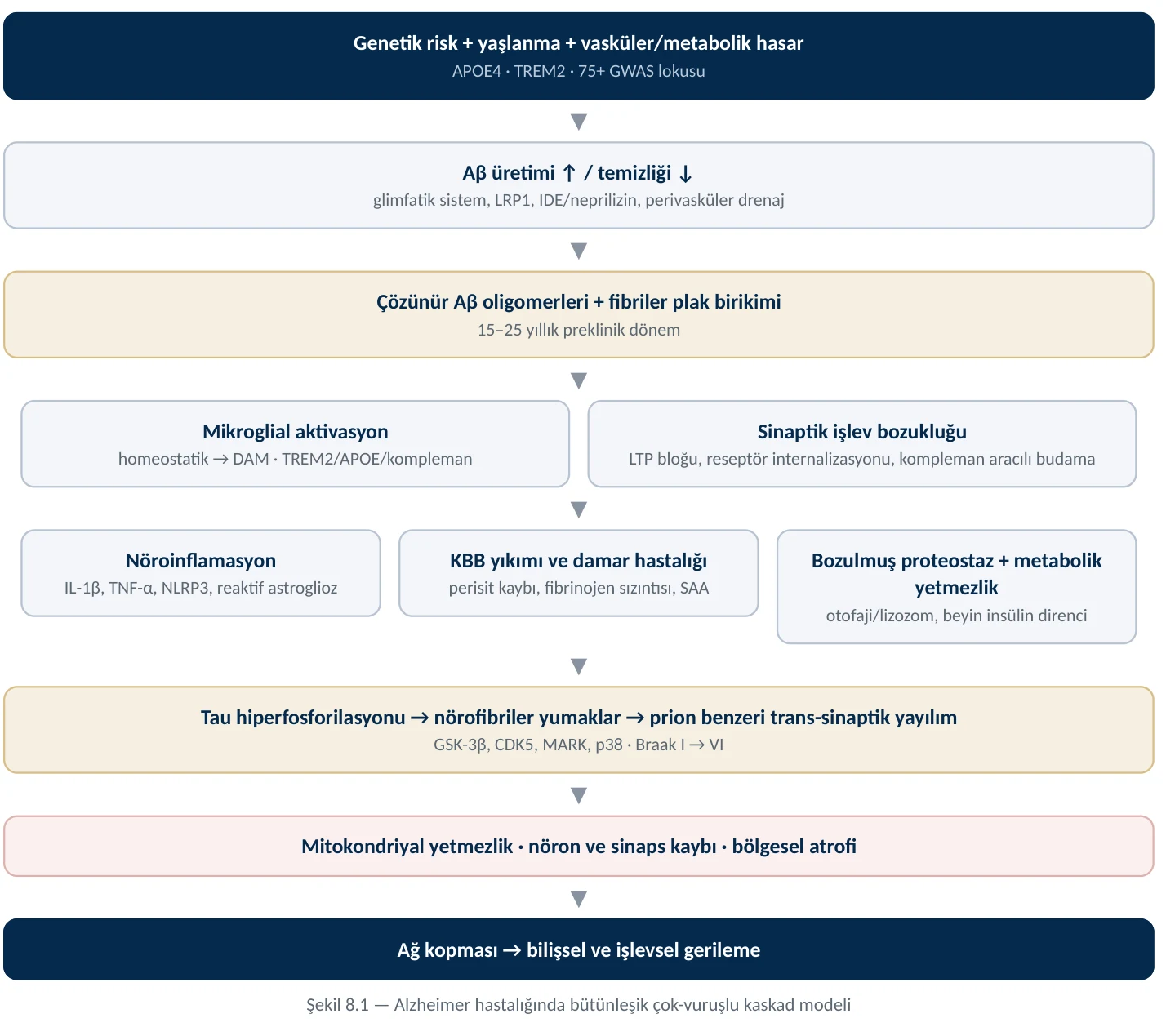
The amyloid cascade hypothesis
Core mechanism. APP, a type-I transmembrane protein with roles in synaptogenesis, iron export and trophic signalling, is processed by two competing pathways:
Non-amyloidogenic: α-secretase (ADAM10) cleaves within the Aβ region → sAPPα (neurotrophic) + C83 →
- p3. No Aβ is produced.
- Amyloidogenic: β-secretase (BACE1) cleaves at the N-terminus of Aβ → sAPPβ + C99; γ-secretase (presenilin-1/2 catalytic core, with nicastrin, APH-1, PEN-2) then cleaves at variable positions within the transmembrane domain → Aβ38, Aβ40, Aβ42, Aβ43.
Aβ42 and Aβ43 are more hydrophobic and aggregation-prone than Aβ40. The pathogenic variable is not total Aβ production but the Aβ42:Aβ40 ratio — this is the unifying explanation for all PSEN1/PSEN2 mutations, which raise the ratio without necessarily increasing total Aβ.
Aggregation chain: monomer → dimer/trimer → low-n oligomer → protofibril → fibril → plaque. Evidence now points to soluble oligomers and protofibrils as the principal synaptotoxic species; plaques act partly as reservoir, partly as inert depot. This is precisely why lecanemab (protofibril-selective) and donanemab (pyroglutamate-Aβ, plaque-selective) differ mechanistically yet both produce clinical effect, and why plaque burden correlates weakly with cognition.
| Evidence supporting causality (strong) | Evidence limiting the hypothesis (equally strong) |
|---|---|
| All three ADAD genes act through APP processing or the Aβ42:Aβ40 ratio; penetrance is essentially complete | Roughly 30% of cognitively normal individuals over 70 are amyloid-positive, and most never develop dementia |
| Trisomy 21 (APP triplication) leads to near-universal AD pathology by age 40 | Plaque burden correlates weakly with cognitive status; tangle burden correlates strongly |
| The APP A673T (“Icelandic”) variant reduces BACE1 cleavage by ~40% and is protective — a human loss-of-function experiment in the protective direction | Multiple amyloid-lowering strategies failed: γ-secretase inhibitors worsened cognition; BACE1 inhibitors also worsened it; solanezumab and early gantenerumab failed |
| Antibodies that clear plaques slow clinical decline; those that do not clear them do not | Effect sizes are modest (25–35%) despite near-complete plaque clearance — implying that by the symptomatic stage, downstream processes have become largely amyloid-independent |
| Aβ accumulation begins 15–25 years before tau spreads beyond the medial temporal lobe and before symptoms (DIAN, A4) | APOE genotype modifies Aβ clearance and accumulation in a dose-dependent manner — so amyloid alone is not a sufficient explanation |
Current position. The hypothesis is best restated as follows: Aβ is a necessary initiating factor whose removal yields more benefit the earlier it occurs; once tau spread has become self-sustaining, its removal yields diminishing returns. This restatement is testable, and PrevenTRON, AHEAD 3-45 and TRAILBLAZER-ALZ 3 are those tests. GRADE — causal role: ⊕⊕⊕⊕. Sufficiency of amyloid clearance to halt the disease: ⊕⊕◯◯ (evidence against).
Tau, neurofibrillary tangles and prion-like spread
Tau (MAPT, 17q21) is a microtubule-associated protein that generates six CNS isoforms through alternative splicing of exons 2, 3 and 10; this gives rise to the 3R and 4R species. The adult human brain expresses roughly equal 3R:4R. AD is a mixed 3R/4R tauopathy — which distinguishes it from PSP and CBD (4R) and from Pick’s disease (3R). Cryo-EM has shown that tau filament folding is disease-specific: the paired helical filament fold of AD is structurally distinct from those of CTE, PSP and
CBD; tauopathies can therefore be defined as distinct molecular strains.
Pathogenic sequence:
- Hyperphosphorylation — at more than 40 residues by GSK-3β, CDK5, MARK/PAR-1, CK1 and p38 MAPK; with concurrent PP2A hypoactivity and O-GlcNAc/phosphorylation competition at shared serines. Aβ oligomers activate several of these kinases — a direct amyloid→tau mechanistic link.
- Detachment from microtubules → destabilised cytoskeleton, impaired transport of mitochondria and cargo.
- Mislocalisation to the somatodendritic compartment — where tau mediates Aβ-induced excitotoxicity via Fyn-dependent NMDAR signalling. Tau reduction is protective against Aβ toxicity and seizures in mouse models — this is the mechanistic rationale for tau ASOs.
- Oligomerisation and paired helical filament formation → neurofibrillary tangles.
- Trans-synaptic prion-like spread. Misfolded tau is released (partly activity-dependent, partly via exosomes), taken up by connected neurons (HSPG, LRP1 and receptor-mediated endocytosis) and templates the misfolding of native tau. This explains Braak staging as network-based spread and makes extracellular tau (bepranemab, etalanetug) a therapeutic target distinct from intracellular tau (diranersen).
Synaptic dysfunction
Synapse loss is the strongest structural correlate of cognitive impairment in AD — exceeding plaque count, tangle count and neuron loss. Mechanisms:
- Aβ oligomers bind PrP^C, mGluR5, NMDAR subunits and α7-nAChR; they drive NMDAR-dependent LTD and block LTP.
- Internalisation of AMPA and NMDA receptors reduces synaptic strength.
- Complement-mediated synaptic pruning: Aβ induces neuronal C1q upregulation; C3 opsonises synapses; microglial CR3 phagocytoses them. This reactivates a developmental pruning programme in the aged brain.
- Presynaptic impairment: SV2A (the in vivo marker of synaptic density), synaptophysin and SNAP-25 are reduced.
- Network hyperexcitability: subclinical epileptiform activity is seen in ~20–40% of AD patients and predicts faster decline; levetiracetam (AGB101) has been trialled on this basis.
Neuroinflammation
Once considered reactive, neuroinflammation is now accepted as a causal contributor. The decisive evidence
is GWAS: the majority of AD risk loci are expressed predominantly or exclusively in microglia (TREM2, CD33, MS4A,
ABI3, PLCG2, INPP5D, SPI1, CR1, CLU, HLA-DRB1).
Microglia
Single-cell and single-nucleus transcriptomics have replaced the M1/M2 dichotomy with a continuum of activation states: homeostatic microglia (P2RY12^high, TMEM119^high); disease-associated microglia (DAM/
MGnD) — a TREM2-independent first step (suppression of homeostatic genes) followed by a TREM2-dependent second step (upregulation of APOE, LPL, CST7, ITGAX, CLEC7A, SPP1, AXL); interferon-responsive, MHC-II^high and proliferating microglia; and lipid-droplet-accumulating, dysfunctional microglia (LDAM).
Astrocytes
Reactive astrocytes lie on a spectrum. A1-like (neurotoxic) astrocytes are induced by microglia-derived IL-1α, TNF-α and C1q; they lose their synaptogenic support function and secrete a saturated-lipid neurotoxin. A2-like states are protective. Suppression of astrocytic GLT-1/EAAT2 leads to glutamate accumulation and excitotoxicity. GFAP is a robust plasma biomarker of astrocytic reactivity and rises early — arguably even before p-tau217 relative to amyloid onset.
Peripheral–central immune interaction
T cells (CD8⁺ TEMRA) infiltrate the AD brain and correlate with tau pathology. Systemic inflammation, gut dysbiosis and infections (HSV-1 reactivation, P. gingivalis gingipains, periodontal disease) have been implicated. The evoke/evoke+ result is informative precisely here: semaglutide markedly reduced peripheral inflammation (hs-CRP) and improved CSF neuroinflammatory markers (YKL-40) — but produced no clinical benefit. This is evidence that reducing peripheral inflammation alone is insufficient. GRADE — causal contribution of neuroinflammation: ⊕⊕⊕◯. Efficacy of anti-inflammatory therapy: ⊕◯◯◯.
Blood–brain barrier and vascular dysfunction
BBB breakdown in the hippocampus is detectable with dynamic contrast-enhanced MRI in normal ageing and accelerates in MCI; it occurs independently of amyloid status. Principal components:
- Pericyte degeneration (measurable via CSF soluble PDGFRβ) precedes and predicts cognitive decline; it is accelerated in APOE4 carriers via the cyclophilin A–MMP9 pathway.
- Fibrinogen leakage into the parenchyma activates microglia via CD11b and drives dendritic spine loss. Reduced LRP1-mediated Aβ efflux and increased RAGE-mediated influx shift the balance
- towards Aβ retention in the brain.
- Cerebral amyloid angiopathy (CAA) — Aβ40 deposition in vessel walls — is present in 80–90% of AD brains, causes lobar microbleeds and superficial siderosis, and is the substrate of ARIA. CAA severity is the principal predictor of ARIA risk; this is why baseline MRI before anti-amyloid therapy (screening for more than 4 microbleeds, superficial siderosis and prior macrohaemorrhage) is mandatory.
The two-hit vascular hypothesis (Zlokovic) proposes that vascular injury (first hit) both directly damages neurons and accelerates amyloid accumulation (second hit) by impairing Aβ clearance. This is the mechanistic bridge between cardiovascular risk factor epidemiology and AD pathology, and it explains why hypertension, diabetes and smoking are risk factors for AD, not only for vascular dementia.
Oxidative stress and mitochondrial dysfunction
The brain uses ~20% of resting oxygen despite being ~2% of body mass, is lipid-rich and has limited antioxidant reserve. In AD: reduced complex IV activity is among the earliest metabolic abnormalities; Aβ accumulates within mitochondria; mitochondrial dynamics shift towards fission; mitophagy is impaired; tau blocks axonal mitochondrial transport, depriving distal synapses of ATP.
The “mitochondrial cascade hypothesis” (Swerdlow) proposes that inherited and acquired mitochondrial dysfunction is primary in late-onset AD. It is a minority view but has not been refuted.
Protein misfolding, autophagy and proteostasis
Neurons are postmitotic; they cannot dilute damaged proteins by dividing. They are therefore uniquely dependent on autophagy and the ubiquitin–proteasome system.
- Autophagy–lysosome failure is among the earliest neuronal abnormalities in AD. Strikingly, autophagic vacuoles are also a site of Aβ production; presenilin-1 is required for lysosomal acidification — establishing a direct, γ-secretase-independent link between PSEN1 mutations and lysosomal dysfunction.
- Multiple AD GWAS loci converge on endolysosomal trafficking: PICALM, BIN1, SORL1 (rare loss-of-function variants lead to near-Mendelian AD), CD2AP, RIN3.
- UPS impairment: tau aggregates directly inhibit the 26S proteasome, establishing a feed-forward loop.
Therapeutically, this is the territory targeted by PROTACs, molecular glues and autophagy enhancers (rapamycin/rapalogs, trehalose,
TFEB activators).
Lipid metabolism, cholesterol and APOE
The brain contains ~25% of the body’s cholesterol and synthesises almost all of it locally behind the BBB.
APOE, produced mainly by astrocytes, is the principal lipid transporter of the CNS. APOE isoforms differ in lipidation efficiency, Aβ clearance, microglial lipid handling and BBB integrity — E4 performs worst on each.
Insulin resistance and brain glucose metabolism
Brain glucose hypometabolism (measured by FDG-PET) begins decades before cognitive symptoms and is prominent in the posterior cingulate and temporoparietal regions. Brain insulin resistance — what some authors call “type 3 diabetes” — affects neuronal glucose uptake, synaptic plasticity and tau phosphorylation. Yet translating this mechanistic story into therapy has failed: intranasal insulin (SNIFF) is negative, pioglitazone (TOMMORROW) failed and oral semaglutide (evoke/evoke+) is definitively negative. The mechanism may still be valid; the drug strategy is not.
Co-pathology — what autopsy actually shows
Community-based autopsy series have shown that most older people with dementia have mixed pathology rather than pure AD. The most frequent accompaniments:
- LATE (limbic-predominant age-related TDP-43 encephalopathy) — affects 30–50% of amnestic cases over 80; invisible during life because it has no biomarker. This is the field’s largest diagnostic gap.
- Lewy body pathology — now detectable during life with the CSF α-synuclein seed amplification assay.
- Cerebrovascular disease — microinfarcts, arteriolosclerosis, CAA.
- Hippocampal sclerosis.
The clinical implication is clear: finding “amyloid-positive” in an older patient does not mean the entire cognitive impairment is attributable to AD. This is also one of the most plausible explanations for why anti-amyloid therapy may be less effective than expected in very old patients.
Genetics
Architecture
The genetic architecture of AD is bimodal: at one end, fully penetrant, very rare autosomal dominant mutations (ADAD, <1% of cases); at the other, a polygenic background of common, low-effect variants, with APOE sitting on top of it as the single dominant common determinant.
Autosomal dominant AD genes
- APP (21q21): more than 60 pathogenic mutations; locus duplication alone also causes ADAD. The triple copy in trisomy 21 produces near-universal AD pathology by age 40.
- PSEN1 (14q24): more than 300 mutations; the most frequent and usually earliest-onset cause of ADAD (30s–50s). The large Colombian E280A kindred is here.
- PSEN2 (1q42): ~40 mutations; rarer, later onset, more variable penetrance.
The clinical value of ADAD. ADAD kindreds are the field’s most valuable experimental resource, because onset timing can be predicted from the mutation and the parental age at onset; this enables prevention trials with defined windows. The DIAN-TU platform is testing gantenerumab, solanezumab and now lecanemab and etalanetug (E2814) in this population. DIAN-TU-001 extension data suggested that very long-term gantenerumab exposure in asymptomatic mutation carriers may reduce the risk of symptom onset — hypothesis-generating, small sample, open-label extension; not definitive — but it is the most direct human evidence that early amyloid clearance may prevent rather than merely slow.
APOE — the dominant common determinant
Three alleles differing at residues 112 and 158: ε2 (Cys112/Cys158), ε3 (Cys112/Arg158), ε4 (Arg112/Arg158).
| Genotype | Population frequency (European ancestry) | AD OR (vs ε3/ε3) | Mean shift in onset |
|---|---|---|---|
| ε2/ε2, ε2/ε3 | ~10–13% | ~0.6 | Later |
| ε3/ε3 | ~60% | 1.0 (reference) | Reference |
| ε3/ε4 | ~20–25% | ~3–4 | ~5 years earlier |
| ε4/ε4 | ~2–3% | ~8–15 | ~10 years earlier |
Mechanisms (numerous, all isoform-dependent): impaired Aβ clearance and increased seeding; exacerbation of tau-mediated neurodegeneration independently of amyloid; pericyte loss and BBB breakdown via cyclophilin A–MMP9; impaired lipid transfer and lipid droplet accumulation in astrocytes and microglia; altered microglial DAM transition; reduced synaptic repair.
The Fortea 2024 debate
Fortea et al. (Nature Medicine 2024), analysing more than 3,000 autopsies and more than 10,000 biomarker-characterised individuals, reported that more than 95% of APOE4 homozygotes were amyloid-positive by age 65 and showed near-universal AD pathology and highly predictable biomarker trajectories; on this basis they argued that ε4/ε4 should be considered a genetic form of AD rather than a risk factor.
The counter-argument is this: pathology is not disease; a substantial proportion of ε4/ε4 carriers never develop dementia in their lifetime; and reclassification would label ~2% of the population with a fatal disease without an approved intervention. It is an unresolved debate with heavy consequences.
Resilience experiments — two patients, one pathway
- A homozygous carrier of APOE3 Christchurch (R136S) in the Colombian PSEN1 E280A kindred remained cognitively normal even ~30 years after expected onset, despite an extraordinarily high amyloid burden and with limited entorhinal tau — a finding linking APOE–HSPG binding to tau spread (Arboleda-Velasquez et al., Nat Med 2019).
- A carrier of the RELN-COLBOS (H3447R) variant showed similar resilience (Lopera et al., Nat Med 2023) and converged on the same reelin–APOE–ApoER2 pathway.
These two individuals are arguably the most informative patients in modern AD research: they show that in humans amyloid burden can be dissociated from tau spread and clinical disease, and they define a druggable pathway.
GWAS and the polygenic component
Bellenguez et al. (Nature Genetics 2022; n≈111,000 cases / 677,000 controls) identified 75 risk loci, 42 of them new.
Pathway enrichment groups them into four functional clusters:
| Cluster | Representative genes | Biology |
|---|---|---|
| Amyloid/APP processing | APP, ADAM10, APH1B, SORL1, ACE | Aβ production and clearance |
| Tau | MAPT (weak in AD, strong in PSP/FTD), BIN1, FERMT2, CASS4 | Tau binding and spread |
| Endolysosomal/trafficking | BIN1, PICALM, CD2AP, SORL1, RIN3, ZCWPW1 | Endocytosis, autophagy, retromer |
| Immune/microglial | TREM2, CR1, CLU, MS4A, CD33, ABI3, PLCG2, INPP5D, SPI1, HLA-DRB1, TNIP1 | Innate immunity, complement, phagocytosis |
Notable individual loci: TREM2 R47H (OR ~2.5–4) — master regulator of the DAM transition; elevated soluble
TREM2 in CSF is associated with slower decline, supporting a protective microglial response. PLCG2 P522R
— rare protective variant; key drug target. ABCA7 loss-of-function variants confer OR ~2–4 and are enriched in populations of African ancestry. SORL1 rare truncating variants approach Mendelian penetrance.
Polygenic risk scores
PRSs combining GWAS variants reach an AUC of roughly 0.72–0.78 when APOE is included and
~0.65 when it is excluded — so APOE carries most of the discriminative power. Constraints that currently preclude clinical use:
- Failure of ancestry transferability. PRSs derived from European-ancestry GWAS lose 50–80% of their predictive accuracy in African-ancestry populations. Their clinical roll-out would widen inequities.
- The population–individual distinction. Good at stratifying a cohort into risk tiers; poor at telling an individual their absolute risk.
- No actionability. There is no approved intervention indicated on the basis of a PRS result.
- Incremental value over APOE + age + sex + family history is modest.
Legitimate current use: clinical trial enrichment (selecting high-risk participants for prevention trials), not clinical care. GRADE — clinical utility of PRS: ⊕⊕◯◯.
Familial versus sporadic AD
| Feature | ADAD (APP/PSEN1/PSEN2) | Sporadic late-onset AD |
|---|---|---|
| Proportion of cases | <1% | >95% |
| Onset | Age 30–60 | >65 years |
| Inheritance | Autosomal dominant, near-complete penetrance | Complex, polygenic + environmental |
| Predictability of onset | High (mutation + parental age) | Low |
| Core pathology | Same (plaques + tangles) | |
| Distinguishing features | More CAA, myoclonus, seizures, spastic paraparesis; less co-pathology | Frequent co-pathology (LATE, Lewy, vascular) |
| Aβ42:Aβ40 | Markedly increased | Variable |
| Research value | Defines the preclinical timeline; enables prevention trials with known windows | Represents the true clinical burden |
Risk Factors
The 2024 Lancet Commission framework
The Livingston Commission update (Lancet 2024) identified 14 modifiable risk factors accounting for ~45% of the combined population-attributable fraction (PAF) of dementia cases.
| Life stage | Factor | Weighted PAF | Direction of intervention |
|---|---|---|---|
| Early life (<45) | Low education | 5% | Raising educational attainment; building cognitive reserve |
| Midlife (45–65) | Hearing loss | 7% | Hearing aids / cochlear implant |
| LDL cholesterol (new in 2024) | 7% | Lipid management from midlife onwards | |
| Depression | 3% | Treat; monitor | |
| Head injury | 3% | Helmets, fall prevention, contact-sport policy | |
| Physical inactivity | 2% | ≥150 min of moderate-intensity activity per week | |
| Diabetes | 2% | Glycaemic control | |
| Smoking | 2% | Cessation | |
| Hypertension | 2% | SBP ≤130 mmHg from midlife onwards | |
| Obesity | 1% | Weight management | |
| Excess alcohol | 1% | ≤21 units per week | |
| Late life (>65) | Social isolation | 5% | Social engagement programmes |
| Air pollution | 3% | Environmental policy (PM2.5) | |
| Untreated vision loss (new in 2024) | 2% | Cataract surgery, refractive correction |
Selected factors in detail
Hypertension. Midlife (40s–60s) hypertension is the strongest vascular risk factor; late-life blood pressure shows a J-curve (in the very old, low BP is associated with worse outcomes, probably reverse causation arising from frailty). SPRINT-MIND (intensive SBP <120 vs <140) significantly reduced incident MCI and the composite of MCI + probable dementia; probable dementia alone did not reach significance (underpowered; the trial was stopped early for cardiovascular benefit). This is the best available RCT evidence for any single pharmacological prevention strategy in dementia. GRADE: ⊕⊕⊕◯
Hearing loss. RR ~1.9 for untreated midlife hearing loss; the highest single PAF of midlife (7%). ACHIEVE (n=977, 3 years) found no significant effect in the overall cohort but a 48% reduction in cognitive decline in the pre-specified high-risk ARIC subgroup. Mechanisms: reduced cognitive stimulation, listening effort drawing on cognitive resources, accelerated atrophy of the auditory cortex and social withdrawal. Hearing correction is cheap, safe and beneficial independently of any cognitive effect. GRADE — for cognition: ⊕⊕◯◯; for practice: strongly recommended.
Sleep. The relationship is bidirectional. Slow-wave sleep drives glymphatic Aβ clearance; in humans, a single night of sleep deprivation
measurably raises CSF and PET Aβ. Obstructive sleep apnoea is associated with increased amyloid burden and accelerated cognitive decline. Conversely, sleep disruption is an early symptom of AD (involvement of the suprachiasmatic nucleus and locus coeruleus), so reverse causation matters. Both short (<6 hours) and long (>9 hours) sleep are associated with higher risk. Treat sleep apnoea. Treat insomnia — but avoid benzodiazepines and anticholinergics; these are independently associated with dementia risk.
Physical activity. Consistent observational association (RR ~0.6–0.8 for high vs low activity). Mechanisms: increased BDNF and IGF-1, neurogenesis, improved cerebrovascular function and BBB integrity, reduced systemic inflammation, improved insulin sensitivity and plausibly enhanced glymphatic clearance. However, RCT evidence for cognitive benefit is weaker than the observational literature implies: DAPA (exercise in established dementia) was negative; EXERT found no difference between the aerobic and stretching arms. Exercise nonetheless remains the most robust beneficial single behaviour available.
Head trauma. Moderate–severe traumatic brain injury with loss of consciousness increases risk (RR ~1.5–1.8). Repetitive mild head impacts are associated with chronic traumatic encephalopathy (a distinct 4R tauopathy) rather than with AD. [D] The first and largest study of retired elite footballers was presented at AAIC 2026: higher reported depression, anxiety and subjective cognitive difficulty were found, together with brain differences requiring further investigation; additional studies linked heading exposure and career length to biomarkers of neural injury, tau accumulation and CTE risk.
Depression. RR ~1.6–1.9. Interpretation is genuinely difficult: late-life depression is frequently a prodromal manifestation of AD (mild behavioural impairment), whereas mid-life depression appears to be a true risk factor via HPA axis dysregulation, hippocampal glucocorticoid toxicity, inflammation and reduced engagement. Treat depression in every case; but do not assume that treating it will prevent dementia.
Air pollution. PM2.5 exposure is associated with dementia incidence in multiple cohorts (RR ~1.1–1.4 per 10 µg/m³) and the mechanisms are plausible. Because exposure is involuntary and population-wide, even a small RR translates into a large
PAF — and it can be addressed only through regulation, not through individual behaviour.
Alcohol. The J-shaped associations in observational data are heavily confounded by "sick quitters" and socioeconomic factors. Mendelian randomisation studies do not support a protective effect of light drinking; heavy drinking (>21 units/week) is clearly harmful through both direct neurotoxicity and thiamine deficiency syndromes. Evidence-based advice: less is better; there is no protective dose.
Clinical Presentation
Reconciling three staging systems
| Biological stage (AA 2024) | Clinical syndrome | FAST | CDR global | Typical MMSE | Duration |
|---|---|---|---|---|---|
| Stage 1 | Asymptomatic, biomarker positive (preclinical) | 1 | 0 | 28–30 | 10–20 years |
| Stage 2 | Subtle decline / subjective cognitive decline; transitional | 2 | 0–0.5 | 26–30 | 2–7 years |
| Stage 3 | MCI due to AD (prodromal) | 3 | 0.5 | 24–28 | 2–7 years |
| Stage 4 | Mild AD dementia | 4 | 1 | 20–24 | 2–4 years |
| Stage 5 | Moderate AD dementia | 5 | 2 | 10–19 | 2–4 years |
| Stage 6 | Severe AD dementia | 6–7 | 3 | <10 | 1–3 years |
Median survival from dementia diagnosis is 4–8 years; cases extending to 20 years also occur. Younger age at onset, male sex, high comorbidity and non-amnestic presentation predict shorter survival.
Preclinical AD (Stages 1–2)
Biomarker positive, cognitively normal on standard tests. Change may be detectable on sensitive composite scales (PACC, PACC5) and digital cognitive assessments. Subjective cognitive decline (SCD) — the person's own perception of worsening without objective deficit — roughly doubles the risk of progression to MCI, particularly when accompanied by "SCD-plus" features: onset after age 60, persistence, worry and confirmation by an informant.
MCI due to AD (Stage 3)
Objective impairment in at least one cognitive domain (typically ≥1.5 SD below norms), preserved independence in instrumental activities of daily living and absence of dementia. In memory clinic populations the annual rate of progression to dementia is
~10–15% (lower in community samples); ~15–20% revert to normal, and this usually reflects non-AD causes (depression, medication, sleep, thyroid, B12).
Amnestic MCI with positive AD biomarkers is prodromal AD, and is the population in which lecanemab and donanemab were studied and in which they perform best.
Mild AD dementia (Stage 4)
- Episodic memory: encoding and storage are impaired — rapid forgetting; no improvement with cueing or recognition. This is the reverse of the retrieval-deficit pattern of subcortical/vascular disease (where cueing helps) and is diagnostically valuable at the bedside.
- Word-finding difficulty; category fluency (animal naming) markedly impaired relative to letter fluency.
- Visuospatial and navigational impairment — getting lost in familiar places; often the family's first complaint.
- Executive dysfunction — planning, multitasking, managing finances. Impaired financial capacity is often the first deficit with functional consequences and is frequently missed until serious loss has occurred.
- Anosognosia — loss of insight; begins early and progresses. This is a symptom, not denial.
- Behavioural: apathy (overall the most common neuropsychiatric symptom), anxiety, depressive symptoms, irritability.
Moderate AD dementia (Stage 5)
Marked memory loss extending to remote memory; disorientation to time and place. Language: anomia, paraphasias, reduced comprehension. Apraxia (dressing, tool use) and agnosia (including failure to recognise familiar faces). Assistance is needed with basic activities of daily living.
Neuropsychiatric symptoms peak here: agitation, aggression, delusions (theft, infidelity,
Capgras, "phantom boarder"), visual hallucinations, sundowning, wandering, sleep–wake reversal. Caregiver burden is at its peak; the risk of transition to institutional care is determined more by neuropsychiatric symptoms than by cognitive severity.
Severe AD dementia (Stage 6)
Verbal output falls to a minimum, with eventual mutism. Loss of ambulation and incontinence. Dysphagia — the direct precursor of aspiration pneumonia, the most common cause of death. Primitive reflexes re-emerge; myoclonus and seizures occur in 10–20%.
Weight loss and cachexia despite adequate intake.
Atypical presentations (~15% of AD; higher in early-onset)
| Variant | Core features | Location of pathology | Notes |
|---|---|---|---|
| Posterior cortical atrophy | Visuospatial/visuoperceptual deficits, simultanagnosia, optic ataxia, oculomotor apraxia (Bálint), alexia, Gerstmann | Occipitoparietal | Younger onset; memory relatively preserved early; often presents first to an ophthalmologist |
| Logopenic variant PPA | Impaired single-word retrieval and sentence repetition, phonological errors; grammar and comprehension preserved | Left temporoparietal junction | The underlying pathology is AD in the majority of cases |
| Behavioural/dysexecutive (frontal) variant | Disinhibition, apathy, executive failure | Frontal | Confused with bvFTD; biomarkers are mandatory |
| Corticobasal syndrome (with AD pathology) | Asymmetric rigidity, apraxia, alien limb, myoclonus | Frontoparietal | The pathology is AD in ~25–40% of CBS cases |
| Down syndrome-associated AD | Onset in the 40s–50s; seizures and myoclonus prominent; early behavioural change | Diffuse | Baseline intellectual disability makes detection difficult; DS-specific scales should be used |
Early-onset AD (<65 years) accounts for 5–10% of cases, is enriched for atypical presentations, progresses more rapidly and carries a different psychosocial burden (job loss, dependent children, delayed diagnosis — a median delay of more than 2 years compared with late-onset disease).
Neuropsychiatric symptoms
| Symptom | Prevalence across the disease course | Peak stage |
|---|---|---|
| Apathy | 50–70% | All stages; earliest |
| Depression | 30–50% | Early–moderate |
| Anxiety | 30–50% | Early–moderate |
| Agitation/aggression | 30–50% | Moderate–severe |
| Delusions | 20–40% | Moderate |
| Hallucinations (visual) | 10–20% | Moderate–severe (if early and prominent, reconsider dementia with Lewy bodies) |
| Sleep disturbance | 25–40% | All stages |
| Disinhibition | 15–30% | Moderate |
Mild behavioural impairment (MBI) — late-onset, persistent neuropsychiatric symptoms in an older adult without dementia — is now recognised as a prodromal marker with predictive value comparable to that of MCI.
Diagnosis
Diagnostic algorithm
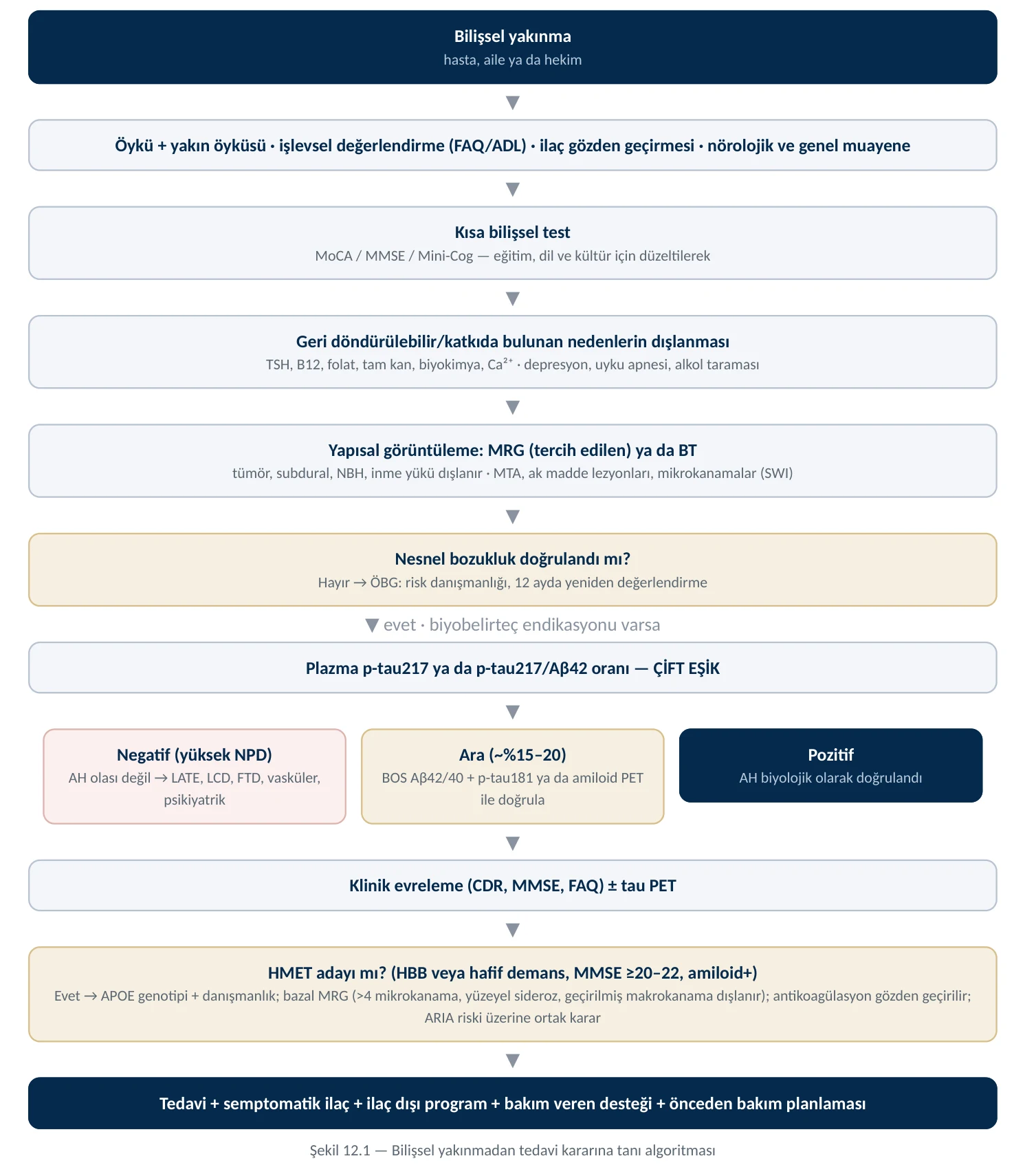
Three coexisting criteria systems
| Framework | Basis | Key feature | Best use |
|---|---|---|---|
| NIA-AA 2011 | Clinical + biomarker-supported | "Probable/possible AD dementia"; MCI due to AD | Still widespread in clinical practice; familiar |
| IWG-2 / IWG 2021 & 2024 | Clinico-biological | Requires both a specific clinical phenotype and biomarker positivity. Asymptomatic biomarker positive = "at risk", not a patient | Conservative; ethically cautious |
| AA Revised Criteria 2024 | Purely biological | Core 1 positivity means AD regardless of symptoms. Numerical stages 1–6. Biomarkers are categorised as A, T1, T2, N, I, V, S | Clinical trials; biomarker-era practice; treatment eligibility |
2024 AA biomarker categories: Core 1 — amyloid PET; CSF Aβ42/40, p-tau181/Aβ42, t-tau/Aβ42; accurate plasma tests (p-tau217, p-tau217/Aβ42). Core 1 positivity establishes AD. Core 2 — tau PET; CSF MTBR-tau243, phosphorylated tau205. Core 2 stages severity. Non-specific — N (NfL, atrophy, FDG-PET hypometabolism), I (GFAP, YKL-40, sTREM2), V (vascular), S (α-synuclein SAA).
Neuropsychological assessment
| Instrument | Duration | Range | Best use | Limitations |
|---|---|---|---|---|
| Mini-Cog | 3 min | — | Primary care triage | Low sensitivity for MCI |
| MMSE | 10 min | 0–30 | Staging, longitudinal follow-up | Ceiling effect in MCI; education/language bias; copyright-protected |
| MoCA | 10–15 min | 0–30 | MCI detection (superior to MMSE) | Requires education correction (+1 for ≤12 years); requires certification |
| ACE-III / M-ACE | 15–20 min | 0–100 | Domain profile; FTD–AD differentiation | Long |
| ADAS-Cog | 30–45 min | 0–70/85 | Trial primary endpoint | Insensitive in MCI/preclinical disease |
| CDR / CDR-SB | 30–60 min | 0–3 / 0–18 | Gold standard for staging; DMT trial endpoint | Requires informant report and a trained rater |
| NPI-Q | 5 min | 0–36 | Neuropsychiatric symptoms + caregiver distress | Dependent on informant report |
| FAQ | 5 min | 0–30 | Functional/IADL assessment | Dependent on informant report |
Imaging modalities
| Modality | What it detects | Sensitivity/specificity for AD | Availability | Role |
|---|---|---|---|---|
| CT | Structural; excludes tumour, subdural, hydrocephalus, large infarct | Low/Low | Universal | Acceptable minimum structural investigation |
| MRI (T1, FLAIR, SWI/GRE, DWI) | MTA, hippocampal volume, white matter lesions, microbleeds, siderosis | Moderate/Moderate | Wide | Mandatory before and during DMT; essential for differential diagnosis |
| FDG-PET | Regional glucose metabolism | ~85–90% / ~70–75% | Moderate | Differential diagnosis in clinically uncertain cases (AD–FTD–DLB) |
| Amyloid PET | Fibrillar Aβ; quantified in Centiloids | ~90–95% / ~85–90% (against autopsy) | Limited | Confirms amyloid status; DMT eligibility; treatment monitoring |
| Tau PET | Paired helical filament tau; Braak-like staging | ~90% / ~90% | Research/specialist centre | Stages the disease; the best imaging correlate of cognition |
Key MRI findings in AD: medial temporal atrophy (Scheltens MTA scale; ≥2 abnormal under age 75, ≥3 above), posterior/parietal atrophy (Koedam scale; prominent in early-onset disease and PCA), diffuse cortical atrophy and absence of findings suggesting alternative diagnoses.
The Centiloid scale standardises amyloid PET across tracers: <20–24 CL ≈ negative/cleared; 24–40 CL intermediate; >40 CL clearly positive. Anti-amyloid trials aim to reduce below ~24 CL.
CSF biomarkers
| Analyte | Direction in AD | Notes |
|---|---|---|
| Aβ42 | ↓ (sequestered into plaques) | As a stand-alone test, highly sensitive to assay and pre-analytical conditions |
| Aβ42/Aβ40 ratio | ↓ | Preferred — corrects for individual total Aβ production and pre-analytical variability |
| p-tau181 | ↑ | Widely used; specific for AD |
| p-tau217 | ↑ | Best-performing phospho-epitope; the earliest to change |
| p-tau231 | ↑ | Changes very early, very close to amyloid onset |
| Total tau | ↑ | Marker of neurodegeneration; not specific (also elevated in CJD, stroke) |
| MTBR-tau243 | ↑ | Correlates with tau PET burden; Core 2 staging marker |
| NfL | ↑ | Axonal injury; not specific across neurodegenerative diseases |
| α-synuclein seed amplification assay | Positive if Lewy co-pathology is present | Now clinically important — identifies Lewy co-pathology during life |
FDA-approved automated CSF platforms (Lumipulse, Elecsys) have largely eliminated between-laboratory variability. Where PET is unavailable, CSF remains the reference standard, is cheaper than PET and
provides multiple pieces of information that PET cannot.
Blood biomarkers — the centre of the transformation
This is the clinically most consequential development of the 2024–2026 period.
| Biomarker | AUC against amyloid PET | Earliest abnormality | Clinical status (July 2026) |
|---|---|---|---|
| p-tau217 | 0.90–0.96 | Very early (close to amyloid onset) | Best single analyte. FDA-approved as a ratio |
| p-tau217/Aβ42 ratio | 0.93–0.97 | Very early | [D] FDA approval on 16 May 2025 (Fujirebio Lumipulse): 91.7% PPA, 97.3% NPA (n=499); indeterminate results <20% |
| p-tau231 | 0.83–0.90 | The earliest of all | Research |
| p-tau181 | 0.80–0.88 | Early | [D] FDA-approved (Roche Elecsys); 97.9% NPV; entered use as a rule-out test in US primary care in February 2026 |
| Aβ42/40 (mass spectrometry) | 0.80–0.88 | Earliest | Narrow dynamic range → assay-sensitive |
| GFAP | 0.75–0.85 | Early (astrocytic) | Adjunctive; prognostic |
| NfL | 0.65–0.75 | Late; not specific | For neurodegeneration/prognosis, not for diagnosis |
What changed in 2025–2026
[D] FDA approvals. The Fujirebio Lumipulse G pTau217/Aβ1-42 plasma ratio — the first blood-based in-vitro diagnostic test for AD
— was approved via the 510(k) pathway on 16 May 2025 for symptomatic adults aged 55 and over in specialist care;
it entered use across the US in August 2025. The Roche Elecsys pTau-181, approved in 2025, was positioned in February 2026 as a rule-out test in US primary care with a 97.9% NPV.
[D] Prognostic value in asymptomatic individuals (AAIC 2026 / JAMA, Buckley et al.). A pooled analysis of 2,705 cognitively unimpaired adults from A4/LEARN, HABS,
ADNI, WRAP and HABS-HD (mean follow-up 4.7 years;
518 progressed):
- Each 1 SD increase in plasma p-tau217 → 38% increase in the risk of progression to clinical impairment (95% CI 31–44).
- Independent of amyloid PET: after Centiloid adjustment, p-tau217 retained a 30% risk; the contribution of amyloid burden was 21%.
- Predicted 2/5/10-year risk: 4%/20%/39% in the high group (>1.1 SD); 8%/35%/63% in the very high group (>2.5 SD).
- Model performance: 10-year C-index 0.73; AUC 0.88.
Appropriate use — and misuse
| Do | Don't |
|---|---|
| Use in symptomatic patients in whom AD is in the differential diagnosis | Do not screen asymptomatic people outside research. In a population with 10% prevalence, even a test with 95% specificity yields a PPV well below 70% — and there is no approved treatment for preclinical AD |
| Use a two-threshold strategy (rule-out / intermediate / rule-in). A single threshold destroys the test's principal clinical value | Do not assume that thresholds are transferable between test platforms. They are not; each requires local validation |
| Confirm intermediate results with CSF or PET | Do not ignore confounders: chronic kidney disease (reduced clearance raises p-tau and NfL), body mass index (haemodilution lowers concentrations), age and possibly ethnicity shift values |
| Confirm before starting disease-modifying therapy | Do not use NfL to diagnose AD. It indicates neurodegeneration of any cause |
GRADE — diagnostic accuracy of plasma p-tau217 in symptomatic populations: ⊕⊕⊕⊕. For asymptomatic screening: ⊕⊕◯◯ and not recommended.
Differential diagnosis
| Condition | Distinguishing clinical features | Distinguishing investigations |
|---|---|---|
| LATE / TDP-43 | Amnestic, slower, older (>80) | Amyloid negative + hippocampal atrophy; no biomarker during life — a major gap |
| Dementia with Lewy bodies | Fluctuating cognition, early visual hallucinations, parkinsonism, REM sleep behaviour disorder, severe neuroleptic sensitivity | DaTscan abnormal; reduced MIBG cardiac scintigraphy; CSF α-synuclein SAA positive |
| Frontotemporal dementia (behavioural) | Early personality/behavioural change, disinhibition, hyperorality, stereotypies; memory preserved early | Frontotemporal atrophy/hypometabolism; AD biomarkers negative; C9orf72/GRN/MAPT |
| Vascular cognitive impairment | Stepwise course, focal signs, early gait disturbance, executive-predominant | Extensive white matter lesions, strategic infarcts, lacunes |
| Normal pressure hydrocephalus | Gait first, then urinary incontinence, then cognition; magnetic gait | Ventriculomegaly with DESH; positive lumbar drainage test |
| Depression ("pseudodementia") | "I don't know" answers, effort-dependent performance, preserved benefit from cueing, self-report > informant report | Improves with treatment; AD biomarkers negative |
| Creutzfeldt-Jakob disease | Rapid (weeks–months), myoclonus, ataxia | Cortical ribboning on DWI; PSWC on EEG; RT-QuIC positive; very high CSF t-tau and 14-3-3 |
| Autoimmune encephalitis | Subacute, seizures, psychiatric, dysautonomia | Antibody panel (LGI1, CASPR2, NMDAR); FLAIR mesial temporal hyperintensity; treatable |
| Drug-induced | Temporal relationship | Anticholinergic burden score; benzodiazepines; opioids; often reversible |
| Metabolic/nutritional | Variable | B12, folate, TSH, Na⁺, Ca²⁺, liver/kidney; thiamine |
| Obstructive sleep apnoea | Daytime sleepiness, snoring, morning headache | Polysomnography; treatable |
Digital biomarkers and artificial intelligence
Digital cognitive assessment. Tablet- and smartphone-based batteries provide high-frequency, low-burden, unsupervised longitudinal measurement. Advantages: reduced practice effects through parallel forms, ecological validity, sensitivity to intra-individual variability (itself an early marker) and scalability. Limitations: the confounder of digital literacy, device heterogeneity, limited normative data and unvalidated cross-cultural transfer.
Passive digital markers. Speech and language analysis (acoustic features, lexical diversity, pause structure, semantic coherence — detectable years before diagnosis in longitudinal writing samples), typing dynamics, navigation patterns derived from smartphone
GPS, gait speed and variability from wearables, sleep architecture, driving telematics. They are attractive because they require no participation; but they raise serious privacy and consent issues, particularly in people with cognitive impairment.
assessment.
Current Standard Treatments
Comparison of approved drugs
| Drug | Class / mechanism | Indication | Dose | Effect size | Main adverse effects |
|---|---|---|---|---|---|
| Donepezil | Reversible AChE inhibitor | Mild–severe AD | 5→10 mg/day | ADAS-Cog ~−2.7 points at 6 months; ~0.5–1.0 MMSE points | Nausea, diarrhoea, vomiting, anorexia, vivid dreams, bradycardia, syncope, muscle cramps |
| Rivastigmine | AChE and BuChE inhibitor | Mild–moderate AD; Parkinson's disease dementia | 1.5→6 mg twice daily oral; patch 4.6→9.5→13.3 mg/24 h | Similar to donepezil | GI effects (prominent with oral; far fewer with the patch), weight loss, application-site reaction |
| Galantamine | AChE inhibitor + allosteric nicotinic modulator | Mild–moderate AD | 8→16→24 mg/day | Similar to donepezil | GI, dizziness, bradycardia; caution in renal/hepatic impairment |
| Memantine | Uncompetitive, low-affinity, fast-off NMDA antagonist | Moderate–severe AD | 5→20 mg/day | SIB ~+3 points; small cognitive and behavioural benefit | Dizziness, headache, confusion, constipation; very well tolerated |
| Brexpiprazole | Atypical antipsychotic | Agitation associated with AD dementia (FDA 2023) | 0.5→2–3 mg/day | CMAI ~−5.3 points | Boxed warning: increased mortality in elderly patients with dementia; somnolence, akathisia, weight gain, falls |
| Suvorexant | Dual orexin receptor antagonist | Insomnia in AD | 10–20 mg at night | Modest sleep improvement | Somnolence, falls, abnormal dreams |
Cholinesterase inhibitors — a realistic appraisal
Mechanism. Loss of basal forebrain cholinergic neurons reduces cortical and hippocampal acetylcholine. ChEIs inhibit acetylcholinesterase (rivastigmine also butyrylcholinesterase, whose relative importance increases as AD progresses), thereby increasing synaptic
ACh. This is purely symptomatic; it amplifies signalling in surviving neurons and does not alter the underlying pathology.
Efficacy. Approximately −2.7 ADAS-Cog points at 6 months compared with placebo, roughly 1.0–1.5 MMSE points; small benefits in activities of daily living and global impression. The three agents are clinically equivalent; comparative trials show no meaningful difference. Effects are detectable at the group level but often imperceptible at the individual level. GRADE
— existence of the effect: ⊕⊕⊕⊕; its magnitude being small: ⊕⊕⊕⊕.
- Titrate slowly — most discontinuations are due to GI effects during titration, not at the maintenance dose.
- Take with food; if vivid dreams occur, consider morning rather than evening dosing (or the reverse if insomnia is present).
- The rivastigmine patch markedly reduces GI adverse effects and is a genuine option for those with GI intolerance.
- Cardiac caution: bradycardia, heart block, syncope and — importantly — an increased risk of hip fracture and permanent pacemaker insertion (documented in large cohorts). A baseline ECG is reasonable in those with a cardiac history or taking rate-limiting drugs.
- Do not co-prescribe with anticholinergics — an alarmingly common prescribing error. Review the medication list for oxybutynin, diphenhydramine, tricyclics and first-generation antipsychotics.
- Discontinuation: the DOMINO-AD trial showed that withdrawing donepezil in moderate–severe AD produced measurable cognitive and functional worsening. Continue unless there is intolerance; if you do stop, taper and monitor.
Memantine
Mechanism. In AD, increased glutamatergic tone produces chronic low-level NMDA receptor activation, increasing synaptic noise and permitting Ca²⁺-mediated excitotoxicity. Memantine's uncompetitive, low-affinity, fast-off blockade preferentially inhibits pathological tonic activation while preserving physiological phasic signalling — the pharmacological property that distinguishes it from the cognitively toxic high-affinity NMDA antagonists (ketamine, MK-801).
Efficacy. Approved for moderate–severe AD. It provides benefit in cognition (SIB ~+3 points), function and — of great practical importance — behavioural symptoms, particularly agitation and aggression. It is not effective in mild AD and should not be started there. Its principal practical virtue is excellent tolerability. Combination with a ChEI is standard in moderate–severe disease and provides modest additional benefit.
Management of neuropsychiatric symptoms
Non-pharmacological approaches are always first-line. The DICE framework (Describe, Investigate, Create, Evaluate) is the standard structured approach.
Non-pharmacological interventions with evidence: individualised music therapy (one of the strongest evidence bases for agitation), structured exercise, bright light therapy for sleep–wake disturbance, reminiscence therapy, Montessori-based activities, multisensory stimulation, caregiver communication training (overall the highest-yield intervention), environmental modification and a structured daily routine.
| Symptom | First-line | Notes |
|---|---|---|
| Depression | SSRI (sertraline; citalopram ≤20 mg in the elderly because of QTc) | Evidence is weak (DIADS-2, HTA-SADD were negative); treat clear major depression, not mild dysphoria |
| Agitation/aggression | Brexpiprazole (the only FDA-approved option) or citalopram (CitAD evidence) | All antipsychotics carry a boxed warning for increased mortality in elderly patients with dementia (~1.6–1.7-fold relative risk) and add stroke risk |
| Psychosis | Risperidone (0.5–1 mg) has the best evidence; quetiapine has the weakest — despite being the most widely used | Avoid absolutely in dementia with Lewy bodies — severe neuroleptic sensitivity can be fatal. Reassess at 3 months and attempt withdrawal |
| Sleep disturbance | Sleep hygiene, light therapy, low-dose trazodone, suvorexant | Avoid benzodiazepines, Z-drugs and antihistamines (falls, delirium, cognitive worsening) |
| Apathy | Methylphenidate (showed benefit in ADMET-2) | Monitor blood pressure, appetite and agitation |
Comparison of non-pharmacological interventions
| Intervention | Target | Level of evidence | Effect size | Practical notes |
|---|---|---|---|---|
| Cognitive stimulation therapy | Cognition, quality of life (mild–moderate) | 1a (Cochrane) | Comparable to ChEIs for cognition | Group-based, 14 sessions; well manualised; the strongest non-pharmacological cognitive evidence |
| Structured exercise | Physical function, mood, agitation | 1a | Strong for physical function; weak for cognition in established dementia (DAPA negative) | ≥150 min/week; aerobic + resistance combined |
| Music therapy | Agitation, mood | 1a | Moderate for agitation | Individualised playlists are the most effective |
| Home-based occupational therapy | ADL function, caregiver burden | 1b | Moderate | COTiD programme |
| Caregiver skills training | Caregiver depression, delaying institutional care | 1a | Large — the NYU Caregiver Intervention delayed nursing home placement by ~1.5 years | The highest-value intervention in the field on a cost-per-outcome basis |
| Cognitive training (drill) | Trained tasks | 1a | Improves trained tasks; far transfer weak | Commercial "brain training" claims exceed the evidence |
| Rigid reality orientation | — | — | May increase distress | Superseded by validation/person-centred approaches |
| Multidisciplinary care coordination | Hospitalisation, institutionalisation, caregiver burden | 1b | Moderate–large | Care navigation models |
Multidisciplinary care
Optimal AD care requires: neurology/geriatrics/psychiatry, neuropsychology, nursing, social work, occupational therapy and physiotherapy, speech and language therapy (dysphagia and communication), pharmacy (deprescribing), dietetics and palliative care.
Disease-Modifying Therapies
Anti-amyloid monoclonal antibodies — comparison
| Parameter | Aducanumab | Lecanemab (Leqembi) | Donanemab (Kisunla) |
|---|---|---|---|
| Target epitope | Aggregated Aβ (fibrils + oligomers) | Aβ protofibrils (soluble, large oligomers) | Pyroglutamate-3-modified Aβ (N3pG) — present only in established plaques |
| Pivotal trials | EMERGE (n=1,638) / ENGAGE (n=1,647) | CLARITY AD (n=1,795), 18 months | TRAILBLAZER-ALZ 2 (n=1,736), 76 weeks |
| Primary endpoint | CDR-SB | CDR-SB | iADRS |
| Result | Contradictory — EMERGE −0.39 (22%); ENGAGE null | CDR-SB −0.45 (27% slowing), p<0.001 | iADRS overall 22.3%; low/medium tau 35.1%; CDR-SB 28.9%/36.0% |
| Amyloid reduction | ~59 CL at 18 months | ~55.5 CL; 68% amyloid-negative at 18 months | ~84 CL; 76% cleared at 18 months |
| ARIA-E | 35% | 12.6% (placebo 1.7%) | 24% (placebo 2.1%) |
| ARIA-H | 19% | 17.3% (placebo 9.0%) | 31.4% (placebo 13.6%) |
| ARIA-E in APOE4 homozygotes | Markedly higher | ~32.6% | ~40.6% |
| Attributed deaths | — | 3 in the open-label extension (2 on anticoagulants, 1 after tPA) | 3 in TB-ALZ 2 |
| Administration | 10 mg/kg IV every 4 weeks | 10 mg/kg IV every 2 weeks ×18 months → maintenance every 4 weeks; or SC autoinjector | 700 mg every 4 weeks ×3 → 1400 mg IV every 4 weeks |
| Duration | Indefinite | Indefinite (maintenance) | Finite — stopped once amyloid is cleared (unique to this agent) |
| Regulatory status (Jul. 2026) | Discontinued in November 2024 | FDA full approval (Jul. 2023); EU (2025); Japan, China, UK. [D] SC initiation dosing approved on 13 Jul. 2026 | FDA (Jul. 2024); [D] EU approval in 2026 only for ε4 non-carriers and heterozygotes; no ε4 restriction in the US/Japan/China |
| US list price | — | ~$26,500/year | ~$32,000/typical course |
Interpreting the effect size — the central debate
The real disagreement is not whether these drugs work. It is whether the amount by which they work matters.
The statistical result. CLARITY AD: a 0.45-point CDR-SB difference on an 18-point scale, at 18 months. TRAILBLAZER-ALZ 2:
a 2.92-point iADRS difference on a 144-point scale.
| Arguments that it is clinically meaningful | Arguments that it is not meaningful |
|---|---|
| Time-based reframing is more intuitive and arguably more honest: the effect corresponds to roughly a 4–7-month delay in reaching a given level of disability within 18 months | The difference is below or at the margin of most proposed MCIDs (0.5–1.0 in MCI; 1.0–2.0 in mild AD) |
| Effects grow with treatment duration in open-label extensions; the 3-year CLARITY AD extension continued to diverge from a matched natural-history cohort | Functional unblinding via ARIA (in 12–37% of those treated) may bias clinician- and informant-rated outcomes upward. This has never been adequately measured and is the strongest methodological objection |
| Benefit is markedly larger in earlier disease: donanemab, 60% slowing on iADRS in the low/medium-tau MCI subgroup; 48% in those under 75 | ~40% of patients on donanemab still progressed; the drug slows a trajectory, it does not stabilise it |
| Patients and caregivers value the delay of specific functional milestones (stopping driving, needing help with finances) more than scale scores | Group-mean differences do not identify responders; there is no way to tell an individual patient whether they benefited |
| These are the first drugs to alter the biological course of AD in humans | Trial populations (biomarker-confirmed, medically stable, well supported, predominantly white, mean age ~71–73) do not represent the typical clinic patient |
ARIA — amyloid-related imaging abnormalities
Pathophysiology. Antibody binding to vascular Aβ in cerebral amyloid angiopathy triggers perivascular inflammation, Fc receptor-mediated microglial activation in the vessel wall and loss of vascular integrity — producing vasogenic oedema and effusion (ARIA-E) or microhaemorrhage and superficial siderosis (ARIA-H).
Classification. ARIA-E: parenchymal vasogenic oedema and/or sulcal effusion (FLAIR hyperintensity). ARIA-H: new cerebral microhaemorrhages (≤10 mm; SWI/GRE) and/or superficial siderosis. Radiological severity: mild (<5 cm, single focus) / moderate (5–10 cm or multifocal) / severe (>10 cm).
Timing. ARIA-E occurs predominantly in the first 3–6 months (typically doses 3–7) and is asymptomatic in ~75–80% of cases. When symptomatic: headache, confusion, dizziness, visual disturbance, nausea, gait instability; rarely seizure, encephalopathy or fatal haemorrhage.
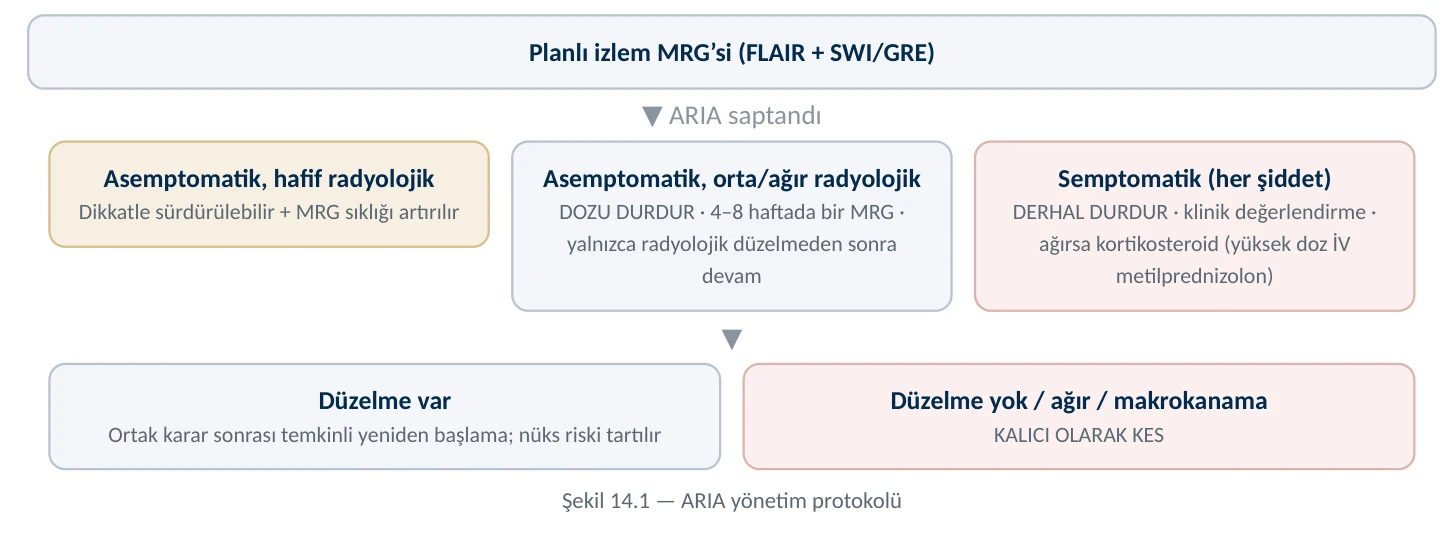
Real-world effectiveness
[D] The LEADER study (AAIC 2026; Eisai/Biogen-sponsored, pre-peer review). A multicentre retrospective real-world study across diverse US clinical settings with a mean of 17 months of lecanemab treatment: 82.5% of patients remained clinically stable or improved (75.9% stable — same disease stage; 6.6% improved). Results were consistent across sex, race, ethnicity and APOE genotype; the safety profile, including ARIA, was consistent with the US label.
Transition to subcutaneous administration
[D] This is not a convenience footnote but a genuine change in the care model:
- August 2025: the FDA approved the Leqembi IQLIK autoinjector for maintenance dosing (360 mg weekly after 18 months of IV); it launched on 6 October 2025 at $375 per autoinjector.
- 13 July 2026: the FDA approved subcutaneous initiation dosing — 500 mg weekly, given as two 250 mg injections of ~15 seconds each. US launch late August 2026.
- Patients can use IV or SC at any point in the course and switch between them.
- In an autoinjector acceptability study, 94% of patients and caregivers found the device easy to use.
Its strategic significance: the infusion-centre bottleneck was limiting the uptake of anti-amyloid therapy arguably more than the efficacy debates. Home administration + blood-based diagnostics + diagnostic accuracy in primary care together define a decentralised AD treatment pathway that did not exist 18 months ago. The open question is whether MRI monitoring capacity will become the new bottleneck.
Anti-tau therapies
| Agent | Class | Target | Key result |
|---|---|---|---|
| Diranersen (BIIB080) | Antisense oligonucleotide, intrathecal | MAPT mRNA → reduces total tau production | [D] Phase 2 CELIA missed its primary dose–response endpoint. CSF total tau fell by 50–65% at all doses; tau PET regressed. Prespecified analyses showed slowing of clinical decline at all doses — but the strongest clinical signal was at the lowest dose, where biomarker reduction was smallest. Advancing to Phase 3 |
| Bepranemab (UCB0107) | mAb, mid-domain tau | Extracellular tau; blocks spreading | Phase 2 TOGETHER missed the primary endpoint (CDR-SB at week 80). Tau accumulation was reduced by 33–58% versus placebo. Significant ADAS-Cog benefit on a secondary endpoint. Subgroup (low tau + APOE4 non-carriers): 63–67% slowing of tau accumulation |
| Etalanetug (E2814) | mAb, microtubule-binding region | Tau seeds; blocks spreading | Phase 2/3 in DIAN-TU (on a lecanemab background) and Phase 2 in sporadic early AD. Completion expected 2028 |
| Semorinemab, tilavonemab, zagotenemab, gosuranemab | N-terminal tau mAbs | Extracellular N-terminal tau | All failed. The N-terminal epitope appears to be the wrong target |
| AADvac1 | Active tau vaccine | Misfolded tau | Phase 2 (ADAMANT): immunogenic; no clinical benefit |
| O-GlcNAcase inhibitors | Small molecule | Increases tau O-GlcNAcylation, reducing phosphorylation/aggregation | Phase 2; mixed |
The CELIA result — what it shows and what it does not
[D] What CELIA established. It is the first randomised trial to show that a tau-targeted agent in humans can produce (a) robust, dose-dependent target engagement (a
50–65% reduction in CSF total tau and regression on tau PET) and (b) a signal of slowing of clinical decline.
[D] What CELIA did not establish. It missed its primary endpoint — there was no dose–response relationship for change in CDR-SB.
Worse for interpretation, the relationship ran in the opposite direction: more tau reduction at the higher doses, the stronger clinical signal at the lowest dose.
Assessment: this is the most important tau result to date and, at the same time, the most confusing. It justifies Phase 3; it does not justify confidence. Independent, peer-reviewed publication of the full dataset is mandatory. GRADE
— clinical benefit of tau lowering: ⊕⊕◯◯.
Combination therapy — the emerging consensus
The mechanistic argument is now widely accepted: AD is multifactorial; single-target monotherapy will reach a plateau. The oncology analogy (single agents → combination regimens → durable control) is invoked constantly: current anti-amyloid drugs address roughly 30% of decline, and therapies targeting other pathways are needed for the remaining 70%.
| Combination | Rationale | Status |
|---|---|---|
| Anti-amyloid + anti-tau | Sequential blockade of the cascade | DIAN-TU (lecanemab + E2814); Phase 2 in sporadic AD |
| Anti-amyloid + anti-inflammatory | Addressing the residual neuroinflammatory driver | In design |
| Anti-amyloid + metabolic | Addressing hypometabolism | Constrained by the evoke failure |
| Anti-amyloid induction → maintenance | Deep clearance followed by minimal exposure | Donanemab's finite-duration paradigm; trontinemab |
| Prevention combination in ADAD | Multi-pathway approach in a population with predictable onset | DIAN-TU platform |
The barriers are structural as much as scientific: combination trials require cross-company collaboration, complex factorial designs with large samples, unclear regulatory pathways for combination approval, and pricing models that stack two expensive biologics. Platform trials (DIAN-TU and proposed adaptive platforms) are the most feasible route.
Cost-effectiveness
| Item | Detail |
|---|---|
| Drug acquisition cost | Lecanemab ~$26,500/year; donanemab ~$32,000/course; SC autoinjector $375/dose |
| Ancillary costs | Amyloid PET or CSF ($1,000–7,000); APOE genotyping; 4+ monitoring MRIs per year ($1,000–3,000 each); infusion administration; specialist visits |
| Estimated total annual cost per patient | ~$50,000–90,000 including monitoring (in most US analyses) |
| ICER assessment | Concluded that prices exceed conventional cost-effectiveness thresholds ($100–150k/QALY) under most assumptions |
| Budget impact | Even if only 10–15% of eligible patients in the US were treated, annual spending would rival the largest drug categories in Medicare |
| Equity implications | Infusion centres, MRI capacity, PET access and dementia specialists are concentrated in urban academic centres. Rural, low- and middle-income-country and under-resourced populations are structurally excluded. The SC formulation and blood-based diagnostics partly mitigate this but do not resolve the MRI monitoring requirement |
Emerging Therapies
Overview of the pipeline
| Indicator | 2026 | 2016 (comparison) |
|---|---|---|
| Active clinical trials | 192 | ~142 |
| Number of distinct agents | 158 | 93 |
| Phase 3 | 54 trials / 36 drugs | — |
| Phase 2 | 89 trials / 84 drugs | — |
| Phase 1 | 49 trials / 45 drugs | — |
| New trials started in the past year | 59 | — |
| Repurposed agents | 56 (35% of drugs) | — |
| Trials targeting pathways other than amyloid and tau | 75% | — |
| Amyloid-targeted share | ~20% | 33% |
| Tau-targeted share | ~20% | 6% |
| Inflammation/immune-targeted share | ~20% | 6% |
The structural message is clear: the field has diversified away from amyloid monotherapy towards a multi-mechanism, combination-oriented and biomarker-integrated model. [D] Readouts of 29 Phase 2 trials are scheduled for 2026.
Next-generation anti-amyloid: BBB-penetrant antibodies
[D] Trontinemab (Roche) is the most important agent in this class and arguably the most promising asset in the entire pipeline.
Design. A 2+1 bispecific "Brainshuttle" antibody: two anti-Aβ binding arms plus a monovalent arm targeting transferrin receptor 1 (TfR1) on brain endothelium; it crosses
the BBB by exploiting receptor-mediated transcytosis. The monovalent TfR1 binding is deliberate — bivalent binding leads to receptor cross-linking, lysosomal degradation and reticulocyte toxicity. This is the same anti-Aβ pharmacophore as gantenerumab, which failed as a conventional antibody, re-engineered so that it is now transported efficiently.
[D] Phase 3 programme: TRONTIER 1 and 2 — early symptomatic AD, started in 2025. PrevenTRON — announced at AAIC 2026 (London): 1,600 cognitively unimpaired participants selected by high plasma p-tau217, with time to clinical progression as the primary endpoint. PrevenTRON is notable in two respects: it is one of the first large trials to use a blood biomarker as the primary inclusion criterion instead of PET or CSF, and it targets the preclinical stage in which the amyloid hypothesis predicts maximal benefit. If successful, it will be the strongest test to date of whether AD can be prevented rather than slowed.
Other next-generation agents: Remternetug (Lilly; donanemab successor, N3pG-Aβ-targeted, subcutaneous, faster/deeper clearance; Phase 3 TRAILRUNNER programme, including a preclinical AD trial). ALZ-801/valiltramiprosate (oral small-molecule Aβ oligomer inhibitor; read out with mixed/negative primary results in APOLLOE4 Phase 3 in APOE4 homozygotes; interpretation contested). Aβ vaccines (ACI-24.060, UB-311, ALZ-101) — potentially the only feasible approach for low- and middle-income countries because of low cost, no need for infusion infrastructure and durable antibody titres; the risk is the requirement for B-cell-restricted epitope design that avoids the T-cell response imposed by the AN1792 meningoencephalitis experience.
Gene therapy
| Approach | Agent | Mechanism | Status and assessment |
|---|---|---|---|
| APOE2 transfer | LX1001 (AAVrh.10- hAPOE2) | Intracisternal AAV-mediated APOE2 transfer; converting the APOE4/4 brain to an E2/E4 profile | Phase 1/2 completed (n=15). [D] Safe and well tolerated; no ARIA; dose- and time-dependent CSF APOE2 expression in all participants; CSF t-tau and p-tau181 decreased in 9 of 13 evaluable patients. No evidence of clinical efficacy. Oxford 4; GRADE ⊕◯◯◯ |
| APOE2-Christchurch | LX1021 | ApoE2 carrying the protective R136S variant | Preclinical; draws directly on the Colombian resilience case |
| NGF transfer | CERE-110/AAV2- NGF | Trophic support to basal forebrain cholinergic neurons | Phase 2 failed. Autopsy showed inadequate NGF distribution — a delivery failure, not necessarily a target failure |
| BDNF transfer | AAV2-BDNF | Trophic support to the entorhinal cortex/hippocampus | Phase 1; strong preclinical rationale in primates |
CRISPR and genome editing
The most obvious target is APOE4 → APOE3/APOE2 base editing (a two-nucleotide change). Allele-specific editing of ADAD mutations and editing of APP at the β-secretase site to reduce Aβ without inhibiting the other functions of BACE1 are also plausible. CRISPRi/CRISPRa (epigenome editing) is attractive because it is reversible.
Barriers: somatic delivery to a sufficient number of neurons and glia in a 1.4 kg organ; off-target editing in non-dividing postmitotic cells with no possibility of repair by dilution; immune response to Cas proteins; irreversibility.
Assessment: there is no human CRISPR trial for AD. Realistic first-in-human application is post-2030 and most likely in APOE4 homozygotes or ADAD carriers.
RNA therapeutics
This is the most credible near-term "new modality" in AD — chiefly because diranersen has shown that ASO delivery and target engagement in the CNS work.
Advantages: high target specificity; rational design from sequence; broad CNS distribution with intrathecal administration; reversibility (unlike gene therapy — an important safety advantage for a chronic disease); established regulatory precedent (nusinersen, tofersen).
Constraints: intrathecal administration is invasive and requires repeated procedures; distribution to deep cortical grey matter is poor compared with the spinal cord and periventricular regions; and — as CELIA showed — target engagement does not guarantee a clean clinical dose–response.
Stem cell and regenerative therapies
| Approach | Rationale | Clinical status | Honest assessment |
|---|---|---|---|
| Mesenchymal stem/stromal cells (MSC) | Paracrine: anti-inflammatory cytokines, trophic factors, exosome release. Not cell replacement — MSCs do not become neurons | Phase 1/2a completed | Safe; no convincing efficacy. Small samples, open-label or underpowered, heterogeneous products. The mechanism is immunomodulation, and immunomodulation has failed repeatedly in AD |
| Neural stem/progenitor cells | Replacing lost neurons | Preclinical; very limited Phase 1 | Cell replacement is not a coherent strategy in AD — see below |
| iPSC-derived microglia replacement | Replacing dysfunctional microglia with TREM2- or APOE-corrected cells | Preclinical | Far more plausible than neuron replacement — microglia are replaceable, migratory and their functions are diffuse rather than circuit-specific |
| Exosomes / extracellular vesicles | Cell-free delivery of miRNA and protein cargo; can cross the BBB | Preclinical; early Phase 1 | An attractive delivery platform; cargo standardisation and potency assays remain unresolved |
GRADE — clinical efficacy of stem cell therapy in AD: ⊕◯◯◯. Patients should be actively counselled not to pay for unregulated stem cell treatments.
Immunotherapy and microglial modulation
| Target | Agents | Rationale | Status |
|---|---|---|---|
| TREM2 agonism | AL002, oral small molecules | Pushing microglia towards a productive DAM state | AL002 Phase 2 INVOKE-2 did not meet its endpoints; oral TREM2 agonists in Phase 1 |
| NLRP3 inflammasome inhibition | Various small molecules | Blocking IL-1β maturation and ASC-speck-mediated Aβ seeding | Preclinical/Phase 1 |
| Complement (C1q/C3) inhibition | ANX005/ANX007 | Preventing complement-mediated synapse loss | Phase 2 (mainly in other indications) |
| TNF-α inhibition | XPro1595 (soluble-TNF selective); perispinal etanercept (unvalidated) | Reducing neuroinflammation | XPro1595 Phase 2; perispinal etanercept has no credible controlled evidence |
| Active Aβ/tau vaccines | ACI-24.060, UB-311, AADvac1, ACI-35.030 | Durable, low-cost immunity | Phase 1/2 |
| IVIG | Gammagard | Natural anti-Aβ antibodies | Phase 3 failed |
The lesson of the anti-inflammatory field to date: broad immunosuppression fails (NSAIDs/ADAPT, prednisone, IVIG); peripheral anti-inflammatory action fails (semaglutide/evoke); and the only credible cell-state modulator tested at scale (AL002) has also failed. The remaining hypothesis — precise, brain-penetrant, microglial state-specific modulation delivered at the right disease stage — is unrefuted but unproven. Inflammation now makes up ~20% of the pipeline; the next three years will test it properly.
Protein degradation technologies
PROTACs are bifunctional molecules that recruit an E3 ligase (cereblon, VHL) to the target → ubiquitination → proteasomal degradation. They are catalytic and do not require sustained target occupancy. Tau-PROTACs degrade tau in neurons and in tauopathy mice (preclinical). Molecular glues are smaller and have better BBB properties. ATTECs/
AUTACs are autophagy-tethering compounds and have the key advantage of being able to degrade large aggregates (aggregated tau and Aβ fibrils) that the proteasome cannot process.
Assessment: conceptually the most elegant approach to proteinopathy. The obstacle is entirely pharmacological: getting a bifunctional molecule of ~800–1,100
Da across the BBB at sufficient concentration. Molecular glues and
ATTECs are therefore the more likely near-term winners. First-in-human trials in AD plausibly 2028–2032.
Drug delivery and BBB crossing
| Approach | Mechanism | Status and assessment |
|---|---|---|
| Receptor-mediated transcytosis | TfR1 (Brainshuttle), insulin receptor, CD98hc, LRP1 | [D] Clinically validated (trontinemab). The winning approach so far. Also being applied to enzymes, ASOs and gene therapy capsids |
| Focused ultrasound + microbubbles | Transient, reversible, targeted BBB opening | Phase 1/2 completed; safe and repeatable; modest amyloid reduction in combination with aducanumab (Rezai et al., NEJM 2024). Real and safe; but each session requires an MRI-guided procedure — scalability and cost are the limit |
| Intranasal delivery | Olfactory and trigeminal nerve pathways bypass the BBB | Insulin (SNIFF — negative, device problems), exosomes, peptides. Attractive; the dose fraction that arrives is small and variable |
| Nanomedicine | Liposomes, polymeric nanoparticles, gold nanoparticles | Intense preclinical activity, almost nothing in Phase 2+. The preclinical-to-clinical translation failure rate here is near-total; treat published nanoparticle results with strong scepticism |
| Glymphatic enhancement | Boosting endogenous clearance (sleep optimisation, AQP4 modulation, exercise) | Preclinical/early clinical. Under-investigated and cheap; deserves more attention |
Neuromodulation
| Method | Mechanism | Evidence and assessment |
|---|---|---|
| Deep brain stimulation — fornix | Stimulation of the memory circuit | ADvance Phase 2 (n=42): primary endpoint not met. Prespecified subgroup: possible benefit at age ≥65, possible harm at <65. The age interaction is unexplained and may be chance. GRADE ⊕◯◯◯ |
| rTMS | Modulation of cortical excitability | Numerous small RCTs; NeuroAD (rTMS + cognitive training) received FDA de novo clearance. Meta-analyses suggest a small-to-moderate cognitive effect. Heterogeneous protocols, small samples, high risk of publication bias. GRADE ⊕⊕◯◯ |
| tDCS | Subthreshold cortical polarisation | Very small and inconsistent effects; low cost and safety are its main appeal. GRADE ⊕◯◯◯ |
| 40 Hz gamma sensory stimulation (GENUS) | Entrainment of gamma oscillations with light/sound → microglial activation, amyloid reduction (striking in mice) | Phase 2 (OVERTURE) reported reduced whole-brain atrophy and functional benefit; Phase 3 HOPE is ongoing. The most interesting device approach. Non-invasive, home-based, cheap. But mouse-to-human translation is uncertain and independent replication is limited. GRADE ⊕⊕◯◯ |
| Photobiomodulation (near-infrared) | Cytochrome c oxidase activation | Small open-label and pilot studies. Mechanistically plausible; evidence weak, commercially over-marketed. GRADE ⊕◯◯◯ |
[D] The evoke/evoke+ result — full analysis
Design. Two Phase 3, randomised, double-blind, placebo-controlled trials; once-daily oral semaglutide 14 mg (flexible dosing); 3,808 participants aged 55–85 with amyloid-confirmed MCI or mild AD dementia. evoke+ additionally allowed inclusion of participants with significant small-vessel pathology. Enrolment was global (Europe 1,986; North
America 707; Asia 602; Latin America 303; other 208); 51.4–70.5% APOE4 carriers by region. Two-year main treatment phase, 156-week follow-up.
- It is the cleanest dissociation between biomarker movement and clinical outcome. Semaglutide improved CSF tau species, neuroinflammatory markers, synaptic markers and systemic inflammation — and produced nothing clinically. This is a direct, adequately powered answer to the assumption that biomarker improvement predicts clinical benefit, and it should temper enthusiasm for every agent whose case rests mainly on biomarkers. It is also a warning flag for the interpretation of CELIA.
- It markedly limits the peripheral inflammation hypothesis. Reducing peripheral inflammation may not be enough to change the course of CNS disease — this is shifting the field's attention towards brain-penetrant, cell-type-specific anti-inflammatory approaches.
- It limits the metabolic/"type 3 diabetes" hypothesis as a treatment strategy — not as a mechanistic explanation, and not necessarily for earlier intervention or diabetic subpopulations.
- It was large, global, well designed and clear — with 3,808 participants, this is not a result missed through lack of power.
What it did not establish: that GLP-1 agonists have no role in prevention (evoke enrolled symptomatic patients); that injectable or brain-penetrant GLP-1 agents would behave the same way; or that metabolic health is irrelevant to dementia risk (the epidemiology is unaffected).
Repurposed agents
[D] 35% of drugs in the pipeline (56 agents) are repurposed. The rationale is strong — known safety, faster development, lower cost — but the track record in AD is poor (NSAIDs, statins, hormone replacement therapy, pioglitazone, IVIG, semaglutide). Prominent current candidates: rapamycin/sirolimus (mTOR inhibition → autophagy induction; the strongest geroscience candidate), levetiracetam (AGB101) (suppressing subclinical hyperexcitability in MCI), montelukast, dasatinib + quercetin (senolytic; SToMP-AD), valacyclovir (the VALAD Phase 2 testing the HSV-1 reactivation hypothesis), bumetanide (identified computationally by reversal of the APOE4 transcriptomic signature) and low-dose efavirenz (CYP46A1 activation → cholesterol turnover).
Lifestyle and Prevention
This is the section of the review with the highest confidence in the evidence and the largest population impact.
US POINTER — the defining trial
[D] Baker LD, Espeland MA, Whitmer RA et al. JAMA. 2025;334(8):681–691.
Design. Phase 3, single-blind, 5-site, 2-year RCT; n=2,111; enrolled between May 2019 and March 2023, final follow-up
May 2025. Participants aged 60–79; sedentary lifestyle, poor diet and at least two additional risk criteria (family history of memory impairment, cardiometabolic risk, ethnicity, older age, sex). 1:1 randomisation:
- Structured arm (n=1,056): frequent peer-team meetings, prescribed regular exercise, MIND diet, cognitive training, social/cognitive challenge, monthly blood pressure monitoring.
- Self-guided arm (n=1,055): fewer peer meetings, general health education, participant-managed lifestyle change.
Results. Both groups improved on the global cognitive composite over two years. The structured intervention produced significantly greater improvement and protected cognition against expected age-related decline. [D] Benefits were consistent across age, sex, ethnicity, cardiovascular health status and APOE ε4 genotype.
GRADE — multidomain intervention improves cognition: ⊕⊕⊕◯. Reduces dementia incidence: ⊕⊕◯◯.
[D] Global adaptation and expansion of the POINTER model was reported at AAIC 2026 (WW-FINGERS network; now covering more than 60 countries).
Dietary patterns
| Diet | Composition | Evidence quality and effect | Assessment |
|---|---|---|---|
| Mediterranean | Olive oil, fish, vegetables, legumes, nuts, whole grains, moderate wine; low red meat | Large cohorts; PREDIMED RCT (primary endpoint CVD; cognitive substudies positive). RR ~0.6–0.8 for AD in cohorts | The best-supported dietary pattern. Benefits cardiovascular, metabolic and cognitive outcomes simultaneously. GRADE ⊕⊕⊕◯ |
| MIND | 10 brain-healthy groups (green leafy vegetables, berries, nuts, olive oil, whole grains, fish, poultry, legumes) + 5 groups to limit | RR ~0.47 with high adherence in the Rush cohorts. However, the MIND RCT (NEJM 2023, n=604, 3 years) was NEGATIVE for the primary cognitive endpoint — both arms improved; the control arm also received calorie restriction and diet-quality improvement | The null result of the RCT is important and under-communicated. The control arm was not a true control. Reasonable to recommend; do not overstate. GRADE ⊕⊕◯◯ |
| DASH | Low sodium, high fruit/vegetables, low-fat dairy | Cohort + blood pressure RCTs | Lowers blood pressure → indirect cognitive benefit. Already recommended in hypertension |
| Ketogenic / MCT | Very low carbohydrate; ketone bodies as an alternative fuel | Small RCTs; modest cognitive signals, stronger in APOE4 non-carriers | Mechanistically coherent (bypasses impaired glucose metabolism); adherence poor; lipid effects should be monitored. GRADE ⊕⊕◯◯ |
| Western diet | High saturated fat, refined carbohydrate, ultra-processed food | Cohort | Increases risk; ultra-processed food consumption is associated with faster cognitive decline. Avoid |
| Supplements — vitamins E and C, selenium, ginkgo, omega-3, B vitamins, curcumin, resveratrol | — | Numerous RCTs: consistently negative (GEM, PREADVISE, ADCS trials). B vitamins may help only in hyperhomocysteinaemia (VITACOG) | Do not recommend supplements for AD prevention. The evidence is negative, the marketing aggressive |
Practical synthesis: recommend a Mediterranean or MIND dietary pattern as part of a holistic approach. Do not recommend isolated supplements. The evidence supports dietary patterns, not single nutrients.
Exercise
Recommendation: ≥150 minutes of moderate-intensity aerobic activity per week, resistance training ≥2 times per week, and balance work.
Mechanisms: increases in BDNF and IGF-1; hippocampal neurogenesis and volume increase (Erickson et al. showed a ~2% increase in hippocampal volume with aerobic training in older adults); improved cerebral perfusion and BBB integrity; reduced systemic inflammation; improved insulin sensitivity and sleep quality; probably enhanced glymphatic clearance.
Sleep
- Aim for 7–8 hours; both <6 and >9 hours are associated with higher risk.
- Screen for and treat obstructive sleep apnoea — common, underdiagnosed, treatable and associated with amyloid burden.
- Consistent sleep–wake timing; morning bright-light exposure.
- Avoid benzodiazepines, Z-drugs and anticholinergic sedatives — each is independently associated with cognitive harm.
- Enhancement of slow-wave sleep (acoustic stimulation, novel pharmacology) is under investigation.
Cognitive and social engagement
- Education and occupational complexity build cognitive reserve; the association with delaying clinical expression without reducing pathology is robust.
- Bilingualism is associated with a ~4–5-year delay in symptom onset in several cohorts (not all replicated).
- Cognitive training: the ACTIVE trial showed durable effects on the trained abilities at 10 years; a secondary analysis found reduced dementia risk in the processing-speed arm — intriguing but an isolated finding. Far transfer is weak.
- Novel, effortful and socially embedded activities appear more beneficial than repetitive drills — not more sudoku, but learning a language or an instrument.
Risk factor modification — practical targets
| Target | Goal | Evidence |
|---|---|---|
| Blood pressure | SBP <130 mmHg from midlife onwards | SPRINT-MIND — the best RCT evidence for pharmacological prevention |
| LDL cholesterol | Per cardiovascular guidelines | Lancet Commission 2024 (new factor, PAF 7%) |
| HbA1c | Individualised; avoid hypoglycaemia (independently harms cognition) | Cohort |
| BMI | Normal range in midlife; do not attempt weight loss in late life | Cohort (the late-life "obesity paradox" is largely reverse causation) |
| Smoking | Cessation at any age | Cohort; risk returns to normal over years |
| Alcohol | ≤21 units per week; less is better | Mendelian randomisation studies do not support a protective dose |
| Hearing | Audiometry and correction | ACHIEVE (high-risk subgroup) |
| Vision | Cataract surgery, refractive correction | Lancet Commission 2024 (new factor) |
| Depression | Effective treatment | Cohort |
| Anticholinergic burden | Deprescribing | Strong cohort evidence for a dose-dependent association with dementia |
Prevention trials — the current landscape
| Trial | Population | Intervention | Primary endpoint | Status |
|---|---|---|---|---|
| AHEAD 3-45 | Cognitively unimpaired; intermediate (A3) or elevated (A45) amyloid | Lecanemab | Cognitive composite (PACC5) / amyloid change | Enrolment complete; results ~2028 |
| TRAILBLAZER-ALZ 3 | Cognitively unimpaired/very early; enriched by telephone TICS-m screening + plasma biomarker | Donanemab | Time to clinical progression | Enrolment complete; [D] may report in 2026 |
| [D] PrevenTRON | 1,600 cognitively unimpaired people selected by elevated plasma p-tau217 | Trontinemab | Time to clinical progression | Announced at AAIC 2026 |
| TRAILRUNNER-ALZ 3 | Preclinical AD | Remternetug (SC) | Clinical progression | Enrolling |
| DIAN-TU | ADAD mutation carriers (asymptomatic and symptomatic) | Lecanemab, etalanetug | Cognitive/biomarker | Ongoing; ~2028 |
| US POINTER extension / WW-FINGERS | At-risk older adults, 60+ countries | Multidomain lifestyle | Cognition; dementia incidence in the long term | [D] Expanding globally |
Precision Medicine
Biomarker-guided treatment
The current model is already partly precision medicine:
- Diagnostic confirmation — plasma p-tau217 (two-cut-off) → CSF/PET confirmation → treatment of biomarker-positive patients only. This has eliminated the 25–30% clinical misdiagnosis rate that ruined older trials.
- Stage-based selection — in TRAILBLAZER-ALZ 2, tau PET stratification showed that low/medium tau burden predicted markedly greater benefit (35.1% vs 22.3% iADRS slowing). Clinical implication: tau staging should inform who receives anti-amyloid therapy, and earlier is better.
- Safety stratification — APOE genotype and microbleed/siderosis burden on baseline MRI determine ARIA risk and eligibility in the EU.
- Treatment monitoring — amyloid PET Centiloid decline (guides the donanemab discontinuation decision), plasma p-tau217 as a response marker, MRI for ARIA surveillance.
- Stopping rules — donanemab's finite-duration paradigm is the field's first biomarker-triggered stopping rule.
Genotype-guided treatment
| Genotype | Current clinical implication |
|---|---|
| APOE ε4/ε4 | Highest ARIA risk (ARIA-E ~32–45%). Donanemab exclusion in the EU. Intensified MRI surveillance where treated. Target population for APOE-directed gene therapy and dedicated trials |
| APOE ε3/ε4 | Moderately elevated ARIA risk; eligible in all jurisdictions |
| APOE ε2 carrier | Lower AD risk; but higher risk of CAA-related haemorrhage — a relevant and frequently overlooked caveat |
| ADAD (APP/PSEN1/PSEN2) | DIAN-TU eligibility; predictable onset makes prevention possible; genetic counselling and cascade testing for the family |
| Down syndrome | Distinct course; dedicated assessment tools; excluded from most trials — a marked equity gap |
Artificial intelligence and machine learning
| Application | Maturity | Assessment |
|---|---|---|
| Automated MRI volumetry | Clinical (FDA-cleared) | Reliable; in routine use |
| Multimodal diagnostic classification | Research | In-sample AUC 0.85–0.95; external validation weak |
| Progression prediction | Research | Predicts MCI→dementia conversion; limited clinical actionability |
| Digital cognitive assessment | Entering clinical use | Scalable; digital literacy is a confounder |
| Speech/language analysis | Research | Detects change years before diagnosis; privacy concerns |
| Retinal imaging analysis | Research | Cheap, scalable — high potential |
| AI-driven drug discovery | Growing | Target identification from multi-omics; generative chemistry; repurposing. No AI-discovered AD drug has yet succeeded in the clinic |
| Trial enrichment/pre-screening | Operational | Genuinely valuable — lowers screen-failure rates (which reached 55–68% in evoke) |
Digital health and wearables
- Continuous passive monitoring: actigraphy (sleep architecture, circadian rhythm), gait speed and variability, heart rate variability, home sensor networks (activity patterns, medication adherence, night-time wandering).
- Remote trial conduct: TRAILBLAZER-ALZ 3 used a decentralised method with telephone-based TICS-m screening and plasma biomarkers to reach participants in remote regions — a template for scalable prevention trials.
- Ethical and practical issues: consent from a person with progressive cognitive impairment; data ownership; the surveillance–autonomy tension; the risk of monitoring replacing human care; the digital divide in older and low-income populations.
The precision AD clinic in 2026 and in 2030
Future Directions
Treatment roadmap — realistic expectations
| Period | Confidence | Expectation |
|---|---|---|
| 2026–2028 | High | Blood biomarker-guided diagnosis becomes standard in specialist care and increasingly spreads to primary care; subcutaneous anti-amyloid normalises home treatment; [D] 29 Phase 2 readouts in 2026; possible TRAILBLAZER-ALZ 3 readout; diranersen enters Phase 3; trontinemab Phase 3 continues |
| 2028–2030 | Moderate | Prevention trial results (AHEAD 3-45, DIAN-TU, first PrevenTRON data); trontinemab may become the third approved anti-amyloid with a markedly better safety profile; first Phase 3 tau readout; first rigorous combination Phase 2 results; anti-inflammatory Phase 2/3 readouts |
| 2030–2035 | Moderate–low | Combination regimens in specialist practice; preclinical treatment if prevention trials succeed; biomarker-guided initiation and discontinuation; protein degraders and next-generation RNA therapeutics in late-phase trials |
| 2035–2045 | Speculative | Multi-target regimens delaying symptom onset by 5–10 years; gene therapy/editing in defined genotypes; possible glial cell replacement; population-level risk factor programmes producing a measurable decline in incidence |
| On no horizon | — | No reversal of established dementia. No neuronal replacement that restores memory. No single curative agent. |
Investment priorities
Scientifically promising: amyloid + tau combination in early/preclinical disease; brain-penetrant, microglial state-specific immune modulation (the hypothesis remaining after evoke and INVOKE-2); the reelin–APOE–ApoER2 resilience pathway defined by the Christchurch and COLBOS cases; application of BBB-shuttle platforms beyond antibodies; ATTECs and molecular glues for aggregate clearance; glymphatic/sleep-based clearance enhancement (cheap and under-studied); senolytics.
Apparently low-yield based on repeated failures: broad antioxidants and vitamin supplements; systemic anti-inflammatories that do not enter the CNS; neuronal cell replacement; new N-terminal tau antibodies; BACE1 inhibition at doses that impair cognition.
New biomarkers needed
| Gap | Why it matters | Status |
|---|---|---|
| TDP-43 / LATE | Affects 30–50% of amnestic cases over 80; invisible during life | None — highest priority |
| Synaptic integrity (fluid) | The closest correlate of cognition | SV2A PET exists; fluid markers (neurogranin, SNAP-25) imperfect |
| Microglial state | Distinguishing protective from harmful activation | sTREM2, TSPO PET (poor specificity, TSPO polymorphism confounds) |
| BBB integrity | Early, treatable, APOE4-linked | CSF sPDGFRβ, DCE-MRI — research only |
| Response prediction | Which patient will benefit from which drug | None validated |
| Ancestry-appropriate cut-offs | Current cut-offs are derived from cohorts of European ancestry | Actively in development; urgent |
Necessary trial design innovations
- Platform and adaptive trials (the DIAN-TU model) — shared placebo arms, adaptive randomisation, faster stopping for futility.
- Better outcome measures. CDR-SB and ADAS-Cog are insensitive in early disease. Time-to-event endpoints (time to CDR progression, time to loss of independence) are far more interpretable for patient and physician. [D] Both PrevenTRON and TRAILBLAZER-ALZ 3 use time to clinical progression — a welcome shift.
- Decentralised recruitment — reduces geographic exclusion.
- Rigorous blinding assessment. Given the ARIA problem, trials should systematically measure and report whether participants and raters can guess the arm. Almost none do today.
- Longer duration. 18-month trials of a 20-year disease are structurally underpowered to detect disease modification.
- Delayed-start and randomised-withdrawal designs — to separate symptomatic from disease-modifying effect.
- Patient-meaningful MCIDs agreed before unblinding.
Critical Discussion
Current limitations
Treatment. Effect sizes are modest; no treatment halts the disease, let alone reverses it. Anti-amyloid antibodies require infusion or injection, MRI monitoring and specialist supervision; they carry a risk of serious harm; they cost tens of thousands of dollars per year; and they exclude a large proportion of real-world patients (those on anticoagulants, those with high microbleed burden, APOE4 homozygotes in the EU, those with moderate–severe disease, those with significant comorbidity). For moderate–severe AD there is no treatment beyond symptomatic agents.
Diagnosis. Despite blood biomarkers, most people with dementia worldwide never receive a formal diagnosis; the diagnosis rate is roughly 50–60% in high-income countries and far lower in low- and middle-income countries. Biomarker cut-offs are not harmonised across platforms and not validated across ancestries.
Structural. Too few dementia specialists, insufficient MRI and PET capacity, insufficient infusion capacity and — most importantly — insufficient post-diagnostic care. A system that can diagnose but cannot support has limited value for families.
The graveyard — what failed and why
| Programme | Outcome | Lesson |
|---|---|---|
| AN1792 (active Aβ vaccine, 2002) | 6% aseptic meningoencephalitis; halted. Autopsy: plaques cleared, dementia progressed | (a) T-cell epitopes must be avoided; (b) plaque clearance alone in late disease does not restore cognition |
| γ-secretase inhibitors | Worsened cognition; skin cancers | Inhibition of Notch and other substrates; the enzyme has essential physiological roles |
| BACE1 inhibitors | Worsened cognition across the class, including in prevention settings | BACE1 has numerous physiological substrates; near-complete inhibition is harmful. Mechanism-based failure across the class |
| Solanezumab (monomer-binding) | Failed in both symptomatic and preclinical AD | Target species matters: monomers are not the toxic species |
| Gantenerumab | Failed; insufficient amyloid clearance at achievable doses | Dose/exposure limited by ARIA — directly gave rise to trontinemab |
| Aducanumab | Contradictory Phase 3s; controversial approval; commercial failure; discontinued in 2024 | Regulatory and scientific process failure; damaged the field's credibility |
| NSAIDs (ADAPT) | Halted; no benefit, cardiovascular harm | Broad anti-inflammation fails |
| Hormone replacement therapy (WHIMS) | Increased dementia risk with late-initiated treatment | Timing matters; the "critical window" hypothesis remains untested |
| N-terminal tau antibodies | All failed | Wrong epitope; N-terminal tau fragments are not the spreading species |
| AL002 (TREM2 agonist, INVOKE-2) | Did not meet its endpoints | The first rigorous test of microglial state modulation — negative |
| [D] Semaglutide (evoke/evoke+) | Clearly negative despite biomarker improvement | Biomarker improvement does not guarantee clinical benefit; peripheral anti-inflammation is insufficient |
| Dimebon (latrepirdine) | Striking Phase 2 success, complete Phase 3 failure | The classic cautionary tale about small, single-centre Phase 2 results |
Research gaps
- What initiates sporadic AD? In ADAD the trigger is genetic. In >95% of cases the initiating event is unknown.
- Why does tau spread along particular networks? Connectivity explains the topology, but not why the entorhinal cortex is first, or why some individuals with high tau remain cognitively intact.
- What is resilience? The Christchurch and COLBOS cases show that resilience exists and is genetically tractable. The systematic study of resilient individuals is under-resourced relative to its potential payoff.
- Sex differences. The mechanism of higher tau burden in women is unknown, and there is no sex-specific treatment strategy.
- Co-pathology interaction. How do AD, LATE, Lewy and vascular pathologies interact — additively, synergistically, or via a shared upstream mechanism?
- The biomarker–clinical disconnect. evoke moved biomarkers and produced no clinical benefit; CELIA moved biomarkers and produced a paradoxical dose–response. The field's core assumption is under genuine strain and needs to be investigated directly.
- Optimal treatment duration and discontinuation. Nobody knows how long to treat, whether amyloid re-accumulates, or whether treatment can be safely stopped.
- Mechanisms of neuropsychiatric symptoms — the symptoms that determine transition to institutional care are the least understood mechanistically.
Controversies
| Controversy | Position A | Position B | Assessment |
|---|---|---|---|
| Are anti-amyloid effects clinically meaningful? | The first disease modification in history; benefit grows with duration and early treatment | Below the MCID; confounded by functional unblinding; poor benefit–burden ratio | Both partly right. Meaningful for a well-selected minority; oversold as a general advance |
| Should asymptomatic biomarker-positive people be called "patients"? | AA 2024: yes — biology defines the disease, enables early treatment | IWG: no — most never progress; labelling causes harm when no approved treatment exists | Unresolved. In practice: do not test asymptomatic people outside research until a prevention trial reads out positive |
| Was the aducanumab approval justified? | Unmet need; the biomarker surrogate is reasonable | Advisory committee overruled; contradictory trials; FDA credibility eroded; three members resigned | Widely regarded as an error — including by most supporters of the drug class |
| Is the amyloid hypothesis correct? | Genetics and successful antibodies support causality | Modest effects, high amyloid-positivity rate in normals, numerous failures | "Necessary but not sufficient" is the defensible position |
| Has AD research been damaged by data fraud? | The retracted Aβ*56 papers and findings of image manipulation damaged specific lines of research | The core amyloid evidence never rested on those papers | Both true. Genuine misconduct occurred; it did not create the amyloid hypothesis (which predates it by a decade) but it misdirected resources |
| Are we over-medicalising ageing? | Early biological diagnosis enables intervention | Risk of pathologising normal ageing and generating unhelpful anxiety | A legitimate concern; requires careful disclosure practice |
| Are blood tests being rolled out too fast? | Enormous access gain; validated performance | Risk of misuse for screening, false positives, direct-to-consumer marketing | Use in symptomatic patients; resist screening. The AAIC 2026 primary care data strongly support the former |
| Is the inverse dose–response in CELIA real? | Points to an inverted U in tau reduction; physiological tau is necessary | A multi-dose Phase 2 that missed its primary endpoint — most likely chance | Assume chance until Phase 3. But if the inverted U in tau reduction is true, it would be a major finding |
Priorities — ranked
- Population-scale prevention. Highest impact per dollar. Requires policy, not pharmacology.
- Prevention trial results (2027–2030). The field's central bet.
- Combination therapy development, with public funding for the trials that industry will not run.
- A TDP-43 biomarker.
- Diversity and global access, including low-cost modalities (vaccines, oral small molecules) that are deliverable in low- and middle-income countries.
- Care infrastructure and caregiver support — the intervention with the best-established effect on transition to institutional care.
- Methodological reform — blinding assessment, prespecified MCIDs, longer trials, independent replication.
- Understanding resilience.
Special Section: Eleven Questions
Direct answers, to the extent the evidence permits, to the questions patients and families ask most often.
Can Alzheimer's disease be cured?
No — not today, and not with anything currently in clinical development.
"Cure" implies the elimination of the disease process and the recovery of lost function. AD destroys neurons and synapses. No approved or investigational treatment regenerates them in a way that restores the specific learned connectivity in which memory is encoded. Even complete removal of amyloid and tau in an established case leaves the accumulated structural damage as it is.
The realistic reframing — and this is not a consolation prize — is the conversion into a chronic, managed, biomarker-monitored condition; the analogue of what happened in HIV (1996) or cardiovascular disease (1960–2000). In this model people carry AD pathology, receive maintenance treatment and die of another cause at a normal age. This is a reasonable 15–It is a 25-year goal and depends on the success of the prevention trials.
Can progression be halted?
Not at present. In the preclinical stage, probably possible within 5–10 years.
Anti-amyloid antibodies slow decline by 25–35%; they do not halt it. [D] Real-world LEADER data showing 82.5% "stable or improved" at month 17 are encouraging but uncontrolled and insensitive to staging — they do not demonstrate arrest.
The strongest theoretical rationale for arrest is to intervene before tau spread becomes self-sustaining. Once tau has begun to propagate trans-synaptically across the neocortex, removing its upstream trigger has limited effect — which is exactly what the modest effect sizes in the symptomatic stage show. AHEAD 3-45, TRAILBLAZER-ALZ 3 and PrevenTRON are testing whether earlier intervention can do better.
Can progression be slowed?
Yes. This is established.
- Anti-amyloid antibodies: 25–35% relative slowing over 18 months; a delay of ~4–7 months. GRADE ⊕⊕⊕◯
- Cholinesterase inhibitors/memantine: symptomatic benefit equivalent to an apparent delay of ~6–12 months; no disease modification. GRADE ⊕⊕⊕⊕
- Structured multidomain lifestyle intervention: improves cognition over 2 years in at-risk adults.
GRADE ⊕⊕⊕◯
- Vascular risk factor control: SPRINT-MIND reduced the incidence of MCI. GRADE ⊕⊕⊕◯
- [D] Tau-targeted therapy: first randomised signal (CELIA), unconfirmed. GRADE ⊕⊕◯◯
Combining these — disease-modifying therapy + symptomatic therapy + aggressive risk factor control + structured lifestyle + hearing correction + caregiver support — is probably additive, but this has never been formally tested. It is also what good clinical care already looks like.
Can neurons be regenerated?
To any meaningful extent in the adult human AD brain: no.
- Adult hippocampal neurogenesis in the subgranular zone persists in humans (its magnitude is debated) and declines markedly in AD; even at maximal rate it produces a negligible number of neurons relative to the loss.
- In the neocortex, entorhinal cortex and basal forebrain — the regions that matter most in AD — there is no neurogenesis at all.
- Enhancing endogenous neurogenesis improves some outcomes in mice; translation to humans is unproven.
- Even successful neurogenesis would not restore memories; memories are encoded not in the existence of neurons but in specific patterns of synaptic weights.
What can recover: synaptic function in surviving neurons (the basis of ChEI benefit and of the transient improvement seen in some patients), dendritic spine density and neuronal metabolic health. That is the realistic target for "recovery".
Can stem cells restore cognition?
No — and patients should be told this plainly.
MSC trials have shown safety, not convincing efficacy. Neural stem cell transplantation faces the connectivity, information-storage, milieu and scale problems described in Section 15.6. Unregulated clinics marketing "stem cell therapy" for AD are selling an unproven intervention at high cost and with real risk (infection, embolism, tumour, ectopic tissue). GRADE ⊕◯◯◯
The legitimate roles of stem cell technology in AD are: patient-derived iPSC disease models (already highly productive), glial replacement (microglia, astrocytes — conceptually feasible) and exosomes as a delivery platform.
Can gene editing prevent the disease?
Theoretically yes, for defined genotypes; in practice, not within a decade.
The clearest target is APOE4 → APOE3/APOE2 base editing (a two-nucleotide change). The barriers: delivery to a sufficient number of cells in the brain; off-target editing in postmitotic cells with no dilution mechanism; irreversibility; the immunogenicity of Cas proteins and cost. There is no human gene-editing trial for AD. First-in-human application is realistically post-2030 and will remain confined to genetically defined high-risk populations.
The nearer-term genetic intervention is gene therapy (LX1001 and its successors); it is already being administered in humans and — importantly — [D] has produced meaningful biology (dose-dependent CSF APOE2 expression, reduced CSF tau markers, no ARIA in 15 patients) — but without any evidence of clinical benefit.
A realistic future timeline
See the table in Section 18.1. The most likely 2040 scenario: AD is identified by a blood test in midlife or early old age; it is treated preventively with a combination of a next-generation anti-amyloid agent, a tau-targeted agent and rigorous risk factor control; and most biomarker-positive people therefore never develop dementia. Those presenting with established dementia are treated symptomatically and palliatively, as today. The disease will have turned from a dementia problem into a screen-and-prevent problem — exactly what happened with cervical cancer, HIV and coronary disease.
The most promising experimental therapies
Ranked by expected value (probability of success × effect size):
- [D] Trontinemab. 92% amyloid clearance with ARIA-E <5% decouples efficacy from the class's dominant risk. Three Phase 3 trials spanning preclinical to mild dementia. The highest-confidence asset in the pipeline.
- Preclinical/prevention anti-amyloid trials (AHEAD 3-45, TRAILBLAZER-ALZ 3, PrevenTRON, TRAILRUNNER-ALZ 3). They test the field's central hypothesis at the stage where it should work best.
- [D] Diranersen (BIIB080). The first tau-targeted clinical signal. Discounted for the missed primary endpoint and the unexplained inverse dose–response; but tau is the right target and this is the first agent to reach it.
- Amyloid + tau combination (DIAN-TU). Mechanistically the most likely route to large effects.
- Remternetug. Subcutaneous; deeper/faster clearance than donanemab.
- 40 Hz gamma sensory stimulation. Non-invasive, cheap, home-deliverable, globally scalable — if Phase 3 is positive the impact would be disproportionately large; substantial uncertainty about translation.
- Brain-penetrant microglial state modulators (oral TREM2 agonists, NLRP3 inhibitors). High risk, high reward after AL002 and evoke. Active Aβ/tau vaccines. The only anti-amyloid modality that is plausibly affordable at global scale.
- Active Aβ/tau vaccines. The only anti-amyloid modality that is plausibly affordable at global scale.
- BBB-shuttled ASOs and enzymes. A platform technology with broad applicability.
- Population-scale structured multidomain prevention. Not experimental, and by a clear margin the item on this list with the highest expected population value.
Combination therapies
The consensus is now firm: AD will require combination therapy. Anti-amyloid agents address roughly
30% of decline; the remaining 70% requires other mechanisms. The rational framework is sequential and stage-specific:
- Preclinical: amyloid clearance (deep, then maintenance) + risk factor control.
- MCI/prodromal: amyloid + tau + lifestyle.
- Mild dementia: amyloid + tau + anti-inflammatory + symptomatic + lifestyle.
- Moderate–severe: symptomatic + neuropsychiatric management + palliative care.
The barriers are structural, not scientific: cross-company collaboration, factorial design complexity, sample size, an unclear regulatory pathway for combinations and stacked pricing. Publicly funded platform trials with shared placebo arms are the only realistic route.
Personalised treatment strategies
Achievable now: biomarker-confirmed diagnosis; expectation-setting by tau stage; APOE-based ARIA risk stratification and (in the EU) eligibility; amyloid PET-guided donanemab discontinuation; individualised risk factor targets.
Achievable by ~2030 if the science permits: mechanism-matched treatment selection; realistic expectation-setting through co-pathology characterisation; ancestry-appropriate biomarker thresholds; response-adaptive dosing.
Opportunities for early intervention
The most consistent finding in the entire treatment literature: earlier is better.
- Donanemab: 35.1% slowing in low/medium tau; 22.3% in the overall population; 60% on the iADRS in the MCI subgroup.
- The trontinemab and remternetug programmes are moving directly into preclinical populations.
- [D] Plasma p-tau217 now identifies high-risk asymptomatic individuals in strata with a 10-year progression risk of 39–63% — enabling exactly the enrichment that prevention trials need.
Clinical Recommendations
Diagnosis
- Take a structured history together with an informant. Informant-reported functional change is the single most valuable diagnostic datum.
- Use the MoCA rather than the MMSE when MCI is in question; correct for education and use population-appropriate norms.
- Exclude reversible contributors: TSH, B12, folate, full blood count, biochemistry, calcium; screen for depression, sleep apnoea, alcohol and anticholinergic/sedative burden. Deprescribe before diagnosing.
- Request MRI (with SWI/GRE) as the preferred structural investigation; use CT only when MRI is contraindicated or unavailable.
- Use plasma p-tau217 or the p-tau217/Aβ42 ratio in symptomatic patients in whom AD is in the differential diagnosis, with a two-cut-point strategy. Confirm intermediate results with CSF or amyloid PET.
- Confirm with CSF or PET before starting disease-modifying therapy.
- Do not order AD biomarkers in asymptomatic individuals outside research.
- Interpret biomarkers in the light of renal function, BMI and age.
- Consider α-synuclein SAA if Lewy co-pathology is suspected; consider LATE in an amyloid-negative amnestic patient over 80.
- Disclose the diagnosis explicitly, face to face, with the caregiver present, with written material and with a scheduled follow-up appointment. Diagnostic disclosure is a clinical procedure and should be treated as one.
Treatment
- Recommend a cholinesterase inhibitor in mild–moderate AD. Titrate slowly, take with food, consider the rivastigmine patch for GI intolerance and audit the medication list for concurrent anticholinergics.
- Add memantine in moderate–severe disease; do not start it in mild AD.
- Do not stop the ChEI merely because a DMT has been started or merely because the disease has progressed (DOMINO-AD).
- Consider an anti-amyloid antibody in MCI or mild AD dementia with confirmed amyloid pathology; MMSE ≥20–22, no anticoagulation, ≤4 microbleeds, no superficial siderosis, no prior lobar macrohaemorrhage, and adequate MRI access and caregiver support.
- Genotype APOE before treatment, with pre-test counselling. Discuss the markedly higher ARIA risk in ε4/ε4 carriers.
- Counsel in absolute and time-based terms: "This may delay reaching a given level of disability by roughly 4–7 months over an 18-month period. It will not improve your memory. It will not stop the disease."
- Follow the MRI monitoring schedule in the label. Give the patient an alert card stating that they are on anti-amyloid therapy — critical for stroke units considering thrombolysis.
- [D] Consider the subcutaneous autoinjector if infusion access is a barrier — approved for both initiation and maintenance from July 2026.
- Manage neuropsychiatric symptoms non-pharmacologically first. Investigate pain, infection, constipation, retention, sensory deprivation and the environment. Use the DICE framework.
- If an antipsychotic is needed, use the lowest effective dose, document that the increased mortality risk was discussed, review at 3 months and attempt withdrawal. Never use one where dementia with Lewy bodies is suspected.
- Deprescribe: anticholinergics, benzodiazepines and, in advanced disease, statins, tight glycaemic control and aggressive antihypertensives.
Prevention and risk reduction (for every patient and every at-risk family member)
- Systolic blood pressure <130 mmHg from midlife onwards.
- Lipid management according to cardiovascular guidelines (Lancet Commission 2024).
- Test and correct hearing. The same applies to vision.
- ≥150 minutes of moderate-intensity aerobic exercise per week plus resistance training.
- Mediterranean or MIND dietary pattern. No supplements.
- Screen for and treat obstructive sleep apnoea; aim for 7–8 hours of sleep; avoid sedative-hypnotics.
- Support smoking cessation; limit alcohol to ≤21 units per week.
- Treat depression; maintain social engagement.
- Refer to a structured multidomain programme where available (POINTER/FINGERS model).
Care and support
- Begin advance care planning at diagnosis, while capacity is preserved: proxy, financial power of attorney, advance directives, hospitalisation and resuscitation preferences, feeding preferences.
- Address driving explicitly; use a formal on-road test where possible.
- Assess and protect financial capacity early.
- Assess the caregiver at every visit (Zarit burden scale, depression screening). Refer the caregiver to skills training — the single most effective intervention for delaying transition to institutional care.
- Refer to national Alzheimer's associations (in Türkiye, the Alzheimer Association and its local branches) — for guidance, education and respite support.
- Involve palliative care early; dementia is a terminal illness. Do not place feeding tubes in advanced dementia — careful hand feeding is preferred and does not worsen outcomes.
- Discuss research participation. Clinical trials are a legitimate care option, and — particularly in minority and rural populations — under-enrolment is a problem that constrains the field.
Conclusion
Between 2021 and 2026, Alzheimer's disease changed category. From a clinical syndrome diagnosed by exclusion and managed symptomatically, it became a biologically defined disease, detectable from blood and pharmacologically modifiable, with an approved class of treatment that alters its course. This is a real and historically significant transition, and it deserves to be acknowledged as such.
It is also, measured against what patients and families need, a modest beginning.
Three approved anti-amyloid antibodies (one now withdrawn) slow decline by roughly a quarter to a third over eighteen months. They demand infusion or injection, serial MRI, specialist supervision and tens of thousands of dollars a year; and they carry a real, if manageable, risk of brain oedema and haemorrhage that cannot be ignored. They benefit a well-selected minority of patients — most of all those treated earliest. They do not stop the disease and they do not restore what has been lost.
What has changed most decisively is not treatment but diagnosis. FDA approval of blood-based biomarkers and the finding shown at AAIC 2026 — that a family physician with a p-tau217 result in hand diagnoses AD as accurately as a memory clinic specialist — removed the bottleneck that constrained the whole field. Combined with subcutaneous administration, this defines a decentralised care pathway that did not exist two years ago.
The next five years will be defined by three tests. Can intervention in the preclinical stage prevent, rather than merely slow? AHEAD 3-45, TRAILBLAZER-ALZ 3, DIAN-TU and PrevenTRON will answer this by roughly 2030, and their answer will set the field's direction for a decade. Can tau be used as a treatment target?
CELIA delivered the first positive signal — wrapped in an unexplained inverse dose–response that must be resolved.
Can combinations do what monotherapy cannot? The mechanistic rationale is strong; the binding constraint is structural and commercial.
Two cautions should be carried forward from this period. The failure of evoke/evoke+ — a large, well-designed trial in which a drug improved CSF tau, neuroinflammatory markers, synaptic markers and systemic inflammation yet produced no clinical benefit — is a direct empirical objection to the field's habit of treating biomarker movement as evidence of efficacy. And the persistent inequity in who can access any of this is not a footnote: more than 60% of people with dementia live in countries where amyloid PET, MRI monitoring and $30,000-a-year biologics are not available and will not be for the foreseeable future.
A cure is not coming. Prevention is already here — incompletely understood and badly under-implemented. The realistic goal — plausible within fifteen to twenty-five years, depending on the prevention trials — is to turn Alzheimer's disease into a chronic condition that most people who carry its pathology never experience as dementia. That is not the story anyone wants to tell. It is the story that is true on the evidence, and it deserves to be pursued with far more urgency than it currently receives.
Glossary
Brief definitions of the technical terms used in the text. Terms established in the international literature by their English abbreviations have been kept in their original form.
- Aβ (amyloid-beta) — A 38–43-amino-acid peptide produced by sequential cleavage of APP by BACE1 and γ-secretase. Aβ42 is the most aggregation-prone species and the principal component of plaques.
- ADAD (autosomal dominant Alzheimer's disease) — AD caused by fully penetrant mutations in APP, PSEN1 or PSEN2; under 1% of cases, early onset.
- ADAS-Cog — Alzheimer's Disease Assessment Scale–Cognitive subscale; 0–70 (11 items) or 0–85 (13 items); higher = worse. The traditional trial endpoint.
- ADL / IADL — Activities of Daily Living (bathing, dressing, feeding, toileting) / Instrumental ADL (finances, medication, transport, meal preparation).
- Allocortex — Phylogenetically older, three-layered cortex (hippocampus, entorhinal cortex); as opposed to the six-layered neocortex.
- Anosognosia — Lack of awareness of one's own deficit; a neurological sign, not psychological denial.
- APOE — Apolipoprotein E gene (chromosome 19); ε2/ε3/ε4 alleles; the principal lipid carrier of the CNS; the strongest common genetic determinant of late-onset AD.
- APP — Amyloid precursor protein; a type-I transmembrane protein encoded on chromosome 21.
- ARIA — Amyloid-Related Imaging Abnormalities. ARIA-E: vasogenic oedema/sulcal effusion. ARIA-H: microhaemorrhage/superficial siderosis. The dominant safety concern of anti-amyloid antibodies.
- ASO (antisense oligonucleotide) — A short synthetic nucleic acid that binds target mRNA to trigger RNase H-mediated degradation or alter splicing; administered intrathecally for CNS targets.
- ATN framework — Biomarker classification: A (amyloid), T (tau), N (neurodegeneration); extended in 2024 with I (inflammation), V (vascular) and S (synuclein).
- BACE1 (β-secretase) — The enzyme that performs the first cleavage of APP in the amyloidogenic pathway.
- BBB (blood–brain barrier) — The selective endothelial barrier formed by tight junctions, pericytes and astrocytic end-feet.
- Braak staging — Neuropathological staging (I–VI) of the spread of tau/neurofibrillary pathology from the transentorhinal cortex to the isocortex.
- CAA — cerebral amyloid angiopathy — Aβ deposition in cerebral vessel walls; present in 80–90% of AD brains; the substrate of ARIA and lobar haemorrhage.
- CDR / CDR-SB — Clinical Dementia Rating (global 0–3) / Sum of Boxes (0–18); an informant-based staging instrument and the primary endpoint of modern DMT trials.
- Centiloid (CL) — Standardised amyloid PET scale allowing comparison across tracers; 0 = mean of young controls, 100 = typical AD.
- ChEI (cholinesterase inhibitor) — Donepezil, rivastigmine, galantamine; symptomatic treatment that increases synaptic acetylcholine.
- Cognitive reserve — The capacity to carry pathology without expressing it clinically; built by education, occupational complexity and lifelong engagement.
- Co-pathology — Concurrent non-AD pathology (vascular, LATE/TDP-43, Lewy body, hippocampal sclerosis); the rule rather than the exception over age 80.
- CSF (cerebrospinal fluid) — The fluid sampled by lumbar puncture for measurement of Aβ42/40, p-tau and t-tau.
- DAM (disease-associated microglia) — A transcriptionally distinct microglial state induced around plaques through a TREM2/APOE-dependent programme.
- Default mode network (DMN) — A set of interconnected regions active at rest (posterior cingulate, precuneus, medial prefrontal, lateral parietal); the principal site of amyloid deposition.
- DMT (disease-modifying therapy) — Treatment that alters the underlying disease process, not merely the symptoms.
- Entorhinal cortex — The gateway between the neocortex and the hippocampus; the earliest site of AD tau pathology after the locus coeruleus.
- FDG-PET — [¹⁸F]fluorodeoxyglucose PET; measures regional glucose metabolism; temporoparietal/posterior cingulate hypometabolism is characteristic of AD.
- GFAP (glial fibrillary acidic protein) — Astrocytic intermediate filament; a plasma biomarker reflecting astrocytic reactivity that rises early in AD.
- Glymphatic system — The perivascular CSF–interstitial fluid exchange pathway that clears brain solutes including Aβ; AQP4-dependent and markedly enhanced during slow-wave sleep.
- GRADE — Grading of Recommendations, Assessment, Development and Evaluation; the system for rating certainty of evidence (high/moderate/low/very low).
- iADRS — Integrated Alzheimer's Disease Rating Scale (0–144); a combined cognitive-functional composite; the primary endpoint of TRAILBLAZER-ALZ 2.
- iPSC (induced pluripotent stem cell) — A somatic cell reprogrammed to pluripotency; used to generate patient-specific neurons and glia for disease modelling.
- LATE / LATE-NC — Limbic-predominant Age-related TDP-43 Encephalopathy (Neuropathological Change); an AD-mimicking amnestic dementia of very old age; no biomarker during life.
- Lecanemab — A humanised IgG1 antibody selective for Aβ protofibrils (Leqembi).
- Locus coeruleus — Pontine noradrenergic nucleus; the earliest site of tau pathology in the human brain.
- LTP / LTD — Long-term potentiation/depression; the activity-dependent synaptic change underlying learning; both are disrupted by Aβ oligomers.
- MCI (mild cognitive impairment) — Objective cognitive impairment with preserved functional independence; "MCI due to AD" if biomarker-positive.
- MCID (minimal clinically important difference) — The smallest change patients perceive as beneficial; contested for the CDR-SB in AD.
- Memantine — A non-competitive, low-affinity, fast-dissociating NMDA receptor antagonist; approved in moderate–severe AD.
- MMSE / MoCA — Mini-Mental State Examination / Montreal Cognitive Assessment; brief cognitive screening tests (0–30). The MoCA is more sensitive for MCI.
- MTBR-tau — Microtubule-binding region tau; CSF MTBR-tau243 correlates with tau PET burden; a Core 2 staging biomarker.
- Neurofibrillary tangle (NFT) — Intraneuronal aggregate of hyperphosphorylated tau in the form of paired helical filaments.
- NfL (neurofilament light chain) — Axonal cytoskeletal protein; a sensitive but non-specific marker of neuroaxonal injury.
- NLRP3 inflammasome — Cytosolic multiprotein complex driving IL-1β maturation; activated by Aβ; implicated in AD neuroinflammation.
- NPS (neuropsychiatric symptoms) — Apathy, depression, anxiety, agitation, psychosis, sleep disturbance; the principal determinants of caregiver burden and of transition to institutional care.
- Oligomer — Small soluble aggregate of Aβ or tau; now regarded as the principal synaptotoxic species.
- PACC — Preclinical Alzheimer Cognitive Composite; a sensitive composite used in preclinical-stage trials.
- PAF (population attributable fraction) — The proportion of disease in a population attributable to a risk factor, under assumptions of causality and complete elimination.
- PART (primary age-related tauopathy) — Medial temporal tau pathology without significant amyloid; common in very old age; slower course than AD.
- Pericyte — Contractile mural cell located on capillaries that regulates cerebral blood flow and BBB integrity; lost early in AD, accelerated in APOE4 carriers.
- PROTAC — Proteolysis-Targeting Chimera; a bifunctional molecule that recruits an E3 ubiquitin ligase to induce catalytic degradation of a target.
- Protofibril — Large soluble Aβ oligomer; the target of lecanemab.
- p-tau217 — Tau phosphorylated at threonine 217; the best-performing phospho-epitope in blood and CSF for AD detection.
- Pyroglutamate-Aβ (N3pG) — An N-terminally truncated and cyclised Aβ species found predominantly in established plaques; the target of donanemab and remternetug.
- RCT — Randomised controlled trial.
- SAA (seed amplification assay) — An assay that amplifies misfolded protein seeds; CSF α-synuclein SAA now identifies Lewy co-pathology during life.
- SCD (subjective cognitive decline) — Self-reported cognitive worsening without objective deficit; increases the risk of progression to MCI roughly 2-fold.
- Synaptic density — The number of functional synapses; the structural measure most tightly correlated with cognition; measurable in vivo with [¹¹C]UCB-J SV2A PET.
- Tau — Microtubule-associated protein encoded by MAPT; becomes hyperphosphorylated and aggregates in AD; six isoforms in the CNS (3R and 4R).
- Tauopathy — Disease characterised by pathological tau aggregation; AD is a mixed 3R/4R tauopathy.
- TfR1 (transferrin receptor 1) — Endothelial receptor used to cross the BBB by receptor-mediated transcytosis (Brainshuttle platform).
- Thal phase — Staging (1–5) of the spread of amyloid deposition from the neocortex to the cerebellum; distinct from, and largely opposite in direction to, Braak tau staging.
- TREM2 — Triggering Receptor Expressed on Myeloid cells 2; microglial receptor; rare loss-of-function variants (R47H) carry a 2–4-fold AD risk; the master regulator of the DAM transition.
References
- Alzheimer, A. (1907). Über eine eigenartige Erkrankung der Hirnrinde. Allgemeine Zeitschrift für Psychiatrie, 64, 146–148.
- Blessed, G., Tomlinson, B. E., & Roth, M. (1968). The association between quantitative measures of dementia and of senile change in the cerebral grey matter of elderly subjects. British Journal of Psychiatry, 114(512), 797–811.
- Whitehouse, P. J., Price, D. L., Struble, R. G., et al. (1982). Alzheimer's disease and senile dementia: Loss of neurons in the basal forebrain. Science, 215(4537), 1237–1239.
- Glenner, G. G., & Wong, C. W. (1984). Alzheimer's disease: Initial report of the purification and characterization of a novel cerebrovascular amyloid protein. Biochemical and Biophysical Research Communications, 120(3), 885–890.
- Grundke-Iqbal, I., Iqbal, K., Tung, Y. C., et al. (1986). Abnormal phosphorylation of the microtubule-associated protein tau in Alzheimer cytoskeletal pathology. PNAS, 83(13), 4913–4917.
- Braak, H., & Braak, E. (1991). Neuropathological stageing of Alzheimer-related changes. Acta Neuropathologica, 82(4), 239–259.
- Terry, R. D., Masliah, E., Salmon, D. P., et al. (1991). Physical basis of cognitive alterations in Alzheimer's disease: Synapse loss is the major correlate of cognitive impairment. Annals of Neurology, 30(4), 572–580.
- Hardy, J. A., & Higgins, G. A. (1992). Alzheimer's disease: The amyloid cascade hypothesis. Science, 256(5054), 184–185.
- Corder, E. H., Saunders, A. M., Strittmatter, W. J., et al. (1993). Gene dose of apolipoprotein E type 4 allele and the risk of Alzheimer's disease in late onset families. Science, 261(5123), 921–923.
- Strittmatter, W. J., Saunders, A. M., Schmechel, D., et al. (1993). Apolipoprotein E: High-avidity binding to β-amyloid and increased frequency of type 4 allele in late-onset familial Alzheimer disease. PNAS, 90(5), 1977–1981.
- Klunk, W. E., Engler, H., Nordberg, A., et al. (2004). Imaging brain amyloid in Alzheimer's disease with Pittsburgh Compound-B. Annals of Neurology, 55(3), 306–319.
- Jack, C. R., Jr., Knopman, D. S., Jagust, W. J., et al. (2010). Hypothetical model of dynamic biomarkers of the Alzheimer's pathological cascade. Lancet Neurology, 9(1), 119–128.
- Braak, H., & Del Tredici, K. (2011). The pathological process underlying Alzheimer's disease in individuals under thirty. Acta Neuropathologica, 121(2), 171–181.
- Selkoe, D. J., & Hardy, J. (2016). The amyloid hypothesis of Alzheimer's disease at 25 years. EMBO Molecular Medicine, 8(6), 595–608.
- McKhann, G. M., Knopman, D. S., Chertkow, H., et al. (2011). The diagnosis of dementia due to Alzheimer's disease: Recommendations from the NIA-AA workgroups. Alzheimer's & Dementia, 7(3), 263–269.
- Albert, M. S., DeKosky, S. T., Dickson, D., et al. (2011). The diagnosis of mild cognitive impairment due to Alzheimer's disease. Alzheimer's & Dementia, 7(3), 270–279.
- Sperling, R. A., Aisen, P. S., Beckett, L. A., et al. (2011). Toward defining the preclinical stages of Alzheimer's disease. Alzheimer's & Dementia, 7(3), 280–292.
- Jack, C. R., Jr., Bennett, D. A., Blennow, K., et al. (2018). NIA-AA Research Framework: Toward a biological definition of Alzheimer's disease. Alzheimer's & Dementia, 14(4), 535–562.
- Jack, C. R., Jr., Andrews, J. S., Beach, T. G., et al. (2024). Revised criteria for diagnosis and staging of Alzheimer's disease: Alzheimer's Association Workgroup. Alzheimer's & Dementia, 20(8), 5143–5169.
- Dubois, B., Villain, N., Schneider, L., et al. (2024). Alzheimer disease as a clinical-biological construct: An International Working Group recommendation. JAMA Neurology, 81(12), 1304–1311.
- Petersen, R. C., Lopez, O., Armstrong, M. J., et al. (2018). Practice guideline update summary: Mild cognitive impairment. Neurology, 90(3), 126–135.
- Frisoni, G. B., Festari, C., Massa, F., et al. (2024). European intersocietal recommendations for the biomarker-based diagnosis of neurocognitive disorders. Lancet Neurology, 23(3), 302–312.
- Nichols, E., Steinmetz, J. D., Vollset, S. E., et al. (2022). Estimation of the global prevalence of dementia in 2019 and forecasted prevalence in 2050: An analysis for the Global Burden of Disease Study 2019. Lancet Public Health, 7(2), e105–e125.
- Satizabal, C. L., Beiser, A. S., Chouraki, V., et al. (2016). Incidence of dementia over three decades in the Framingham Heart Study. NEJM, 374(6), 523–532.
- Matthews, F. E., Stephan, B. C. M., Robinson, L., et al. (2016). A two-decade dementia incidence comparison from the Cognitive Function and Ageing Studies I and II. Nature Communications, 7, 11398.
- Norton, S., Matthews, F. E., Barnes, D. E., Yaffe, K., & Brayne, C. (2014). Potential for primary prevention of Alzheimer's disease: An analysis of population-based data. Lancet Neurology, 13(8), 788–794.
- Livingston, G., Huntley, J., Sommerlad, A., et al. (2020). Dementia prevention, intervention, and care: 2020 report of the Lancet Commission. Lancet, 396(10248), 413–446.
- Livingston, G., Huntley, J., Liu, K. Y., et al. (2024). Dementia prevention, intervention, and care: 2024 report of the Lancet standing Commission. Lancet, 404(10452), 572–628.
- Rajan, K. B., Weuve, J., Barnes, L. L., et al. (2021). Population estimate of people with clinical Alzheimer's disease and mild cognitive impairment in the United States (2020–2060). Alzheimer's & Dementia, 17(12), 1966–1975.
- Alzheimer's Association. (2026). 2026 Alzheimer's disease facts and figures. Alzheimer's & Dementia.
- Dünya Sağlık Örgütü. (2021). Global status report on the public health response to dementia. WHO.
- Barnes, L. L., & Bennett, D. A. (2014). Alzheimer's disease in African Americans: Risk factors and challenges for the future. Health Affairs, 33(4), 580–586.
- Ferretti, M. T., Iulita, M. F., Cavedo, E., et al. (2018). Sex differences in Alzheimer disease — the gateway to precision medicine. Nature Reviews Neurology, 14(8), 457–469.
- Neu, S. C., Pa, J., Kukull, W., et al. (2017). Apolipoprotein E genotype and sex risk factors for Alzheimer disease: A meta-analysis. JAMA Neurology, 74(10), 1178–1189.
- Buckley, R. F., Mormino, E. C., Rabin, J. S., et al. (2019). Sex differences in the association of global amyloid and regional tau deposition measured by PET in clinically normal older adults. JAMA Neurology, 76(5), 542–551.
- Jonsson, T., Atwal, J. K., Steinberg, S., et al. (2012). A mutation in APP protects against Alzheimer's disease and age-related cognitive decline. Nature, 488(7409), 96–99.
- Jonsson, T., Stefansson, H., Steinberg, S., et al. (2013). Variant of TREM2 associated with the risk of Alzheimer's disease. NEJM, 368(2), 107–116.
- Guerreiro, R., Wojtas, A., Bras, J., et al. (2013). TREM2 variants in Alzheimer's disease. NEJM, 368(2), 117–127.
- Kunkle, B. W., Grenier-Boley, B., Sims, R., et al. (2019). Genetic meta-analysis of diagnosed Alzheimer's disease identifies new risk loci and implicates Aβ, tau, immunity and lipid processing. Nature Genetics, 51(3), 414–430.
- Arboleda-Velasquez, J. F., Lopera, F., O'Hare, M., et al. (2019). Resistance to autosomal dominant Alzheimer's disease in an APOE3 Christchurch homozygote: A case report. Nature Medicine, 25(11), 1680–1683.
- Reiman, E. M., Arboleda-Velasquez, J. F., Quiroz, Y. T., et al. (2020). Exceptionally low likelihood of Alzheimer's dementia in APOE2 homozygotes from a 5,000-person neuropathological study. Nature Communications, 11(1), 667.
- Sims, R., Hill, M., & Williams, J. (2020). The multiplex model of the genetics of Alzheimer's disease. Nature Neuroscience, 23(3), 311– 322.
- Bellenguez, C., Küçükali, F., Jansen, I. E., et al. (2022). New insights into the genetic etiology of Alzheimer's disease and related dementias. Nature Genetics, 54(4), 412–436.
- Lopera, F., Marino, C., Chandrahas, A. S., et al. (2023). Resilience to autosomal dominant Alzheimer's disease in a Reelin-COLBOS heterozygous man. Nature Medicine, 29(5), 1243–1252.
- Fortea, J., Pegueroles, J., Alcolea, D., et al. (2024). APOE4 homozygozity represents a distinct genetic form of Alzheimer's disease. Nature Medicine, 30(5), 1284–1291.
- Escott-Price, V., Sims, R., Bannister, C., et al. (2015). Common polygenic variation enhances risk prediction for Alzheimer's disease. Brain, 138(12), 3673–3684.
- Bateman, R. J., Xiong, C., Benzinger, T. L. S., et al. (2012). Clinical and biomarker changes in dominantly inherited Alzheimer's disease. NEJM, 367(9), 795–804.
- Nixon, R. A. (2013). The role of autophagy in neurodegenerative disease. Nature Medicine, 19(8), 983–997.
- Zlokovic, B. V. (2011). Neurovascular pathways to neurodegeneration in Alzheimer's disease and other disorders. Nature Reviews Neuroscience, 12(12), 723–738.
- Xie, L., Kang, H., Xu, Q., et al. (2013). Sleep drives metabolite clearance from the adult brain. Science, 342(6156), 373–377.
- Hong, S., Beja-Glasser, V. F., Nfonoyim, B. M., et al. (2016). Complement and microglia mediate early synapse loss in Alzheimer mouse models. Science, 352(6286), 712–716.
- Liddelow, S. A., Guttenplan, K. A., Clarke, L. E., et al. (2017). Neurotoxic reactive astrocytes are induced by activated microglia. Nature, 541(7638), 481–487.
- Keren-Shaul, H., Spinrad, A., Weiner, A., et al. (2017). A unique microglia type associated with restricting development of Alzheimer's disease. Cell, 169(7), 1276–1290.
- Shi, Y., Yamada, K., Liddelow, S. A., et al. (2017). ApoE4 markedly exacerbates tau-mediated neurodegeneration in a mouse model of tauopathy. Nature, 549(7673), 523–527.
- DeVos, S. L., Miller, R. L., Schoch, K. M., et al. (2017). Tau reduction prevents neuronal loss and reverses pathological tau deposition and seeding in mice with tauopathy. Science Translational Medicine, 9(374), eaag0481.
- Fitzpatrick, A. W. P., Falcon, B., He, S., et al. (2017). Cryo-EM structures of tau filaments from Alzheimer's disease. Nature, 547(7662), 185–190.
- Deczkowska, A., Keren-Shaul, H., Weiner, A., et al. (2018). Disease-associated microglia: A universal immune sensor of neurodegeneration. Cell, 173(5), 1073–1081.
- Sweeney, M. D., Sagare, A. P., & Zlokovic, B. V. (2018). Blood–brain barrier breakdown in Alzheimer disease and other neurodegenerative disorders. Nature Reviews Neurology, 14(3), 133–150.
- Efthymiou, A. G., & Goate, A. M. (2017). Late onset Alzheimer's disease genetics implicates microglial pathways in disease risk. Molecular Neurodegeneration, 12(1), 43.
- Mathys, H., Davila-Velderrain, J., Peng, Z., et al. (2019). Single-cell transcriptomic analysis of Alzheimer's disease. Nature, 570(7761), 332–337.
- Nelson, P. T., Dickson, D. W., Trojanowski, J. Q., et al. (2019). Limbic-predominant age-related TDP-43 encephalopathy (LATE): Consensus working group report. Brain, 142(6), 1503–1527.
- Gate, D., Saligrama, N., Leventhal, O., et al. (2020). Clonally expanded CD8 T cells patrol the cerebrospinal fluid in Alzheimer's disease. Nature, 577(7790), 399–404.
- Montagne, A., Nation, D. A., Sagare, A. P., et al. (2020). APOE4 leads to blood–brain barrier dysfunction predicting cognitive decline. Nature, 581(7806), 71–76.
- Nedergaard, M., & Goldman, S. A. (2020). Glymphatic failure as a final common pathway to dementia. Science, 370(6512), 50–56.
- Leng, K., Li, E., Eser, R., et al. (2021). Molecular characterization of selectively vulnerable neurons in Alzheimer's disease. Nature Neuroscience, 24(2), 276–287.
- Swerdlow, R. H., Burns, J. M., & Khan, S. M. (2014). The Alzheimer's disease mitochondrial cascade hypothesis: Progress and perspectives. Biochimica et Biophysica Acta, 1842(8), 1219–1231.
- Schneider, J. A., Arvanitakis, Z., Bang, W., & Bennett, D. A. (2007). Mixed brain pathologies account for most dementia cases in community-dwelling older persons. Neurology, 69(24), 2197–2204.
- Boyle, P. A., Yu, L., Wilson, R. S., et al. (2018). Person-specific contribution of neuropathologies to cognitive loss in old age. Annals of Neurology, 83(1), 74–83.
- Blennow, K., & Zetterberg, H. (2018). Biomarkers for Alzheimer's disease: Current status and prospects for the future. Journal of Internal Medicine, 284(6), 643–663.
- Preische, O., Schultz, S. A., Apel, A., et al. (2019). Serum neurofilament dynamics predicts neurodegeneration and clinical progression in presymptomatic Alzheimer's disease. Nature Medicine, 25(2), 277–283.
- Schindler, S. E., Bollinger, J. G., Ovod, V., et al. (2019). High-precision plasma β-amyloid 42/40 predicts current and future brain amyloidosis. Neurology, 93(17), e1647–e1659.
- Karikari, T. K., Pascoal, T. A., Ashton, N. J., et al. (2020). Blood phosphorylated tau 181 as a biomarker for Alzheimer's disease: A diagnostic performance and prediction modelling study using data from four prospective cohorts. Lancet Neurology, 19(5), 422–433.
- Palmqvist, S., Janelidze, S., Quiroz, Y. T., et al. (2020). Discriminative accuracy of plasma phospho-tau217 for Alzheimer disease vs other neurodegenerative disorders. JAMA, 324(8), 772–781.
- Chételat, G., Arbizu, J., Barthel, H., et al. (2020). Amyloid-PET and ¹⁸F-FDG-PET in the diagnostic investigation of Alzheimer's disease and other dementias. Lancet Neurology, 19(11), 951–962.
- Hansson, O. (2021). Biomarkers for neurodegenerative diseases. Nature Medicine, 27(6), 954–963.
- Benedet, A. L., Milà-Alomà, M., Vrillon, A., et al. (2021). Differences between plasma and cerebrospinal fluid glial fibrillary acidic protein levels across the Alzheimer disease continuum. JAMA Neurology, 78(12), 1471–1483.
- Ossenkoppele, R., van der Kant, R., & Hansson, O. (2022). Tau biomarkers in Alzheimer's disease: Towards implementation in clinical practice and trials. Lancet Neurology, 21(8), 726–734.
- Ossenkoppele, R., Pichet Binette, A., Groot, C., et al. (2022). Amyloid and tau PET-positive cognitively unimpaired individuals are at high risk for future cognitive decline. Nature Medicine, 28(11), 2381–2387.
- Janelidze, S., Bali, D., Ashton, N. J., et al. (2023). Head-to-head comparison of 10 plasma phospho-tau assays in prodromal Alzheimer's disease. Brain, 146(4), 1592–1601.
- Ashton, N. J., Brum, W. S., Di Molfetta, G., et al. (2024). Diagnostic accuracy of a plasma phosphorylated tau 217 immunoassay for Alzheimer disease pathology. JAMA Neurology, 81(3), 255–263.
- Barthélemy, N. R., Salvadó, G., Schindler, S. E., et al. (2024). Highly accurate blood test for Alzheimer's disease is similar or superior to clinical cerebrospinal fluid tests. Nature Medicine, 30(4), 1085–1095.
- Palmqvist, S., Tideman, P., Mattsson-Carlgren, N., et al. (2024). Blood biomarkers to detect Alzheimer disease in primary care and secondary care. JAMA, 332(15), 1245–1257.
- Rabinovici, G. D., Gatsonis, C., Apgar, C., et al. (2019). Association of amyloid positron emission tomography with subsequent change in clinical management among Medicare beneficiaries with mild cognitive impairment or dementia (IDEAS). JAMA, 321(13), 1286–1294.
- La Joie, R., Visani, A. V., Baker, S. L., et al. (2020). Prospective longitudinal atrophy in Alzheimer's disease correlates with the intensity and topography of baseline tau-PET. Science Translational Medicine, 12(524), eaau5732.
- Ossenkoppele, R., Schonhaut, D. R., Schöll, M., et al. (2016). Tau PET patterns mirror clinical and neuroanatomical variability in Alzheimer's disease. Brain, 139(5), 1551–1567.
- Jack, C. R., Jr., Wiste, H. J., Weigand, S. D., et al. (2017). Age-specific and sex-specific prevalence of cerebral β-amyloidosis, tauopathy, and neurodegeneration in cognitively unimpaired individuals. Lancet Neurology, 16(6), 435–444.
- The pTau217/Aβ1-42 plasma ratio: The first FDA-cleared blood biomarker test for diagnosis of Alzheimer's disease. (2025). PubMed ID 40582836. [2025 — yazar listesi doğrulanmalı]
- Buckley, R. F., Townsend, D. L., Birkenbihl, C. J., et al. (2026). The prognostic value of p-tau217 levels on progression to clinical impairment over 2, 5, and 10 years. JAMA. Çevrimiçi ön yayın. https://doi.org/10.1001/jama.2026.12556 [2026 — yazar listesi doğrulanmalı]
- Birks, J. S. (2006). Cholinesterase inhibitors for Alzheimer's disease. Cochrane Database of Systematic Reviews, (1), CD005593.
- Howard, R., McShane, R., Lindesay, J., et al. (2012). Donepezil and memantine for moderate-to-severe Alzheimer's disease (DOMINO- AD). NEJM, 366(10), 893–903.
- McShane, R., Westby, M. J., Roberts, E., et al. (2019). Memantine for dementia. Cochrane Database of Systematic Reviews, 3, CD003154.
- Woods, B., Aguirre, E., Spector, A. E., & Orrell, M. (2012). Cognitive stimulation to improve cognitive functioning in people with dementia. Cochrane Database of Systematic Reviews, (2), CD005562.
- Mittelman, M. S., Haley, W. E., Clay, O. J., & Roth, D. L. (2006). Improving caregiver well-being delays nursing home placement of patients with Alzheimer disease. Neurology, 67(9), 1592–1599.
- Kales, H. C., Gitlin, L. N., & Lyketsos, C. G. (2015). Assessment and management of behavioral and psychological symptoms of dementia. BMJ, 350, h369.
- Porsteinsson, A. P., Drye, L. T., Pollock, B. G., et al. (2014). Effect of citalopram on agitation in Alzheimer disease: The CitAD randomized clinical trial. JAMA, 311(7), 682–691.
- Mintzer, J., Lanctôt, K. L., Scherer, R. W., et al. (2021). Effect of methylphenidate on apathy in patients with Alzheimer disease: The ADMET 2 randomized clinical trial. JAMA Neurology, 78(11), 1324–1332.
- Lee, D., Slomkowski, M., Hefting, N., et al. (2023). Brexpiprazole for the treatment of agitation in Alzheimer dementia: Two randomized clinical trials. JAMA Neurology, 80(12), 1307–1316.
- Ballard, C., Corbett, A., Orrell, M., et al. (2018). Impact of person-centred care training and person-centred activities on quality of life, agitation, and antipsychotic use in people with dementia living in nursing homes (WHELD). PLoS Medicine, 15(2), e1002500.
- Mitchell, S. L., Teno, J. M., Kiely, D. K., et al. (2009). The clinical course of advanced dementia. NEJM, 361(16), 1529–1538.
- Doody, R. S., Raman, R., Farlow, M., et al. (2013). A phase 3 trial of semagacestat for treatment of Alzheimer's disease. NEJM, 369(4), 341–350.
- Honig, L. S., Vellas, B., Woodward, M., et al. (2018). Trial of solanezumab for mild dementia due to Alzheimer's disease. NEJM, 378(4), 321–330.
- Egan, M. F., Kost, J., Voss, T., et al. (2019). Randomized trial of verubecestat for prodromal Alzheimer's disease. NEJM, 380(15), 1408– 1420.
- Mintun, M. A., Lo, A. C., Duggan Evans, C., et al. (2021). Donanemab in early Alzheimer's disease (TRAILBLAZER-ALZ). NEJM, 384(18), 1691–1704.
- Salloway, S., Farlow, M., McDade, E., et al. (2021). A trial of gantenerumab or solanezumab in dominantly inherited Alzheimer's disease. Nature Medicine, 27(7), 1187–1196.
- Budd Haeberlein, S., Aisen, P. S., Barkhof, F., et al. (2022). Two randomized phase 3 studies of aducanumab in early Alzheimer's disease. Journal of Prevention of Alzheimer's Disease, 9(2), 197–210.
- Salloway, S., Chalkias, S., Barkhof, F., et al. (2022). Amyloid-related imaging abnormalities in 2 phase 3 studies evaluating aducanumab in patients with early Alzheimer disease. JAMA Neurology, 79(1), 13–21.
- Ostrowitzki, S., Bittner, T., Sink, K. M., et al. (2022). Evaluating the safety and efficacy of crenezumab vs placebo in adults with early Alzheimer disease. JAMA Neurology, 79(11), 1113–1121.
- van Dyck, C. H., Swanson, C. J., Aisen, P., et al. (2023). Lecanemab in early Alzheimer's disease. NEJM, 388(1), 9–21.
- Sims, J. R., Zimmer, J. A., Evans, C. D., et al. (2023). Donanemab in early symptomatic Alzheimer disease: The TRAILBLAZER-ALZ 2 randomized clinical trial. JAMA, 330(6), 512–527.
- Bateman, R. J., Smith, J., Donohue, M. C., et al. (2023). Two phase 3 trials of gantenerumab in early Alzheimer's disease. NEJM, 389(20), 1862–1876.
- Sperling, R. A., Donohue, M. C., Raman, R., et al. (2023). Trial of solanezumab in preclinical Alzheimer's disease. NEJM, 389(12), 1096– 1107.
- Reish, N. J., Jamshidi, P., Stamm, B., et al. (2023). Multiple cerebral hemorrhages in a patient receiving lecanemab and treated with t- PA for stroke. NEJM, 388(5), 478–479.
- Sperling, R. A., Jack, C. R., Jr., Black, S. E., et al. (2011). Amyloid-related imaging abnormalities in amyloid-modifying therapeutic trials: Recommendations from the Alzheimer's Association Research Roundtable Workgroup. Alzheimer's & Dementia, 7(4), 367–385.
- Cummings, J., Apostolova, L., Rabinovici, G. D., et al. (2023). Lecanemab: Appropriate use recommendations. Journal of Prevention of Alzheimer's Disease, 10(3), 362–377.
- Mummery, C. J., Börjesson-Hanson, A., Blackburn, D. J., et al. (2023). Tau-targeting antisense oligonucleotide MAPTRx in mild
- Alzheimer's disease: A phase 1b, randomized, placebo-controlled trial. Nature Medicine, 29(6), 1437–1447.
- Exploratory analyses of clinical outcomes from the BIIB080 phase 1b study in mild Alzheimer's disease. (2026). Nature Aging, 6(2), 445–453. [2026 — yazar listesi doğrulanmalı]
- Efficacy and safety of oral semaglutide 14 mg (flexible dose) in early-stage symptomatic Alzheimer's disease (evoke and evoke+): Two phase 3, randomised, placebo-controlled trials. (2026). The Lancet. https://doi.org/10.1016/ S0140-6736(26)00459-9 [2026 — yazar listesi doğrulanmalı]
- Cummings, J. L., Zhou, Y., Yang, Y., Zhong, K., Leisgang Osse, A., Fonseca, J., & Cheng, F. (2026). Alzheimer's disease drug development pipeline: 2026. Alzheimer's & Dementia: Translational Research & Clinical Interventions. https://doi.org/ 10.1002/trc2.70251
- Balancing benefit and risk in early Alzheimer's disease: The European Medicines Agency assessment of lecanemab and donanemab. (2026). The Lancet Regional Health – Europe. https://doi.org/10.1016/j.lanepe.2026.101339 [2026 — yazar listesi ve makale numarası doğrulanmalı]
- Erickson, K. I., Voss, M. W., Prakash, R. S., et al. (2011). Exercise training increases size of hippocampus and improves memory. PNAS, 108(7), 3017–3022.
- Rebok, G. W., Ball, K., Guey, L. T., et al. (2014). Ten-year effects of the Advanced Cognitive Training for Independent and Vital Elderly cognitive training trial. Journal of the American Geriatrics Society, 62(1), 16–24.
- Ngandu, T., Lehtisalo, J., Solomon, A., et al. (2015). A 2 year multidomain intervention of diet, exercise, cognitive training, and vascular risk monitoring versus control to prevent cognitive decline in at-risk elderly people (FINGER): A randomised controlled trial. Lancet, 385(9984), 2255–2263.
- Morris, M. C., Tangney, C. C., Wang, Y., et al. (2015). MIND diet associated with reduced incidence of Alzheimer's disease. Alzheimer's & Dementia, 11(9), 1007–1014.
- Lamb, S. E., Sheehan, B., Atherton, N., et al. (2018). Dementia And Physical Activity (DAPA) trial of moderate to high intensity exercise training for people with dementia: Randomised controlled trial. BMJ, 361, k1675.
- Kivipelto, M., Mangialasche, F., & Ngandu, T. (2018). Lifestyle interventions to prevent cognitive impairment, dementia and Alzheimer disease. Nature Reviews Neurology, 14(11), 653–666.
- SPRINT MIND Investigators for the SPRINT Research Group. (2019). Effect of intensive vs standard blood pressure control on probable dementia: A randomized clinical trial. JAMA, 321(6), 553–561.
- Lourida, I., Hannon, E., Littlejohns, T. J., et al. (2019). Association of lifestyle and genetic risk with incidence of dementia. JAMA, 322(5), 430–437.
- Rosenberg, A., Mangialasche, F., Ngandu, T., Solomon, A., & Kivipelto, M. (2020). Multidomain interventions to prevent cognitive impairment, Alzheimer's disease, and dementia: From FINGER to World-Wide FINGERS. Journal of Prevention of Alzheimer's Disease, 7(1), 29–36.
- Craft, S., Raman, R., Chow, T. W., et al. (2020). Safety, efficacy, and feasibility of intranasal insulin for the treatment of mild cognitive impairment and Alzheimer disease dementia (SNIFF). JAMA Neurology, 77(9), 1099–1109.
- Lin, F. R., Pike, J. R., Albert, M. S., et al. (2023). Hearing intervention versus health education control to reduce cognitive decline in older adults with hearing loss in the USA (ACHIEVE): A multicentre, randomised controlled trial. Lancet, 402(10404), 786–797.
- Barnes, L. L., Dhana, K., Liu, X., et al. (2023). Trial of the MIND diet for prevention of cognitive decline in older persons. NEJM, 389(7), 602–611.
- Baker, L. D., Espeland, M. A., Whitmer, R. A., et al. (2025). Structured vs self-guided multidomain lifestyle interventions for global cognitive function: The US POINTER randomized clinical trial. JAMA, 334(8), 681–691. https://doi.org/10.1001/jama. 2025.12923
- Iaccarino, H. F., Singer, A. C., Martorell, A. J., et al. (2016). Gamma frequency entrainment attenuates amyloid load and modifies microglia. Nature, 540(7632), 230–235.
- Lozano, A. M., Fosdick, L., Chakravarty, M. M., et al. (2016). A phase II study of fornix deep brain stimulation in mild Alzheimer's disease. Journal of Alzheimer's Disease, 54(2), 777–787.
- Rezai, A. R., Ranjan, M., D'Haese, P. F., et al. (2020). Noninvasive hippocampal blood–brain barrier opening in Alzheimer's disease with focused ultrasound. PNAS, 117(17), 9180–9182.
- Rezai, A. R., D'Haese, P. F., Finomore, V., et al. (2024). Ultrasound blood–brain barrier opening and aducanumab in Alzheimer's disease. NEJM, 390(1), 55–62.
- de la Monte, S. M., & Wands, J. R. (2008). Alzheimer's disease is type 3 diabetes — evidence reviewed. Journal of Diabetes Science and Technology, 2(6), 1101–1113.
- Long, J. M., & Holtzman, D. M. (2019). Alzheimer disease: An update on pathobiology and treatment strategies. Cell, 179(2), 312–339.
- Hampel, H., Hardy, J., Blennow, K., et al. (2021). The amyloid-β pathway in Alzheimer's disease. Molecular Psychiatry, 26(10), 5481– 5503.
- Scheltens, P., De Strooper, B., Kivipelto, M., et al. (2021). Alzheimer's disease. Lancet, 397(10284), 1577–1590.
- Knopman, D. S., Amieva, H., Petersen, R. C., et al. (2021). Alzheimer disease. Nature Reviews Disease Primers, 7(1), 33.
- Howard, R., & Liu, K. Y. (2020). Questions EMERGE as Biogen claims aducanumab turnaround. Nature Reviews Neurology, 16(2), 63– 64.
- Karlawish, J., & Grill, J. D. (2021). The approval of Aduhelm risks eroding public trust in Alzheimer research and the FDA. Nature Reviews Neurology, 17(9), 523–524.
- Revisiting the therapeutic landscape of tauopathies: Assessing the current pipeline and clinical trials. (2025). Alzheimer's Research & Therapy, 17. https://doi.org/10.1186/s13195-025-01775-x [yazar listesi doğrulanmalı]
- U.S. Food and Drug Administration. (2025, 16 Mayıs). FDA clears first blood test used in diagnosing Alzheimer's disease [Basın açıklaması].
- European Medicines Agency, Committee for Medicinal Products for Human Use. (2025, 24 Temmuz). Summary of opinion (initial authorisation): Kisunla (donanemab).
- Eisai Co., Ltd., & Biogen Inc. (2026, 13 Temmuz). FDA approves LEQEMBI IQLIK (lecanemab-irmb) subcutaneous injection as an initiation dose for early Alzheimer's disease [Basın bülteni].
- Alzheimer's Association. (2025, 24 Kasım). Alzheimer's Association statement on oral semaglutide phase 3 topline data release.
- Alzheimer's Association. (2026, 14 Mayıs). Alzheimer's Association statement on topline results from the CELIA phase 2 clinical trial of tau-targeting therapy diranersen (BIIB080).
- Alzheimer's Association. (2026, 16 Temmuz). Research advances from the 2026 Alzheimer's Association International Conference [Basın bülteni]. AAIC 2026, Londra.